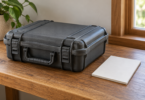
The Plano Spire Compact Crossbow Case is worth considering when you want a rigid case for a scoped crossbow and a separate place for its quiver. The crucial purchase decision is fit. Measure your complete setup and compare its shape with the case interior before relying on a broad claim that it fits most crossbows.
The model covered here is the black Spire 113200, also listed by Plano as SKU PMC113200. This is a source-based buying guide, not a drop test, waterproof test, or confirmation that any particular crossbow has been fitted inside.

Plano Spire 113200 Compact Crossbow Case, Black, 1 Case
As an Amazon Associate we earn from qualifying purchases.
What the Spire includes
Plano’s product page describes a hard shell, foam padding, internal lashing straps, three closure latches, a carry handle, and storage for a quiver in the base. The case can stand on its side. It is intended to accommodate a crossbow with a scope attached, but that remains subject to the dimensions and shape of your equipment.
The purchase is one case. The photographed crossbow, scope, quiver, and bolts are not a supplied archery package. Before ordering, check the seller’s package description if a listing mentions a bundle or accessories beyond the case itself.
| Detail | What the documentation says |
|---|---|
| Model | 113200 / PMC113200 |
| Color | Black |
| Current published exterior size | 41.22 inches long × 27.5 inches wide × 12.25 inches high |
| Catalog interior dimensions | 39 × 24.5 × 12 inches |
| Closure and retention | Three latches, padlock provisions, internal lashing straps |
| Storage | Foam-padded crossbow area and quiver space in the base |
Why interior and exterior measurements differ
The current Plano page gives the exterior dimensions above. A Plano archery catalog lists a 39 × 24.5 × 12-inch interior and an older exterior width of 27 inches. Those figures should not be merged into a new, supposedly precise measurement.
Use the current exterior specification when planning vehicle or shelf space, and verify with the seller if a half-inch difference matters. Use the catalog interior only as an initial fit screen. The molded shell narrows around the stock and has shaped walls, padding, and hardware. It is not an empty rectangular box with every inch of that bounding measurement usable.
A crossbow that is nominally shorter than 39 inches can still fail to fit because its limb position, scope height, or stock profile meets the case in the wrong place. Conversely, an overall width printed on a crossbow’s packaging may describe a different configuration from the one in which it should be transported.
Check your complete setup before buying
- Record the exact crossbow model. Include its year or generation when relevant, plus the installed scope and any stock or crank accessory.
- Use the manufacturer’s safe transport configuration. Measure the equipment unloaded and uncocked as directed by its manual. Do not cock a crossbow simply to make it narrower for a case.
- Measure maximum length and width. Include protruding parts, not just the central rail or a marketing axle-to-axle figure.
- Measure the tallest point. Allow for the scope, mounts, and controls without making the lid press on them.
- Account for the quiver separately. Confirm whether the quiver needs to be removed and whether its actual length and shape fit the base storage.
- Ask about the exact combination. Give Plano or the seller your measurements and model, ideally with a photograph. A review mentioning a similar bow is not a fit guarantee.
Before committing, also check the return conditions for a case that does not fit. Keep all packaging and avoid altering the foam, shell, or straps while assessing fit. A removable scope may solve a clearance problem, but repeated removal can add setup work; decide whether that is acceptable before buying.
What the construction does, and does not, establish
A rigid shell and foam padding are useful features for organized storage and transport. The straps help limit movement when properly positioned. They should secure the equipment without stressing optics or delicate parts, and every latch should close normally without having to force the lid down.
Plano uses protective marketing language for the shell, but the retrieved Spire documentation does not provide a quantified crush-load rating, an IP waterproof rating, or a submersion specification. Do not treat it as a dry box or assume it can safely carry an arbitrary stack of luggage on top.
Padlock provisions allow the case to be secured; they do not make it a safe or prove that locks are supplied in every retail package. Confirm package contents and the size of compatible locks. Store the equipment securely away from children and unauthorized users, following the crossbow manufacturer’s instructions.
Vehicle storage and flights
Check the available space in your vehicle, including the opening through which the case must pass. A case can fit on a back seat yet be awkward to carry through a narrow door. Leave room to open it at your destination, and secure it against sliding during transport.
For air travel, verify your airline’s sporting-equipment policy, size limits, fees, and handling requirements for the exact crossbow setup. TSA lists bows and arrows for checked baggage, not carry-on baggage. That screening rule does not certify this particular case or replace an airline’s conditions. Check destination restrictions separately.
Follow the crossbow manual for unloading, uncocking, and transport; different mechanisms have different procedures. Use appropriate protective storage for sharp accessories so they cannot damage the case lining or injure someone opening it. Do not improvise a de-cocking procedure or transport the bow ready to fire.
When to choose a different case
Look elsewhere if the Spire’s contoured cavity conflicts with your equipment, if your scope or crank requires awkward removal, or if you need documented weather sealing or a specific transport certification. A purpose-designed case listed for your exact crossbow can be a more straightforward fit, while a soft case may take less storage room when rigid protection is unnecessary.
Compare those tradeoffs against how you actually travel. Extra accessories, unfamiliar model names, or a long list of unrelated rifle cases do not answer whether the Spire fits your bow.
Frequently asked questions
Is 41.22 inches the usable interior length?
No. That is the current published exterior length. The catalog gives 39 inches internally, and the shaped cavity still needs a real fit check.
Does it fit every compact crossbow?
No universal fit is established. Compact describes a general category; scope placement, stock shape, and overall dimensions differ.
Is it waterproof or automatically airline approved?
Neither claim is established by the sources reviewed here. Confirm protection requirements and airline acceptance rather than inferring them from the hard shell or lock provisions.
Who is it best suited to?
Someone whose complete setup fits comfortably and who wants a foam-padded, rigid case with internal straps and quiver storage. Exact fit and manageable transport size should decide the purchase.
Image note: AI-generated generic editorial illustration; not a photograph of a named or tested product.