
The best sprocket adapter is the one that matches both sides of the connection: the hub or axle it mounts to and the sprocket it carries. A bicycle rear-hub clamp and a go-kart live-axle hub can appear in the same search results, but they serve different applications.
These two options have identifiable part numbers and published fit dimensions. Choose the Bicycle-Engines 44T assembly for its specified spoked-wheel hub application, or the Azusa 2286 for a matching keyed live axle. The comparison is based on supplier specifications and product images, not hands-on testing.
Best sprocket adapters: two options by application
| Exact part | Best fit | Sprocket connection | Key limitation |
|---|---|---|---|
| Bicycle-Engines ENGJL-SFSCB, 44-tooth kit | Specified 38 mm bicycle rear hub, with no shims | Matching 44T sprocket supplied with the adapter | Spoked wheels only; not a direct mag-wheel mount |
| Azusa 2286 sprocket hub | 1-inch live axle with a 1/4-inch keyway | P2286 pattern: four 5/16-inch holes on a 4-inch bolt circle | Sprocket sold separately; not a bicycle hub clamp |
1. Bicycle-Engines ENGJL-SFSCB: best for a specified bicycle hub and included sprocket
This kit includes a rear-hub adapter and a 44-tooth sprocket. Bicycle-Engines specifies a 38 mm rear bicycle hub for use without shims. That is the configuration recommended here: a measured 38 mm hub on a compatible spoked wheel, with the supplied sprocket.
The listing also describes 30 mm and 20 mm arrangements using different supplied shim combinations. Those are separate fit decisions; confirm the exact arrangement with the supplier before ordering. Don’t substitute homemade packing material or assume a nominal “1.5-inch” hub has the required diameter.
The supplier excludes direct mounting to mag wheels and does not recommend using this sprocket with a conventional rag-joint mount. Its page does not give a numerical sprocket bolt circle or a chain-size specification. Keep the matched assembly together and have the supplier confirm the chain and wheel clearance for your setup. Engine displacement alone does not settle those questions.
Check the ENGJL-SFSCB 44T kit at Bicycle-Engines.
2. Azusa 2286: best for a matching 1-inch keyed live axle
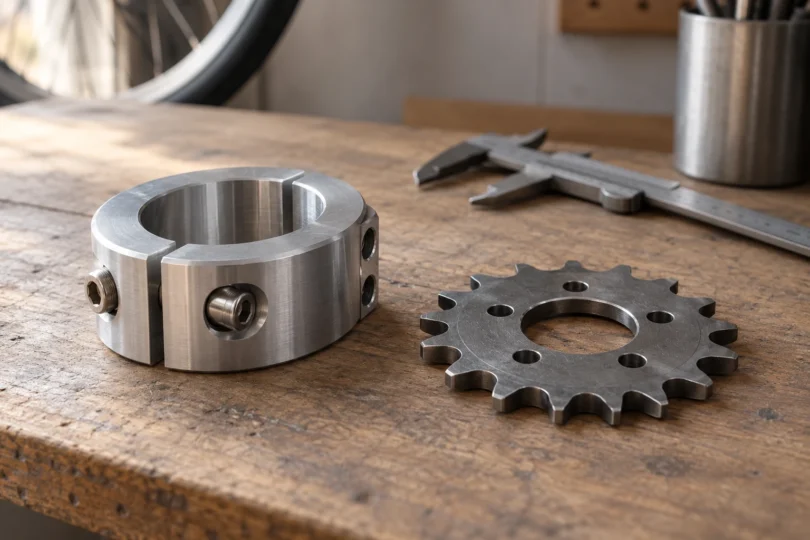
Azusa’s 2286 is a zinc-plated steel sprocket holder for a 1-inch live axle. The maker’s drawing specifies a 1/4-inch keyway and four 5/16-inch mounting holes on a 4-inch bolt circle. The product page lists bolts, locknuts and a set screw with the hub.
Use a separate sprocket with the P2286 mounting pattern and 1.5-inch center bore. Azusa’s catalog lists several chain and tooth-count options for this pattern. That does not make the chains interchangeable: the selected sprocket must match the chain and the rest of the drive system.
This is the appropriate type to investigate for a keyed live-axle kart assembly. It is not a split clamp for the outside of a bicycle hub, and its four-hole pattern should not be confused with other four-hole carriers. Check the complete dimensions against your existing assembly before ordering.
Check Azusa’s 2286 specifications and product details.
Five fit checks that matter more than “universal”
- Identify the mounting surface. A bicycle hub shell, keyed axle and BMX crank spindle need different adapters. Start with the type of assembly you already have.
- Measure the correct diameter. For a hub clamp, use the hub shell diameter where the clamp sits. For a shaft-mounted carrier, match the shaft diameter and keyway. Keep measurements in the units used by the maker; 1.5 inches equals 38.1 mm, not exactly 38 mm.
- Match the sprocket interface. Check the center opening, number of holes, hole size and bolt-circle diameter. Bolt-circle diameter is the diameter of the circle through the hole centers, not simply the distance between any two adjacent holes.
- Confirm chain size and clearance. The adapter’s bore does not tell you which chain fits the sprocket teeth. Check the specified chain, tooth count and available space around the hub, tire, brake and frame.
- Compare the complete package. A bare adapter, a hub with fasteners and an adapter bundled with a sprocket are different purchases. Include all required matching parts when comparing delivered costs.
When neither option is the right buy
If your dimensions differ, choose a part expressly specified for that assembly. Don’t enlarge mounting holes, alter the hub or improvise shims to make an almost-matching part fit. A mechanic or the component supplier can check the interface and alignment before you commit to a purchase.
For the Bicycle-Engines kit, the strongest reason to choose it is the included matching sprocket for the specified hub. For the Azusa, it is the clearly documented axle and P2286 interface. Neither is a universal replacement, and neither should be chosen from engine size or appearance alone.