
The right motor for a go-kart is the one approved for that kart’s exact model, configuration, and intended use. Start with the vehicle’s parts list or manufacturer support, then compare the exact replacement. Engine displacement, horsepower, or an electric motor’s wattage cannot establish compatibility on their own.
Three useful reference points are the Honda GX270 for a kart that specifies that engine configuration, the Briggs & Stratton 206 for an eligible sanctioned racing class, and the factory-authorized Razor Dune Buggy replacement motor for the matching electric vehicle. They serve very different applications, so each recommendation below is conditional on documented fit.
Research disclosure: We reviewed manufacturer product information, support documents, and current racing rules on October 4, 2026. This is a documentation-based buying guide. We have not bench-tested these engines, measured kart speed, or verified an installation on a particular chassis. We have omitted unverified marketplace listings, prices, and stock claims.
Three engine and motor options compared
| Option | Appropriate starting point | Documented detail | Critical purchase check |
|---|---|---|---|
| Honda GX270 | A gasoline kart whose manufacturer approves the exact GX270 type | 270 cc, air-cooled four-stroke OHV; horizontal-shaft family | Full type code, shaft configuration, and kart approval |
| Briggs & Stratton 206 | A sanctioned racing class that permits the required 206 configuration | Factory-sealed short block; purpose-built racing platform | Current class rules, engine identity, and seal eligibility |
| Razor Dune Buggy factory replacement motor | Repairing the matching Razor electric vehicle | The linked Dune Buggy manual lists a 24 V, 250 W motor | Razor confirmation against the vehicle’s product ID and revision |
These are application examples, not a universal interchangeability list. If your kart specifies a different engine or motor, its original specification takes priority.
1. Honda GX270: consider it when the kart specifies the matching type
Honda includes the GX240/270 family on its small-vehicle engine page. The current GX270 specifications list 270 cc displacement and 8.4 hp net output at 3,600 rpm. Honda also lists multiple output-shaft configurations, including straight, tapered, threaded, and reduction types.
Why consider it: The published specifications and model-specific documentation give an owner or service dealer a useful basis for confirming an approved replacement.
Important limit: “GX270” alone does not identify the complete configuration. A version intended for another machine may have the wrong shaft, controls, starting equipment, or packaging for your kart. A shared engine family does not establish fit.
Use Honda’s identification guidance and serial-number-based manual selector alongside the kart maker’s records. Ask the dealer to confirm the full replacement specification in writing before ordering.
2. Briggs & Stratton 206: for the racing class that requires it
The 206 racing engine uses a factory-sealed short block and is built around a controlled competition specification. Its useful distinction for a buyer is eligibility within a particular racing program.
Why consider it: If your chosen track and class specify a 206, selecting the correct eligible package helps avoid buying equipment that cannot pass technical inspection.
Important limit: Briggs states in its 2026 factory rule set that its racing engines are intended solely for sanctioned racing. The document also says the published regulations take precedence over conflicting manufacturer literature. Obtain the current class requirements and any applicable updates from the organizer.
Before buying, have an authorized racing dealer and the track confirm the engine’s identity, seal status, required class configuration, and what the quoted package includes. A used engine described as “206 legal” needs supporting documentation. We would resolve those questions before comparing seller prices.
3. Razor Dune Buggy motor: an exact-replacement route for an electric kart
Razor’s current support hub links a Dune Buggy owner’s manual that lists a 24 V, 250 W motor. It also asks owners to have the 19-character product ID available when requesting replacement parts.
Why consider it: For an existing Dune Buggy, a manufacturer-authorized replacement provides a way to restore the specified system after a confirmed motor fault.
Important limit: The model name, voltage, and wattage do not establish compatibility across all Razor products or revisions. Give Razor the product ID and ask for the currently approved replacement. Do not assume the Dune Runner, Ground Force, and Dune Buggy share the same motor.
The Ground Force support hub separates documentation by product. Use the matching entry and manufacturer support to verify the part before purchasing.
Engine or electric motor: start with the kart you already have
For an existing vehicle, the most useful first question is “What replacement does its manufacturer specify?” That keeps the search focused on restoring a known configuration. A gasoline-to-electric conversion, or the reverse, requires a broader engineering assessment than a motor shopping list can provide.
If you have an unidentified frame or an incomplete project, resolve its identity, condition, and intended use with a qualified kart specialist before choosing a power unit. An attractive engine price does not answer whether the chassis, braking system, controls, and guarding form an appropriate complete vehicle.
For racing, choose the class and confirm its requirements before buying. For a consumer electric kart, start with the product ID and replacement-parts information. For a commercial or recreational gasoline kart, obtain the manufacturer’s approved engine specification.
Compatibility checks to complete before ordering
The following is a purchasing checklist for the manufacturer or service dealer. It is not an installation procedure.
- Identify the complete vehicle. Record the brand, model, product or serial number, revision, and any manufacturer-approved changes already documented for it.
- Identify the original power unit. For a gasoline engine, record the model, type code, and serial number. For an electric vehicle, obtain the exact replacement-part reference from the vehicle maker.
- Verify the physical interface. Ask the dealer to confirm the mounting specification, output-shaft form and dimensions, rotation direction, and clearance requirements against the approved configuration. Similar appearance is insufficient.
- Confirm the complete drive system. The replacement must be approved with the existing transmission or drive components, controls, protective covers, and braking arrangement. Ask who is responsible for checking the complete vehicle.
- For electric models, confirm the matched electrical system. Require compatibility with the factory controller, battery system, connectors, and safety functions. A motor advertised with the same voltage is not enough evidence.
- Check documentation and restrictions. Obtain the correct manuals, seller warranty terms, return conditions, and any racing eligibility documentation before payment.
If the supplier cannot identify the exact variant being shipped or cannot substantiate the claimed fit, choose a better-documented source. Avoid listings that group different shafts, voltages, or vehicle revisions under one vague title.
Compare the total replacement cost
Ask for an itemized quote that states the exact power unit, included components, any manufacturer-required associated parts, labor, shipping, taxes, and warranty coverage. Confirm whether the seller’s advertised package is a complete engine or motor assembly, or only part of what your service provider needs.
For used equipment, ask for identifying photographs, service records when available, and the seller’s inspection or return terms. For a racing engine, eligibility documentation belongs in that evaluation. For an electric kart, request a diagnosis before assuming that poor operation means the motor needs replacement.
This approach lets you compare the cost of restoring the approved configuration against replacing the vehicle. It also avoids turning a low advertised component price into an unexpectedly large repair bill.
Safety limits to keep in view
- Gasoline exhaust: Honda warns that carbon monoxide can accumulate in enclosed or partly enclosed spaces. Do not run a gasoline engine in a garage or other enclosed area. Follow the matching Honda owner’s manual, including its precautions for hot surfaces and fuel.
- Electric-system integrity: Razor directs owners to use authorized replacement parts and retain the original design. It also calls for the recommended charger, functioning brakes, and serviceable guards. Follow the manual for the exact vehicle.
- Complete-vehicle suitability: Rider fit, protective equipment, supervision, terrain, and operating restrictions come from the kart manufacturer or racing organization. Replacing a motor does not change those limits.
- Uncertain condition: Have a qualified service provider inspect unresolved damage or compatibility questions before the vehicle returns to use. Keep protective systems and manufacturer-specified operating limits intact.
Frequently asked questions
What is the best motor for a go-kart?
The best starting point is the exact manufacturer-approved replacement for your kart. The GX270, 206, and Razor examples above belong to different applications; there is no single model that fits every recreational, racing, and electric kart.
Can I select an engine by horsepower alone?
No. Power figures do not establish physical fit, approved operating conditions, or compatibility with the rest of the vehicle. Confirm the complete specification and application first.
Does “horizontal shaft” mean an engine will fit?
No. That description leaves the shaft’s dimensions and form, mounting arrangement, controls, clearances, and vehicle approval unresolved. The exact type code and application documentation matter.
Are two electric motors interchangeable if their voltage and wattage match?
No. Those labels do not confirm the physical mounting, controller compatibility, connectors, or manufacturer approval. Obtain the exact replacement reference for the vehicle’s product ID.
Should a slow or intermittent electric kart get a new motor?
Get a diagnosis first. The symptom alone does not identify which component needs replacement. Manufacturer support or an authorized service provider can help establish the correct repair.
Does this guide recommend engine tuning or speed upgrades?
No. It compares documented applications and replacement-purchase checks. Keep the configuration and operating limits approved by the vehicle manufacturer and, where applicable, the racing rules.
Bottom line
Identify the kart, obtain its approved replacement specification, and confirm the exact part before comparing prices. Clear fit documentation, appropriate service support, and a complete quote are more useful than the largest power number in a listing.
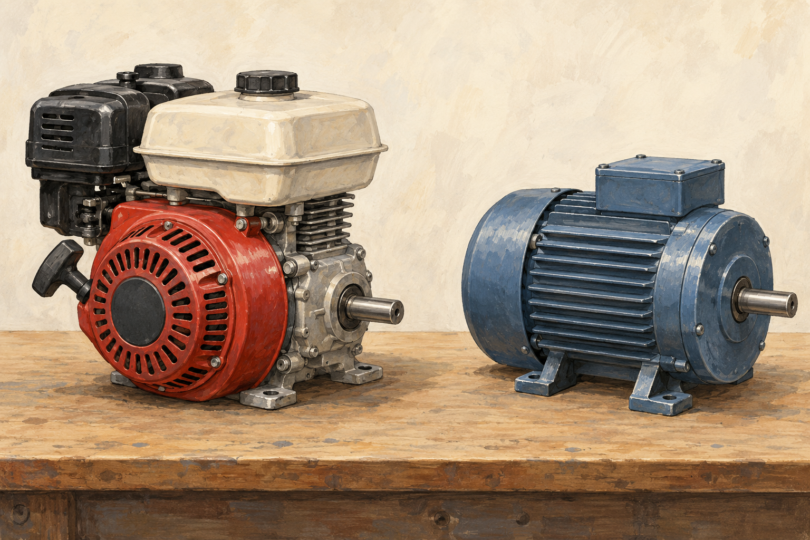
Image note: Original editorial illustration; not specific products or an installation diagram. The separate engine and motor represent broad categories, not confirmed go-kart-compatible units.