
For a screenless graphic tablet for drawing, the Huion Inspiroy 2 M is our starting recommendation if you want a medium-size drawing area and useful shortcut controls. Choose the XPPen Deco LW for a larger wireless workspace, the Wacom One M for a compact, keyboard-led setup, or the Wacom Intuos Pro Medium (2025) when configurable pen grips and dual dials justify spending more.
All four are pen-input devices that work with a compatible host. You draw on the tablet while looking at your computer’s screen. They do not contain a display or run drawing software independently. If you want to draw directly on a screen, see our budget art-tablet guide, which also compares connected displays and standalone tablets.
Research disclosure: Updated October 4, 2026. We compared manufacturer specifications, manuals and support information. We have not performed hands-on testing of these models, measured drawing latency or assigned performance scores. The recommendations below are editorial judgments about features and workflow. Manufacturer links let you check the exact model and current offer.
Four screenless graphics tablets worth comparing
| Tablet | Active area | Connection | Best reason to choose it | Main trade-off |
|---|---|---|---|---|
| Huion Inspiroy 2 M | 221 × 138 mm | Wired USB | 8 shortcut keys, group switching and a scroller | No wireless connection |
| XPPen Deco LW | 10 × 6 inches | USB or Bluetooth | More drawing room with 8 shortcut keys | No built-in dial; connection support varies by host |
| Wacom One M, CTC6110WL | 216 × 135 mm | USB-C or Bluetooth | Compact body and a simple pen-centered workflow | Plan to keep your keyboard close for shortcuts |
| Wacom Intuos Pro Medium, PTK670 | 263 × 148 mm | USB or Bluetooth | 10 ExpressKeys, 2 dials and customizable Pro Pen 3 | Premium features; no finger multitouch |
Specifications above come from the linked manufacturer pages in each recommendation. “Medium” is a product name, not a standardized size: the Intuos Pro Medium has substantially more active drawing width than the Wacom One M.
1. Huion Inspiroy 2 M: a practical starting point for shortcut-heavy drawing
The Inspiroy 2 M combines a 221 × 138 mm active area with eight programmable keys, three group keys and a scroller. Its battery-free PW110 pen supports pressure and tilt. Huion also provides a driver setting to rotate the tablet for left-handed use. See Huion’s Inspiroy 2 M specifications.
Its appeal is the control layout. Assign everyday commands such as undo, brush selection and eraser to a small set of keys, then use the scroller for an adjustment you repeat often. Group switching makes sense once those basics become familiar; programming every possible function on day one adds unnecessary learning.
Choose it if: you draw at a desk and want shortcuts without buying a separate controller. Look elsewhere if: a cable-free setup is important. This model is wired, and its broader operating-system compatibility should not be read as a promise that every platform offers identical driver customization.
2. XPPen Deco LW: a larger surface with wireless flexibility
The Deco LW has a 10 × 6-inch active area, eight shortcut keys and a battery-free X3 Elite pen with tilt support. It connects by USB or Bluetooth. Be careful with the name: the Deco L is the wired version; the Deco LW, model IT1060B, adds wireless operation. XPPen’s comparison page distinguishes them.
This is the model to shortlist if you want to make broader strokes and move the tablet around your desk. Its surface is wider than the Huion and Wacom One models here. Check the full 315 × 187 mm footprint against your keyboard position before buying.
Choose it if: active area and wireless placement matter more than a dial. Watch for: platform-specific connections. XPPen’s Deco-series manual distinguishes direct Bluetooth support from receiver or wired use; do not assume an Android or Chromebook connection will work exactly like a Windows or Mac setup. A wireless tablet still needs a host running the art app.
3. Wacom One M: a compact option for artists who use keyboard shortcuts
The Wacom One M places a 216 × 135 mm drawing area in a 252 × 181 mm body. The CTC6110WL model supports USB and Bluetooth, with a battery-free pen and two customizable pen switches. Wacom’s product information also confirms tilt support. Check the Wacom One M product page and official technical specifications.
Its useful distinction is a fairly generous drawing area in a smaller overall footprint. We would consider it for a laptop desk where a keyboard already handles shortcuts. If you want extensive dedicated tablet controls, the Huion or Intuos Pro is a more natural match.
Choose it if: you prefer a simple workspace and want Bluetooth. Watch for: similarly named listings. Wacom One M is a screenless tablet, One by Wacom is a different product line, and Wacom One pen displays have screens. Confirm the CTC6110 model code and the included pen and cable, especially in configurable bundles.
4. Wacom Intuos Pro Medium (2025): for a more customized drawing setup
The 2025 Intuos Pro Medium, model PTK670, supplies a 263 × 148 mm active area, ten ExpressKeys and two mechanical dials. Its Pro Pen 3 offers adjustable grip, balance and button configuration. Wacom lists USB and Bluetooth connections, Windows 10 or later and macOS 13 or later. See the exact Medium model and full specifications.
The case for upgrading is strongest when you already know what slows you down. Separate brush-size and canvas controls, a preferred pen grip and a wider surface can be useful reasons to spend more. Buying it only because it says “Pro” is a weaker reason.
Choose it if: you will actively configure and use the controls. Watch for: generation confusion. PTK670 is the 2025 model; older PTH660 listings describe different hardware. The 2025 tablet does not support finger multitouch, so do not expect pinch-to-zoom gestures on its surface.
How to choose the right drawing area
Start with the way you move your hand. A compact active area can suit small wrist movements and travel. A larger area gives a broad pen stroke more physical space, but also asks you to move your hand farther. Neither automatically produces better art.
Mark the listed active rectangle on a sheet of paper and place it where the tablet would sit. Try a few long curves while keeping your shoulders relaxed. Then mark the tablet’s outer dimensions, because shortcut bars and borders also occupy the desk. This simple check is more useful than comparing diagonal marketing sizes.
Your screen arrangement matters too. Mapping one small tablet across two wide monitors can make cursor movements feel cramped. For drawing, consider mapping to the monitor that contains your canvas. Wacom documents both single-monitor mapping and proportional mapping. Preserving proportions may leave part of the tablet inactive, but avoids stretching the relationship between your hand movements and the image.
Features that deserve more attention than pressure-level counts
- Driver and app compatibility: Check your exact operating-system version, processor platform and drawing app before ordering. A product page listing an old OS minimum does not establish that every current driver supports that system.
- Pen fit: Grip shape, button placement and replacement-pen availability affect daily use. Manufacturer specifications cannot tell you whether a pen will feel comfortable in your hand.
- Controls you will use: A scroller or dial is valuable when you repeatedly adjust one setting. If your other hand stays on a keyboard, extra tablet buttons may matter less.
- Wired versus wireless: USB is a sensible baseline for setup and troubleshooting. Wireless is useful for desk placement, but adds charging and pairing to maintain.
- Ownership costs: Check replacement nibs, cables and pens. Read software-bundle terms; a trial is different from an ongoing app license.
Pressure sensitivity lets a compatible brush respond to how firmly you press. A larger advertised number alone does not establish smoother lines, better low-pressure response or lower latency. Those claims require appropriate testing. We would choose size, compatibility and control layout before using pressure-level counts as a deciding factor.
A useful first-session checklist
- Install the correct driver from the manufacturer and follow its setup instructions.
- Map the tablet to the intended display and check that circles do not appear stretched.
- Use a pressure-sensitive brush to make light-to-heavy strokes. Confirm pressure works in the drawing app as well as the driver’s test area.
- Assign only a few shortcuts initially, such as undo, erase and canvas navigation.
- During the return period, try your actual workflow: long curves, small details, saving and reopening a file, and any wireless connection you plan to use.
Keep this evaluation separate from learning to draw while looking at a different surface. Early awkwardness can come from that coordination change rather than a hardware fault. Persistent missing pressure, disconnections or distorted mapping deserve troubleshooting rather than simply more practice.
Frequently asked questions
Does a screenless graphics tablet need a computer?
It needs a compatible host that runs the drawing software and shows the image. Some models support selected Android or Chromebook devices, but none of these four is a standalone art computer. Confirm both the host and the connection method.
Can I make professional artwork without a pen display?
Yes. A screenless tablet supplies pen input to your software; the finished file does not depend on having a display under the pen. Choose a display if direct-on-screen drawing suits you, rather than treating it as a requirement for serious work.
Is a larger tablet always better?
No. It changes the amount of physical movement used to cover the screen. Balance active area, drawing style and available desk space. A large tablet squeezed beside a keyboard can be less comfortable than a smaller one positioned well.
Will any stylus work with these tablets?
No. Buy a pen specifically listed as compatible with the exact tablet. Shared terms such as “EMR” or “battery-free” do not by themselves prove cross-brand or cross-generation compatibility.
Do I need a paid drawing app?
No. Krita offers free desktop downloads for supported Windows, macOS and Linux systems. Check the app’s requirements independently of the tablet driver. Paid programs may suit your workflow, but they are not necessary just to begin drawing.
Which one should you buy?
Start with the Inspiroy 2 M for a wired desk setup with useful controls. Compare the Deco LW when you want more drawing room and wireless placement. The Wacom One M suits a compact keyboard-centered setup, while the Intuos Pro Medium makes sense when you can name the pen adjustments and shortcuts you will use. The best choice is the one that fits your hand, software and desk without adding features you will rarely touch.
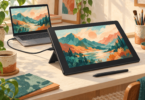
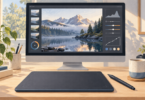
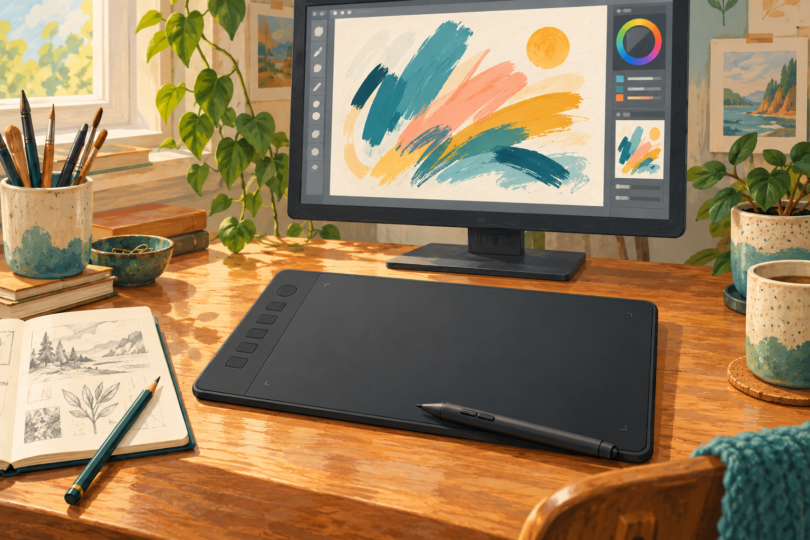
Image note: Original editorial illustration; not a specific product. A screenless pen tablet is shown with a separate monitor displaying artwork.