
The Wacom Intuos Pro Medium (2025, PTK670K0A) is our first choice for photographers who regularly paint Photoshop masks and want more room and programmable controls. For occasional brush corrections, the smaller wired Intuos CTL4100 is a simpler starting point. Choose the Cintiq 16 DTK168K0A when you specifically want to retouch directly on a screen.
All three are accessories for a compatible computer. They do not run Lightroom or Photoshop by themselves. The useful upgrade is the way you place and control a brush; a pen tablet does not make RAW exports, AI selections, or your computer’s processing faster.
Research checked October 4, 2026. This is a specification- and workflow-based buying guide, not a hands-on test. We checked Wacom product documentation and Adobe’s tool guidance. The recommendations below are editorial judgments about different working setups. Current prices and stock are not promised.
Which Wacom tablet fits your photo-editing setup?
| Exact model | Best fit | What you work on | Main trade-off |
|---|---|---|---|
| Intuos Small, wired CTL4100 | Trying pen input; occasional local corrections | Screenless 152 × 95 mm active area; included Wacom Pen 4K | Compact mapping area; no Bluetooth on this model |
| Intuos Pro Medium (2025), PTK670K0A | Frequent Photoshop masking and retouching | Screenless 263 × 148 mm active area; included Pro Pen 3 | More desk space; no finger-touch gestures |
| Cintiq 16, DTK168K0A | Editing directly under the pen tip | 16-inch, 2560 × 1600 IPS pen display; included Pro Pen 3 | Needs a compatible video connection, power, and desk space |
These are three different ways to add pen input to a photo workstation. If you want to sketch or paint without a separate computer, see our standalone tablets for drawing guide.
1. Wacom Intuos Small CTL4100: a practical first pen tablet
The wired Intuos Small makes sense when you mostly use sliders and automatic selections but want a pen for the corrections those tools leave behind. Its included battery-free Pen 4K supports 4,096 pressure levels, and the tablet has four customizable ExpressKeys. Wacom lists a 152 × 95 mm active area for the small model. See the CTL4100 product page and Intuos specifications.
Our recommendation is to begin with a few useful shortcuts, such as undo and brush-size changes. Keep the keyboard nearby until you know which commands you actually repeat. You do not need a large control panel to learn whether pen input suits you.
Choose it if: you edit on a laptop or a single display, have limited desk space, and want to try hand-painted masks without adding another screen.
Skip it if: you prefer broad arm movements or find a small tablet too sensitive when mapped across a large display. The CTL4100 is the wired version; a listing for an Intuos Bluetooth model is a different purchase.
2. Wacom Intuos Pro Medium PTK670K0A: for frequent masking
The 2025 Intuos Pro Medium is the stronger fit when manual retouching is a regular part of your work. It provides a 263 × 148 mm active area, ten ExpressKeys, two mechanical dials, USB and Bluetooth connections, and an included customizable Pro Pen 3. Wacom lists Windows 10 or later and macOS 13 or later as its product requirements; your Adobe app may require a newer system. See the exact PTK670K0A model.
The reason to choose it is the combination of working area and assignable controls. For example, you can dedicate a dial to brush-size changes and keep frequently used mask commands on buttons. That is a workflow option, not a measured claim that it will shorten every edit.
Choose it if: you repeatedly refine edges, paint layer masks, or make localized tonal corrections and want room to move while watching your main monitor.
Skip it if: you depend on finger gestures. Wacom explicitly confirms that the 2025 Intuos Pro has no touch functionality. Do not transfer touch features from an older Intuos Pro listing to this model.
3. Wacom Cintiq 16 DTK168K0A: for retouching on the image
The current Cintiq 16 DTK168K0A combines a 16-inch, 2560 × 1600 IPS screen with a battery-free Pro Pen 3. Its built-in legs provide a 20-degree working angle, while an adjustable stand is an optional extra. It does not have multi-touch. This is the newer 2.5K model, so check the model number rather than relying on the words “Cintiq 16.” See Wacom’s DTK168K0A specifications and box contents.
Drawing directly on the image can be appealing if you dislike looking at a monitor while moving a pen elsewhere. We would choose it for that interaction, rather than assuming a display will produce better masks than a screenless tablet.
Choose it if: direct-on-screen editing is important enough to justify a second display and a more involved desk setup.
Skip it if: you want a wireless or self-contained editing device. Check the connection before buying: Wacom specifies USB-C with DisplayPort Alt Mode, or HDMI plus USB. Extra cables may be required. Plan for power and a comfortable viewing angle as well.
What a pen changes in Lightroom and Photoshop
Photoshop: decide what pressure should control
Adobe documents pen-pressure control for brush size and opacity, with further dynamics available through brush settings. For a layer mask, that lets you choose how pressure affects the painted correction. A firm stroke should not change several things unexpectedly, so start with one pressure-controlled behavior and adjust the brush to the task. See Adobe’s graphics-tablet guidance.
Keep a copy of a familiar photo for practice. Compare a simple edge refinement and a soft tonal correction using the same brush settings. Judge whether you can place the effect consistently, rather than treating a pressure-level number as a measure of editing quality.
Lightroom Classic: use the pen for local brush work
Lightroom Classic’s Masking panel includes a Brush with Size, Feather, Flow, and Density controls, and lets you refine masks by adding or subtracting areas. A pen is most relevant when you need to guide those manual strokes. Automatic subject or sky selection can still be your starting point. See Adobe’s current Masking guide.
Lightroom, Lightroom Classic, and Photoshop have different interfaces and brush behavior. Do not assume a Photoshop pressure setting carries over to Lightroom. Confirm pressure and shortcuts in the exact app version you use.
How to choose without paying for the wrong upgrade
Start with your display and desk
A screenless tablet leaves your existing display as the place where you assess the image. A pen display adds another surface to position, power, and manage. If your current monitor is already the center of your color workflow, a screenless model may be the less disruptive choice.
For the active area, think about movement rather than monitor resolution alone. A larger area gives the same cursor journey more physical travel. If you use two monitors, try mapping the tablet to the editing display first; stretching a small working area across both can make fine placement harder to learn.
Check the computer, driver, and application together
Confirm that the exact tablet has a driver for your operating system, that your computer meets your Adobe application’s requirements, and that you have the right ports or adapters. A supported tablet does not make an unsupported computer suitable for the latest Photoshop. Get the driver from Wacom and verify the pen in the application before customizing every button.
Keep color claims separate from pen control
A pen changes input. It does not establish that a screen is calibrated or that a printed image will match it. We have not measured the Cintiq’s color accuracy or uniformity. If color-critical delivery matters, include display profiling and your actual print or export workflow in the decision.
Compare the complete setup cost
The listed Wacom packages include their pens. You still need a compatible computer and separately licensed editing software. Add any required adapters, display cables, stand, or replacement nibs to the comparison. Treat a bundled software promotion as a time-limited offer unless its current terms explicitly say otherwise.
Frequently asked questions
Do I need a Wacom tablet for Lightroom?
No. Sliders, automatic masks, and many local adjustments can be used with a mouse or trackpad. A tablet is worth considering when manual brush work is frequent or you prefer a pen grip.
Is the Intuos Pro always better than the regular Intuos for photos?
No. Its larger working area and extra controls are useful only if you use them. For occasional touch-ups, start with the smaller model and spend time learning brush control.
Can these Wacom tablets run Photoshop without a computer?
No. The three models in this guide are computer-connected input devices or pen displays. A Cintiq screen does not make it a standalone computer.
Will more pressure levels make my masks twice as accurate?
No such improvement follows from the specification. Brush settings, tablet mapping, hand control, and the mask itself all matter. We have not measured comparative accuracy or editing speed.
Should I choose a small or medium tablet?
Choose small for a compact setup and short movements. Consider medium if you want more physical travel, especially for regular mask painting. Leave room for the keyboard and check the return terms in case the size does not suit your movements.
What should I check on a used or discounted listing?
Match the exact model code, included pen, cables, driver support, and condition. Intuos Pro generations and Cintiq 16 generations differ. A lower price on an older model is not evidence that it has the features described here.
Bottom line: choose the Intuos Small to try pen input, the Intuos Pro Medium for a more configurable retouching workspace, or the Cintiq 16 if you want the image under your pen. Match the device to the work you do by hand.
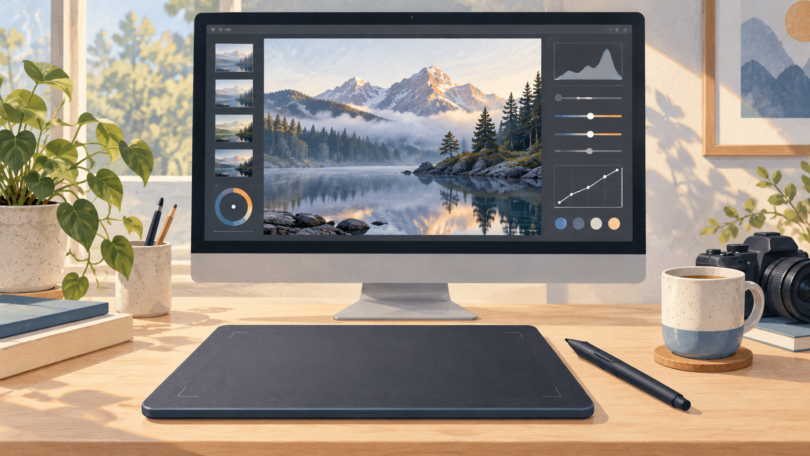
Image note: Illustrative photo-editing workspace with a generic graphics tablet; it does not depict a specific Wacom product or establish device or software compatibility.