
A good tablet under $100 should handle the things you actually want to do: read books, watch videos, browse a few websites, and run your essential apps. For that kind of use, the Amazon Fire HD 8, 2024 release, with 32GB storage and 3GB RAM is the first model to check. The smaller Fire 7, 2026 release, with 16GB storage makes sense when its lower purchase price matters more than screen space.
There is an important catch with both: they use Amazon’s Appstore, and Google Play is not supported. If a particular school, work, banking, or entertainment app is essential, check that app’s Fire tablet compatibility before buying. A cheap tablet that cannot run your required app is poor value.
Two tablets with below-$100 advertised offers
Budget check, October 5, 2026: Best Buy’s US listing displayed $54.99 for the black Fire HD 8 with 32GB storage and 3GB RAM. Kohl’s displayed a $29.99 clearance price on its Fire 7 16GB listing. These are dated retailer observations, before tax and any delivery charges, rather than guaranteed prices. The Kohl’s page covers several colors and requires checking the actual selection and availability. Neither price requires assuming that a 64GB model, a Kids bundle, or an ad-free version costs the same.
- Start with the Fire HD 8: the larger, higher-resolution screen, 3GB RAM, and 32GB storage make it the more useful everyday choice on this shortlist.
- Consider the Fire 7 for a clearance bargain: suitable for basic reading and occasional entertainment if the 16GB model is substantially cheaper.
- Need Google Play or serious handwritten notes? Neither is a good default choice. Check a compatible Android tablet or active-pen tablet separately, and keep your budget intact rather than buying unsuitable hardware.
1. Amazon Fire HD 8, 2024 release: the stronger everyday option
The configuration discussed here is the 8-inch Fire HD 8, 32GB storage, 3GB RAM, black, lockscreen-ad-supported version. It has a 1280 × 800 IPS display and a six-core 2.0GHz processor. Amazon lists support for a microSD card up to 1TB, sold separately. The extra screen area and resolution are useful when reading web pages or watching video, although this is still a compact tablet rather than a full-size document reader.
The 32GB figure describes total storage, not free space after the operating system and bundled software. Amazon lists approximately 25GB available to the user for this configuration, with availability changing after updates. That is a better starting point than the Fire 7’s 16GB configuration, especially if you want several apps and downloaded shows. A memory card can help with compatible downloads, but some apps still need internal storage.
Who should choose it: someone who wants a small home or travel entertainment tablet and has already checked their required apps. It is also the more sensible of these two choices for browsing beyond a single basic page at a time. That recommendation is based on the documented screen, RAM, and storage differences, not on a claimed speed test.
What to watch: the 2024 and 2026 versions share the Fire HD 8 name and 12th-generation designation, but their memory configurations differ. Read the release year and RAM specification. The separate 64GB version has 4GB RAM and a different price. Amazon quotes up to 13 hours of mixed use for the 2024 model; that is a manufacturer estimate, not a promise of 13 hours of continuous streaming.
Check the exact 32GB black Fire HD 8 at Best Buy. That listing identifies model B0CVDN4QS6 and was the source of the $54.99 offer above. During our check, the corresponding Amazon URL opened a different 64GB model, so use the actual configuration and final total rather than assuming that a similarly named listing is the same deal.
2. Amazon Fire 7, 2026 release: a basic clearance option
The Fire 7 is a smaller alternative with a 7-inch 1024 × 600 IPS display, 2GB RAM, and a quad-core 2.0GHz processor. This section concerns the 16GB model. It is most appropriate for a simple, repeatable task such as reading Kindle books, listening to audio, or watching a downloaded program in a compatible app.
The compromise is usable space. Amazon lists about 9.5GB available to the user on the 16GB model before subsequent app and system changes. That can fill quickly. A microSD card of up to 1TB is supported, but it does not turn 2GB RAM into a more capable multitasking system or guarantee that every app can move off internal storage.
Who should choose it: a buyer who values its low clearance price and compact dimensions, understands its app limitations, and needs only light use. At a similar price to the Fire HD 8, the HD 8 is the more attractive choice on the documented specifications. Paying a large markup for scarce Fire 7 stock would undermine the reason to buy it.
What to watch: do not confuse the 2026 release with the older 2019 Fire 7. Amazon’s official specification sheet lists 2GB RAM for the 2026 model and 1GB for the 2019 version. A generic listing title saying only “Fire 7” is insufficient. Amazon rates the 2026 model for up to 10 hours of mixed use and specifies USB-C charging.
Check Kohl’s Fire 7 16GB clearance listing for the dated $29.99 offer. Confirm color, delivery or pickup availability, and the final total. The exact black 16GB Amazon reference is below; that Amazon page was unavailable when checked, so it should not be treated as a confirmed in-stock offer or as the source of Kohl’s price.

Amazon Fire 7 (2026), 16GB, 2GB RAM, Black, Lockscreen Ad-Supported, One Tablet
As an Amazon Associate we earn from qualifying purchases.
How to keep the whole purchase under $100
Decide whether your limit means the tablet’s listed price or the complete checkout total. A $99.99 device is below $100 before tax, but leaves almost no room for anything else. Include delivery, a protective case if you need one, and any required charging accessories. Do not add a memory card automatically: first estimate what you will download and check whether your apps can use it.
A simple example shows why this matters. A hypothetical $55 tablet plus a $15 case is $70 before tax. A $100 tablet plus the same case is $115 before tax. These are budgeting examples, not additional product offers. Similarly, a paid subscription, ad-removal upgrade, extended warranty, or Kids bundle changes the total even when the base tablet initially looks inexpensive.
Check apps before specifications
Search Amazon’s Appstore for the exact apps you use, and check the publisher’s supported devices. A website working in a browser does not establish that its dedicated app, offline mode, video downloads, or school sign-in will work. Do not budget around unofficial Google Play installation as though it were a supported feature.
Separate memory from storage
RAM is the working memory used while apps run. Storage holds apps and files. A listing advertising large “expanded memory” may be describing storage-based virtual memory, which should not be counted as equivalent physical RAM. A microSD capacity claim is also not the capacity supplied in the box.
Be cautious with very old or used tablets
Check the exact generation, operating-system support, account-lock status, battery condition, return policy, and included charger. A familiar brand name does not guarantee that an old model still receives the support you need. For a used device, ask whether it can be reset and set up with your own account before relying on it for daily use.
Common questions
Are these good tablets for college notes?
They may serve for basic reading or typing in compatible apps, but neither is the recommendation here for detailed handwritten notes. A simple capacitive stylus substitutes for a finger; it does not establish active-pen support, dependable palm rejection, or pressure sensitivity. Students should first check their course software and pen requirements.
Can a tablet under $100 replace a laptop?
Only for a narrow set of light tasks. Desktop software, complex documents, extensive multitasking, and specialized peripherals can require a different device. Write down your three most important jobs and verify them before comparing screen size or storage.
Should I buy the cheapest one?
Buy the least expensive tablet that meets your actual requirements. For the verified offers above, start with the Fire HD 8 32GB; consider the Fire 7 16GB when the clearance saving is meaningful and basic use is enough. If the offers disappear or the final total exceeds your limit, wait or compare a new offer rather than stretching the budget because of an old headline.
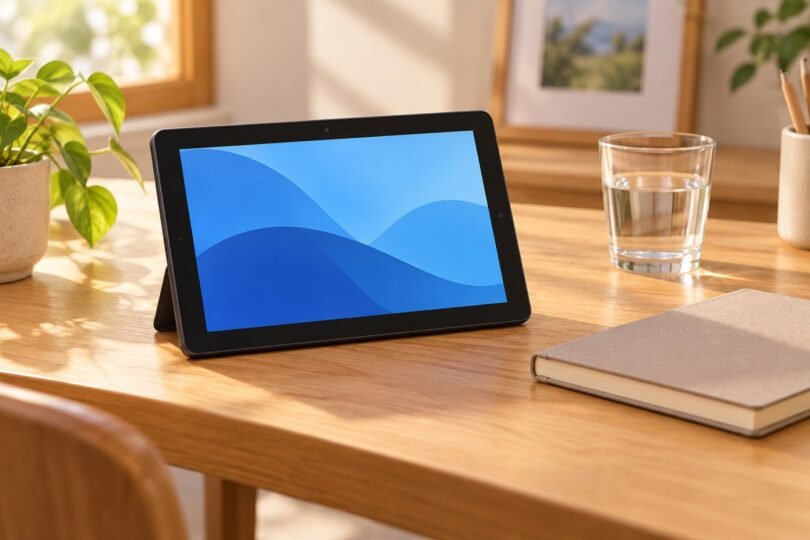
Image note: AI-generated editorial illustration; not a photograph of the named product.