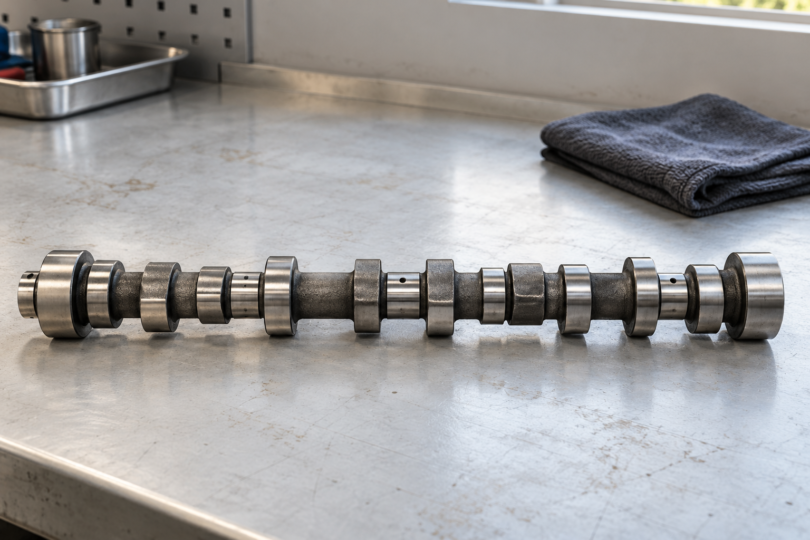

For a Chevy 305 restoration or stock repair, start with a camshaft matched to the engine’s year, VIN code and lifter design. Elgin E-274-S, E-783-S and E-896-S are three documented stock-replacement candidates for different 305 applications. They are alternatives for different engines, so the correct catalog match matters more than choosing the largest lift number.
This comparison concerns the Chevrolet 305-cubic-inch, 5.0-liter OHV V8. It is a focused stock-repair shortlist, not a universal recommendation for every 305 or a recipe for a performance build. Have an engine specialist identify any swapped block, changed cylinder heads or valvetrain conversion before selecting parts.
Best stock replacement cams for a Chevy 305: quick comparison
| Camshaft | Narrow application example from Elgin | Lifter design | Published intake / exhaust specs |
|---|---|---|---|
| Elgin E-274-S | 1982–1983, VIN 7 or S with TBI; verify exact catalog entry | Hydraulic flat tappet | 194° / 202° at 0.050 in.; 0.390 / 0.410 in. valve lift |
| Elgin E-783-S | 1976–1979, VIN G or U with a two-barrel carburetor | Hydraulic flat tappet | 189° / 202° at 0.050 in.; 0.373 / 0.410 in. valve lift |
| Elgin E-896-S | 1988–1994 VIN E; 1988–1989 VIN F with automatic transmission | Hydraulic roller | 179° / 194° at 0.050 in.; 0.350 / 0.385 in. valve lift |
Valve-lift figures above are Elgin’s values with the factory rocker-arm ratio. They are useful for identifying a profile, but do not by themselves establish clearance, spring suitability or compatibility with a modified engine. Each table application is a bounded catalog example, not an extension to every car or truck in the engine-family list.
1. Elgin E-274-S: for the cataloged early TBI application
Elgin’s E-274-S application record specifies 1982–1983 VIN 7 and VIN S with TBI. The cam uses hydraulic flat-tappet lifters; Elgin names HL-1817 as its lifter reference and CL-274K as the associated cam-and-lifter kit number. Confirm the vehicle-specific entry before buying a kit or individual parts.
Pros: exact cam-profile data and a matching lifter reference are published. Cons: the TBI/year/VIN restriction makes this a specialized restoration candidate. It is not the default choice for a later roller-lifter 305.
2. Elgin E-783-S: for the listed carbureted 305 applications
For the 1976–1979 VIN G/U two-barrel application, the E-783-S record is the relevant flat-tappet candidate here. Its 189° intake duration at 0.050 inch differs from E-274-S, even though both specify HL-1817 lifters. Shared lifter references therefore do not establish identical cam profiles or interchangeability.
Pros: the manufacturer provides year, engine-code and induction qualifiers. Cons: other catalog rows add vehicle and emissions-package exceptions, including a California-emissions Camaro/Z28 entry. Have the exact original application confirmed; that wording is not a blanket California approval for installing this cam in another engine.
3. Elgin E-896-S: for the specified factory roller applications
The E-896-S manufacturer page specifies a billet-steel hydraulic-roller cam. Its listed applications include 1988–1994 VIN E and 1988–1989 VIN F with automatic transmission. Elgin names HL-2148 lifters and CL-896K as the associated kit reference.
Pros: it provides a documented stock roller option for the listed later engines. Cons: it is not a flat-tappet-to-roller conversion kit. The similar E-896-SS number is a separate material variant, so verify the exact suffix on the order and packaging.
How to choose the right 305 camshaft
Record the actual engine identification, model year, VIN engine code, fuel system, transmission and lifter design. Use the detailed part row instead of the broad 1976–2002 engine-family heading. That heading groups applications; it does not make a specific flat-tappet or roller part correct for every listed year.
Ask the shop to inspect the valvetrain and identify the cause of wear before ordering. Melling recommends changing the camshaft and lifters as a set. Check the complete bill of materials with the installer: a named cam-and-lifter kit still does not establish that every timing, sealing or service part is included.
Road-use and emissions checks
In the United States, EPA’s Clean Air Act guidance prohibits removing or making vehicle emission-control devices inoperative. Keep required emissions equipment and controls working. A catalog fitment entry, “computer compatible” label or stock-replacement description alone is not a legal approval for a changed engine configuration.
For California, the BAR Smog Check Manual distinguishes replacement parts that remain functionally identical in emissions-related respects from modified parts, and names performance camshafts as an example of the latter. Have the installer verify the applicable replacement-part or exemption requirements for the exact vehicle. No blanket emissions certification is claimed for this shortlist.
Frequently asked questions
Can I use a 350 camshaft in a 305?
Do not infer compatibility from the shared small-block family. Use an exact 305 application record that matches the year, engine code and valvetrain, then confirm the current engine configuration with the supplier.
Are hydraulic flat-tappet and roller cams interchangeable?
They are different cam-and-lifter arrangements. E-274-S and E-783-S specify flat-tappet lifters; E-896-S specifies roller lifters. This shortlist does not authorize a conversion between them.
Which camshaft will make the most power?
No power winner is established here. These are application-specific stock-replacement choices; lift and duration figures alone cannot predict a horsepower increase in your engine.
Does a California-emissions catalog note mean any installation is legal?
No. An application note identifies a particular engine configuration. California distinguishes functionally equivalent replacement parts from modified emissions-related parts; have the exact installation and any required exemption checked.
What if my 305 is a later Vortec truck engine or an older modified build?
Do not extrapolate these examples. Identify the actual engine and obtain its own complete catalog match. A displacement badge, broad family heading or similar-looking camshaft is insufficient.