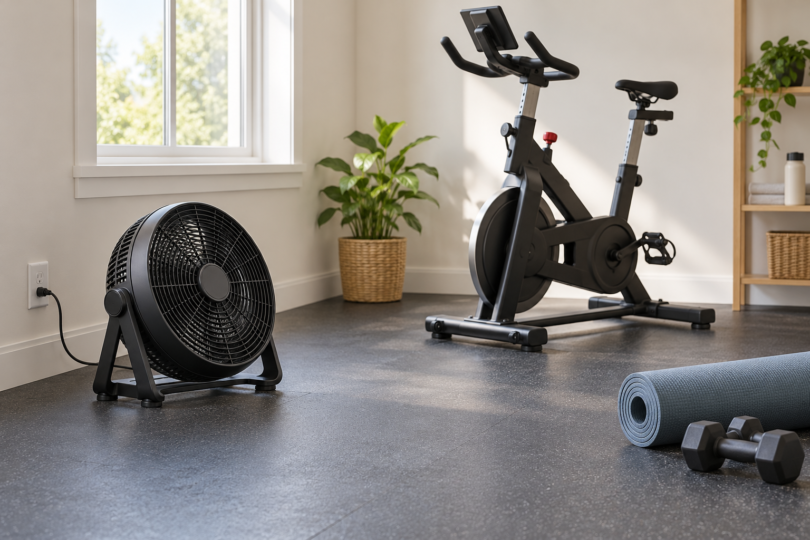

The Lasko U12104 is our pick for aiming airflow at one exercise station. The Vornado 660 is the better starting point when you want an adjustable circulator for different positions around a home workout room. Choose the Lasko Wind Curve T42951 if changing speed by remote and sweeping air from side to side matter most.
This shortlist compares documented features, controls and buying details. We have not measured these fans in a gym, so the recommendations do not establish a winner for airflow, noise, temperature reduction or energy consumption. All three selections are intended here for a dry, indoor residential exercise space.
Three home-gym fans compared
| Fan and exact selection | Best fit in this comparison | Main tradeoff |
|---|---|---|
| Lasko U12104 pivoting blower, Black | Aimed airflow at a bike or other fixed station; three manual speeds | No remote or oscillation; utility-fan sound needs consideration |
| Vornado 660, Black, CR1-0121-06 | A manually aimed room circulator with four push-button speeds | Controls are on the fan; needs a clear position for air to circulate |
| Lasko Wind Curve T42951, Silver, with remote | Remote adjustments and a manufacturer-listed 60-degree oscillation sweep | Fixed tower height and no adjustable tilt |
Lasko U12104: best for one fixed exercise station
The U12104 is a compact blower with a pivoting outlet and a rotary speed dial. Its head can direct air upward from a low position, making it a practical option beside a stationary bike when the fan can sit clear of pedals and foot traffic. Lasko lists a footprint of about 12.19 by 9.63 inches and a height of 12.25 inches.
It has three speeds, a 10-foot power cord and a carry handle. It does not have a remote, timer or oscillation, so choose the direction and setting before the workout. For a room where you constantly move between stations, the Wind Curve’s sweep may be more useful than repeatedly repositioning a blower.
Lasko publishes sound figures of 52.4 dBA on low and 59.3 dBA on high, plus a 92–100 W power range. Those are manufacturer specifications, not measurements at your bike or microphone. If you follow quiet spoken workouts or share the room, consider whether a utility-style blower suits that routine before ordering.
The current U12104 manual limits it to residential use and prohibits wet locations and areas containing flammable liquids or vapors. Treat it as an indoor home-gym fan even though marketing also mentions jobsites and drying. Keep it away from spilled water and do not use it to ventilate paint, gasoline or solvent vapors. Its accessory outlets are not a reason to power exercise equipment through the fan.

Lasko U12104 Pivoting Utility Blower Fan, Black
As an Amazon Associate we earn from qualifying purchases.
Vornado 660: best for flexible room placement
The 660 offers four speeds with push buttons on top and a chrome glide that lets you aim the head between horizontal and vertical airflow positions. Choose it when you want a fan you can point toward a workout area or use to circulate air through the room, without a tall pedestal or tower.
Vornado lists its body at 11.75 inches deep, 13.5 inches wide and 15 inches high, with a 6-foot cord. Measure the actual available floor or stable surface before buying: it needs room around the air inlet and outlet, and it should not intrude into a lifting or walking area. Its smaller height does not eliminate the need for clear floor space.
The current manufacturer page lists 27–53 W across the four settings. We are not using its advertised air-travel distance as a square-foot room rating or a guarantee of wind at your exercise station. Room shape, furniture, equipment and the chosen direction all matter when deciding where the fan can do a useful job.
The selected model is the standard black 660, CR1-0121-06. Buy it for the manual push-button controls and adjustable aim. The 660 AE is a separate model; do not assume voice control, a remote or another model’s features are included with this selection.

Lasko Wind Curve T42951: best for remote control
The silver T42951 pairs three speeds with an included remote, a timer running from 30 minutes to 7.5 hours, and a manufacturer-listed 60-degree oscillation sweep. It is the useful choice here if you want to change the fan setting without leaving a mat or walking over to a floor fan.
Its tower format has a 13-by-13-inch base footprint in Lasko’s specifications. The height is fixed and the head does not tilt, so check that the outlet position suits your equipment. A low recumbent seat or a high exercise-bike position can make airflow direction more important than the fan’s headline height.
Lasko lists 39 dBA on low, 55.4 dBA on high and a 40–48 W power range for the current product. We have not established a common measurement distance or room setup for comparing those sound figures with the other fans. Use them as manufacturer guidance, then evaluate the speed you actually need for your workout.
Oscillation spreads the breeze, but it also turns the outlet away from you for part of each cycle. Leave it fixed when you want continuous air at one position, or use the sweep when sharing the space. The remote also controls Night Mode, but that mode’s speed reduction may not match the steady airflow you want during exercise.

What matters more than a big airflow number
Match the fan to the layout
For one bike or treadmill station, first check whether you can place the U12104 or 660 where its aim reaches you without a cord crossing the approach. For a mat area or shared room, the Wind Curve’s remote and oscillation may matter more. This guide assigns no guaranteed small-, medium- or large-room square-foot coverage to any model.
A fan moves existing air. As the Department of Energy explains, it does not generate chilled air. Do not treat a fan’s airspeed, CFM or reach claim as a promised room-temperature drop. A hot home gym may still need separate temperature control.
Compare noise at the setting you will use
Low-speed noise is less useful if you need high speed throughout a workout. Check the return terms, test the fan from your normal position, and play your usual coaching audio at a comfortable volume. We have not verified a quietest fan, a recording-friendly fan or a sound level for your room.
Keep placement and cleaning simple
Use a stable, level surface and route the cord away from foot traffic. Keep clothing, towels and equipment clear of the grilles. The Lasko and Vornado instructions require keeping the fans away from water and unplugging them before moving or cleaning; follow the current manual for the exact model.
Cleaning access differs. Vornado describes a detachable grille for the 660. The U12104 manual tells owners to vacuum with a brush attachment and not take the fan apart. Avoid assuming that one model’s cleaning tutorial or a removable part applies to another.
For running cost, use the wattage for the actual setting and your electricity tariff. Kilowatt-hours equal watts divided by 1,000, multiplied by hours used. The published power ranges are useful for planning, but this comparison promises no exact electricity bill or air-conditioning savings.
Questions about fans for a home gym
Which fan should I buy for an exercise bike?
The U12104 is our fixed-station pick because you can aim its pivoting outlet from a compact floor position. Choose the 660 if you prefer four push-button speeds and a more conventional circulator. Either needs a placement that clears pedals, feet and cords.
Will a fan cool the whole room like an air conditioner?
No. These fans circulate existing air; they do not make refrigerated air. They can complement the room’s cooling, but no temperature reduction is guaranteed here.
Which is quietest for following a workout video?
We have not measured that. Compare the manufacturer’s low and high sound specifications, then assess the speed and distance you will actually use. A low-speed figure alone cannot answer the question.
Which choice includes a remote?
The selected Wind Curve T42951 includes a remote for its speed, oscillation, timer and Night Mode. The U12104 uses manual controls, while the standard 660 uses its on-fan push buttons.
Were these fans tested in a home gym?
No. The choices are based on manufacturer documentation, exact model checks and the practical requirements of different workout layouts. We make no measured claims about cooling, airflow strength, noise or durability.