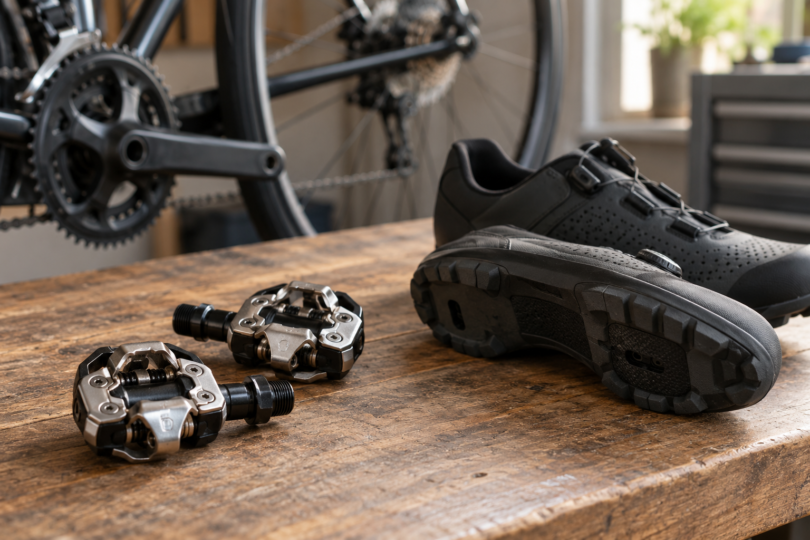

The best clipless pedals for beginners are the ones that match how you plan to ride and the shoes you will use. Our three picks are the Shimano PD-EH500 for alternating between everyday shoes and clip-in riding, the PD-M520 for a compact SPD setup, and the PD-RS500 for a first pair of dedicated road pedals. Choose the shoe and cleat system before choosing the pedal.
These recommendations compare manufacturer specifications and instructions; they are not the result of hands-on testing. “Beginner-friendly” does not mean automatic release or protection from falls. Shimano warns that both SPD and SPD-SL systems require deliberate release and practice.
Best clipless pedals for beginners at a glance
| Pedal | Best fit | Shoe and cleat system | Shimano’s listed included cleats | Main tradeoff |
|---|---|---|---|---|
| Shimano PD-EH500 | Everyday riding with a choice of shoes | SPD / two-bolt on one side; flat platform on the other | SM-SH56 multi-release | Only one side clips in; light action is intended for recreational riding |
| Shimano PD-M520 | Riders who want SPD engagement on both sides | SPD / two-bolt | SM-SH51 single-release | No everyday-shoe platform; release requires an outward heel twist |
| Shimano PD-RS500 | A first dedicated road setup | SPD-SL / three-bolt | Yellow SM-SH11, with six degrees of float | Requires compatible road shoes and a different cleat from SPD |
The cleats above are those Shimano lists with each pedal. Check the exact seller’s box contents before ordering, especially for used, bulk or alternative bundles. Also confirm that the pedal axle and your bicycle’s crank are compatible; a shoe’s bolt pattern does not establish crank compatibility.
1. Shimano PD-EH500: best for everyday shoes and clip-in rides
The PD-EH500 gives you an SPD binding on one face and a pinned flat platform on the other. That makes it our pick for a bicycle used both for casual errands in ordinary shoes and recreational rides in SPD-compatible cycling shoes. You still have to find the appropriate face with your foot: “dual-sided” here means two different functions, not two clip-in sides.
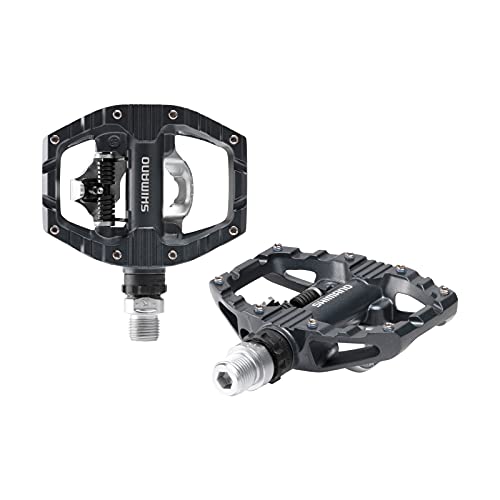
Shimano PD-EH500 SPD and flat platform pedal pair
As an Amazon Associate we earn from qualifying purchases.
Shimano supplies SM-SH56 multi-release cleats and adjustable light-action bindings. The SH56 can release in several directions, including upward, so Shimano says not to use it when pulling up on the pedals or performing jumps. Its manual also warns that aggressive riding or competition can cause unintended release with this recreational pedal. This is a useful option for relaxed riding, not our recommendation for jumping or aggressive trail use.
Pros: a usable flat side, adjustable retention and included multi-release cleats make the EH500 a flexible starting point. Cons: only one face accepts a cleat, the platform pins need care around bare skin, and the light-action system has use limitations. Multi-release cleats still may stay engaged during a loss of balance.
2. Shimano PD-M520: best for a compact two-sided SPD setup
Choose the PD-M520 if you expect to wear SPD shoes for your rides and want bindings on both sides. Unlike the EH500, it does not devote one face to a flat platform. Its compact body, open binding and sealed bearing cartridge make it a straightforward option to compare when you want a dedicated SPD pedal without a large surrounding platform.
Shimano lists SM-SH51 cleats in the standard package. These are two-bolt, single-release SPD cleats: the heel must twist outward to disengage. Do not assume they release like the EH500’s supplied SH56 cleats. The M520 has adjustable spring tension, and its instructions call for equal adjustment across both sides of both pedals.
Pros: either face can engage the cleat, retention is adjustable, and the open design leaves space around the binding. Cons: there is no proper flat platform for ordinary-shoe errands, and the included SH51 uses a specific outward release motion. Choose it for its dedicated SPD layout, not on the assumption that every SPD pedal feels the same.
3. Shimano PD-RS500: best for a first SPD-SL road setup
The PD-RS500 is the road-focused choice. Shimano specifies a lighter spring tension and a larger entry target for beginner and recreational riders, along with a wide pedal platform. It uses SPD-SL three-bolt road cleats, so it belongs on the shortlist when you are already choosing compatible road shoes.
The standard Shimano package includes yellow SM-SH11 cleats with six degrees of total float, or three degrees each way. Float is the small amount of rotational movement allowed while clipped in; it is separate from release tension. The SPD-SL manual specifies an outward heel movement to release. Six degrees of float is not a promise of effortless release or a cure for discomfort.
Pros: a beginner-oriented entry target, adjustable retention and included floating cleats suit a dedicated road setup. Cons: this requires the SPD-SL shoe-and-cleat system, and it gives you no flat-shoe option like the EH500. Riders choosing two-bolt SPD shoes should start with one of the SPD choices above.
What to check before buying and riding
Match all three parts: pedal, cleat and shoe. SPD uses the two-bolt cleats discussed here; SPD-SL uses the larger three-bolt road cleat. A listing that merely says “cycling shoe” is insufficient. Check the shoe manufacturer’s stated cleat compatibility and buy the exact cleat specified for the pedal. If you are unsure about crank fit, cleat position or installation, ask a bicycle shop to check the complete setup before riding.
Read the manual for your model first: EH500, M520 or RS500. Shimano’s starting exercise is to apply the brakes, keep one foot on the ground, and repeatedly engage and release the other foot; practice with each foot. Then begin on level ground away from traffic. Anticipate stops and release a foot before you need to put it down. Practicing reduces unfamiliarity; it cannot guarantee that you will avoid a fall.
Set retention within the manufacturer’s adjustment limits and keep matching bindings evenly adjusted. Too much tension can make release difficult; too little can cause accidental release. Do not wind an adjustment screw past its minimum or maximum stop. Recheck engagement, release, fasteners and cleat wear, and keep dirt out of the bindings. If release becomes abnormal, stop and have the setup inspected.
Frequently asked questions
Which of these pedals is easiest to start with?
For a recreational bicycle that also sees ordinary-shoe trips, we would start with the EH500’s combination of a flat side and light-action SPD binding. If you will always wear SPD shoes, the M520’s two clip-in faces may suit you better. Neither choice removes the need to learn the release motion.
Are SPD and SPD-SL cleats interchangeable?
No. The EH500 and M520 use the SPD system with two-bolt cleats; the RS500 uses SPD-SL with three-bolt cleats. Buy shoes and cleats for the specific system rather than relying on similar names or the word “clipless.”
Do these pedals include cleats?
Shimano lists SM-SH56 with the EH500, SM-SH51 with the M520 and yellow SM-SH11 with the RS500. That describes the manufacturer’s standard packages. Confirm the selected seller’s contents and whether the listing is for a pair of pedals before paying.
Should a beginner always set the tension to minimum?
No. Shimano warns about both excessive and insufficient holding force. Adjust within the permitted range until you can engage and deliberately release reliably during stationary practice, keep corresponding settings equal, and get help if the mechanism or fit feels wrong.
Will multi-release cleats automatically release in a fall?
No. Shimano explicitly warns that SH56 multi-release cleats do not necessarily release when you lose your balance. They can also release unintentionally under upward force. Learn the intended release technique and observe the pedal and cleat’s riding restrictions.