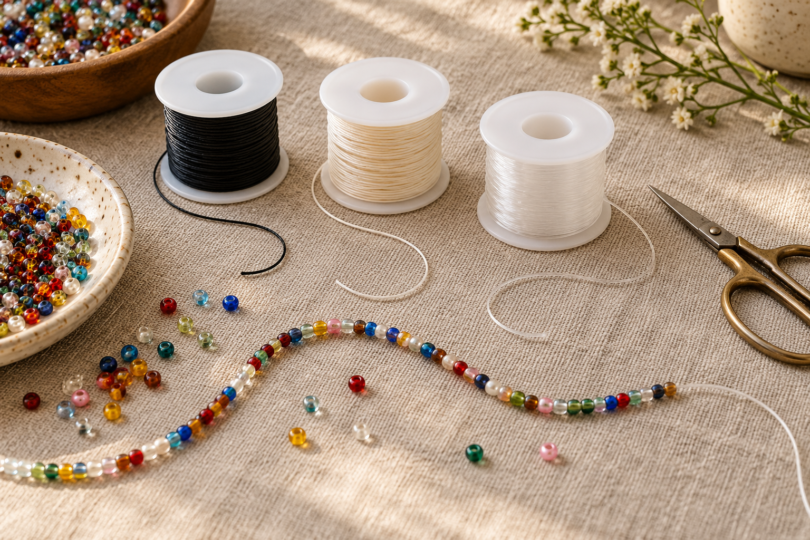

The best thread for waist beads depends on how you want the finished strand to work. For a tied strand with a set length, start with The Beadsmith S-Lon TEX210 nylon cord, provided it fits your beads. For a removable strand that stretches, compare Stretch Magic 0.7 mm elastic cord. These are different construction choices, so decide on the closure before buying a spool.
Our two picks are specific cord products with identifiable sizes and spool lengths. Neither is a universal match for every seed bead. The smallest hole, the number of thread passes and the finished knot all matter more than an oversized pack or a broad claim that a cord is unbreakable.
Two cord options for different waist-bead designs
| Exact selection | Material and construction | Diameter | Selected quantity | Best use |
|---|---|---|---|---|
| The Beadsmith S-Lon TEX210, black | Twisted, bonded multifilament nylon | 0.5 mm | One 77-yard spool, about 70.4 m | Tied or clasped designs with a set length |
| Stretch Magic, clear | Polyurethane elastic cord | 0.7 mm | One 25 m spool, about 82 ft | Stretch designs intended to be removed |
“Fixed” here means that the design does not rely on elastic stretch for putting it on and taking it off. It is not a promise that nylon never moves or settles under tension. An elastic strand needs enough suitable stretch for its intended use, while a fixed strand needs an appropriate tied fit or a usable closure.
1. The Beadsmith S-Lon TEX210: best starting point for a tied strand

The Beadsmith S-Lon TEX210 Nylon Bead Cord, Black, 0.5 mm, One 77-yard Spool
As an Amazon Associate we earn from qualifying purchases.
Choose it for: a simple tied strand, a clasped design or decorative knotting when your beads can accommodate 0.5 mm cord. S-Lon TEX210 is a twisted nylon bead cord. The manufacturer’s single-card entry identifies the black 0.5 mm, 77-yard version as SLBC-BK-R. The selected retail listing is one spool, not the manufacturer’s four-spool wholesale tube.
The Beadsmith’s stringing catalog describes TEX210 as a twisted multifilament nylon cord for stringing and knot-based beadwork. The exact retail listing specifies a bonded three-ply construction. That makes it a relevant material to consider for a fixed waist-bead design; it is not clear stretch cord or a metal jewelry wire.
Tradeoff: 0.5 mm can be too thick for very small holes, especially once a needle or a second pass is involved. The selected listing recommends beads with at least a 0.8 mm hole, but test your own beads before cutting a full working length. A bead’s outside size or an “11/0” label alone does not guarantee the same hole size across every shape and finish.
Black cord may also show through transparent beads and influence the finished color. If that is not the look you want, compare another color of the same size and construction, checking its own listing details. This recommendation applies to the black single-spool selection verified here.
2. Stretch Magic 0.7 mm: best for a removable elastic strand

Choose it for: a stretch design that you intend to remove. The selected product is one clear 0.7 mm spool containing 25 metres. The retail specification identifies polyurethane; Pepperell’s matching manufacturer page describes this as plastic elastic bead cord and confirms the diameter and 25 m length.
The clear material is useful when you do not want an obvious dark line through translucent beads. Its 0.7 mm diameter is larger than the S-Lon selection, however, so it needs correspondingly more clearance through the actual bead holes. Do not force it through an opening that catches or shaves the cord.
Pepperell recommends a Carrick bend, also called a Josephine knot, or a surgeon’s knot for this product. Practice the chosen finish on a short sample before making the complete strand. Follow the cord maker’s current finishing instructions, and check the finished knot under gentle tension before wearing it.
Tradeoff: stretch cord is a deliberate change in how the jewelry fits and is removed. It is not an equivalent replacement when you want a fixed tied strand. Elastic can be damaged by rough bead holes or excessive stretching, and no spool specification establishes a guaranteed wearing life. Check the strand periodically and restring it if the cord or knot shows damage.
How to choose the right thread for your beads
Start with a small sample. String several examples of the smallest-hole beads in your design using the intended needle and number of passes. Add a test knot or closure. If the assembly catches, requires force or cannot accommodate the finish, change the cord size or bead selection before committing to the full piece.
Choose the closure before the length. For a fixed strand, allow working length for the knot or clasp and check that the finished fit is comfortable before trimming. For an elastic design, plan how you will put it on and remove it without dragging it over sharp jewelry or stretching it excessively. Avoid making either type tight enough to dig into skin.
Keep spool length separate from project yield. S-Lon’s selected spool is 77 yards, whereas Stretch Magic’s is 25 metres. The number of finished strands depends on their lengths, knotting allowance, doubled sections and offcuts. A larger spool can suit repeated projects, but it is poor value if its diameter does not fit the beads you already own.
Check the exact variant. Both product families have other sizes, colors and package quantities. For these picks, confirm S-Lon TEX210 black, 0.5 mm, one 77-yard spool, or Stretch Magic clear, 0.7 mm, one 25 m spool. Do not infer the selected size from a review of another variant or from a generic per-unit price field.
For a first fixed design with suitable bead holes, the S-Lon is the straightforward choice. For a strand that must stretch for removal, choose the Stretch Magic and learn its finish before stringing the complete piece. If neither passes easily through your beads, select a finer cord intended for the same construction rather than forcing one of these two options.
Frequently asked questions
Should waist beads use elastic or non-elastic thread?
Use a fixed cord such as S-Lon TEX210 when the design will be tied to a set length or finished with a clasp. Choose elastic such as Stretch Magic when the design is meant to stretch for removal. The closure and intended fit should determine the material.
What size thread fits seed beads?
It depends on the bead’s actual hole and the needle, passes and knot you plan to use. The S-Lon pick is 0.5 mm and the Stretch Magic pick is 0.7 mm. Test several of your smallest-hole beads before cutting a full length; neither size fits every seed bead.
How much cord do I need for one strand?
Allow the desired finished length plus enough extra for your chosen knot or closure and for handling the cord. Doubled sections use additional material. Check the fit and finish before trimming, and calculate project yield from your own working length rather than assuming a fixed number per spool.
Which knot does Stretch Magic recommend?
Pepperell recommends a Carrick bend, also called a Josephine knot, or a surgeon’s knot for the 0.7 mm Stretch Magic product. Practice on a short sample and follow the maker’s current finishing instructions before completing the strand.
Are these listings for one spool or a multipack?
The selected S-Lon listing is one black 0.5 mm, 77-yard spool. The selected Stretch Magic listing is one clear 0.7 mm, 25 m spool. Other variants and wholesale packages differ, so check the selected quantity before ordering.