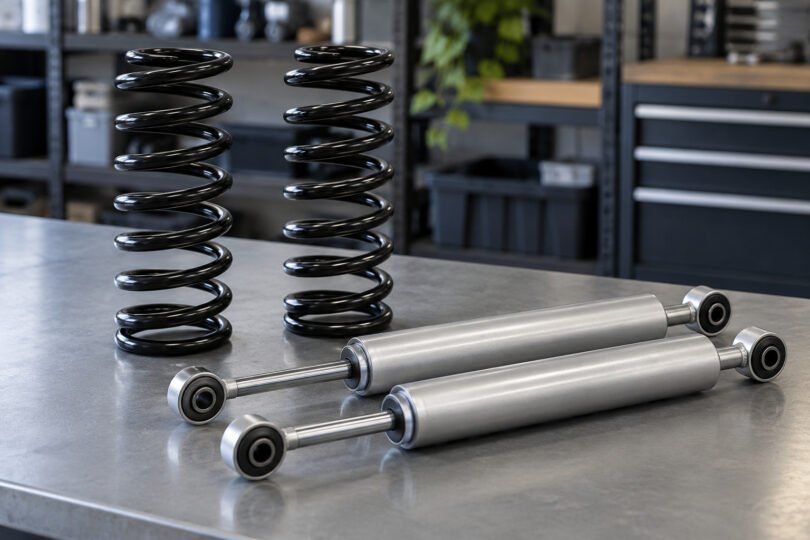

A Jeep TJ 3-inch lift kit should be chosen by the Jeep’s exact year, wheelbase and drivetrain, then by what the package actually includes. Start with a complete parts-and-labor quote from a qualified suspension installer. Springs alone do not address the steering, brake-hose, shock-travel and driveline changes that can accompany a suspension lift.
For a manufacturer-listed three-inch suspension system, compare Zone Offroad’s year-specific J2/J3 kits and BDS’s 418/419 kits. TeraFlex 1141350 is a useful alternative when the installer is specifying the rest of the suspension, but it is a base kit without shocks. Rubicon and Unlimited fitment require particular attention; the same lift height does not make the kits interchangeable.
Confirm which Wrangler you own
Record the model year, short-wheelbase TJ or long-wheelbase LJ Unlimited, engine, transmission, transfer case, axles and existing modifications. The TJ generation spans 1997–2006; the LJ Unlimited is the 2004–2006 long-wheelbase version. JK, JL and Gladiator parts are separate applications. A listing containing the word “Wrangler” is not enough.
Tell the installer about heavy bumpers, a winch, hardtop, spare tire and typical cargo. Zone and BDS warn that initial ride height and payload variations affect the final lift. A nominal three inches is not a guarantee of the measured height on your Jeep, nor does it establish a higher payload or towing rating.
Suspension lift, body lift and combined lift
A suspension lift changes the relationship between the frame and axles using suspension components. A body lift raises the body relative to the frame using body-mount spacers. The two approaches create different clearance and installation issues; a three-inch body lift is not a three-inch suspension kit.
All kits compared here are suspension lifts. Do not add the heights of unrelated parts and assume they form an approved system. The Zone instructions say the manufacturer does not recommend combining suspension lifts, body lifts or other lifting devices. Have the installer assess any lift already on the vehicle before ordering more parts.
Compare the exact packages
| Kit family | Application boundary | Package to check | Important qualification |
|---|---|---|---|
| Zone Offroad J2 / J3 | J2: 1997–2002 TJ. J3: 2003–2006 TJ; the J3 page includes Rubicon and Unlimited. | ZONJ2N and ZONJ3N use Nitro shocks; ZONJ2F is a separately listed FOX 2.0 Adventure option. Coil springs, sway-bar links, bump-stop extensions, rear track-bar bracket and transfer-case drop components. | Alignment-cam hardware may be additional. Select the year-specific package and confirm drivetrain details. |
| BDS 418 / 419 | 418: 1997–2002 TJ. 419: 2003–2006 TJ; the 419 page explicitly excludes Rubicon. | H suffix: NX2 Nitro shocks. FS suffix: FOX 2.0 Performance shocks. Coils, front disconnects, rear links, bump stops, rear track-bar bracket and transfer-case drop. | Front lower control arms and stabilizer are recommended extras. Manual-transmission and skid-plate issues require review. |
| TeraFlex 1141350 | Maker lists short-wheelbase TJ and long-wheelbase LJ. Confirm exact year, steering configuration and Rubicon application with TeraFlex. | Three-inch coil-spring base kit with quick disconnects; no shocks. The linked manual also lists rear links, bump-stop extensions, rear track-bar bracket, transfer-case drop and hardware. | Longer shocks, alignment and caster/geometry correction are additional requirements. Do not confuse it with an eight-arm system. |
Zone Offroad: use the correct year split
The 1997–2002 J2 page and 2003–2006 J3 page describe replacement coils, extended sway-bar links, bump-stop extensions, a rear track-bar bracket and transfer-case drop. The linked installation manual separates earlier and later transfer-case mounting hardware, which makes the year split more than a naming detail.
Zone recommends optional front alignment cams when factory-length lower control arms are used, unless the Jeep already has suitable factory cams. Its later J3 page explicitly lists Rubicon and Unlimited compatibility. The earlier J2 page repeats that note despite its 1997–2002 heading; do not use that inconsistent note to order J2 for a later Jeep. Confirm the full configuration with Zone.
The Zone manual also identifies a forward transmission skid-plate conflict with the increased suspension travel. Have the installer explain the resulting protection and clearance tradeoff before committing to the kit.
BDS: distinguish the shock option and Rubicon exclusion
The BDS 418 family and 419 family offer NX2 Nitro or FOX 2.0 Performance shocks. The published package descriptions include front sway-bar disconnects, rear links and a rear track-bar bracket. BDS recommends a stabilizer and front lower control arms; treat those as separate quote items rather than assuming they arrive in the box.
The 2003–2006 product page says the kit will not work with Rubicon models. It also flags possible shifter-opening interference with manual transmissions. The linked BDS manual identifies a forward transmission skid-plate conflict with the increased travel. Have the installer explain that tradeoff and the appropriate protection plan before buying; do not improvise a clearance modification.
TeraFlex: a base kit needs a complete build plan
TeraFlex 1141350 expressly excludes shocks. The maker calls for geometry correction using adjustable control arms and/or an adjustable front track bar, plus caster correction and alignment. Its notes require longer shocks and discuss wheel backspacing or wheel adapters as separate considerations.
The same notes strongly recommend a CV-style driveshaft and slip-yoke-eliminator solution for a three-inch lift, but the nearby Rubicon exclusion is not clearly separated from that accessory recommendation. Get a written answer for a Rubicon rather than applying a non-Rubicon transfer-case solution. The shared manual covers several packages: the control arms and front adjustable track bar shown for larger systems are not automatically included in 1141350.
What the installed quote needs to cover
Ask the shop for an itemized quote tied to the exact kit SKU and your Jeep. It should identify supplied parts, reusable parts, required additions and work that can only be decided after inspection.
- Condition first: inspect the frame, mounting points, steering joints, bushings and existing suspension. Corrosion or seized hardware can change both the job and its cost.
- Shock and bump-stop travel: verify that the chosen shock lengths, bump stops and spring travel work together through the intended range. Nominal lift height alone does not establish those clearances.
- Axle location and steering: confirm track-bar and control-arm geometry, caster, toe and a centered steering wheel. A steering stabilizer is not evidence that an underlying geometry or wear problem has been corrected.
- Brake hoses and other lines: check front hose slack during the steering sweep and rear hose slack at full extension, plus clearance from moving or hot parts. BDS specifically says longer hoses may be needed. JK brake lines should not be ordered as TJ replacements by assumption.
- Driveline: assess operating angles and vibration with the actual transfer case and shafts. An included transfer-case drop is not a promise that every Jeep will be vibration-free.
- Completion: include the specified alignment, brake and clearance checks, headlight adjustment and the maker’s fastener recheck schedule. Zone and BDS specify a 500-mile fastener check.
These are checks to agree with a qualified installer, not installation directions. The current kit instructions and the factory service manual must govern the work. Both Zone and BDS recommend professional installation.
Do not buy tires from the lift height alone
Several product pages describe 33-inch tire applications, but they also name particular wheel sizes and backspacing and warn that trimming may be necessary. BDS’s current linked manual and product pages give different wheel/backspacing examples. That discrepancy should be resolved with BDS and the installer, not converted into a blanket “33s fit” claim.
Have the shop verify the actual tire’s width and dimensions, wheel specification, fender clearance, steering clearance and suspension travel. Larger or heavier tires also affect the load on steering and suspension components, and TeraFlex warns that braking performance can decrease with significantly larger/heavier tires. Include tire-related changes in the build plan rather than treating the tire purchase as independent.
Road use and ongoing checks
Lifting changes handling. The manufacturers warn about loss of control and rollover, and TeraFlex specifically addresses the higher center of gravity. Drive cautiously, avoid abrupt maneuvers, use seat belts and follow the maker’s operating guidance. A kit listing does not establish that your finished vehicle meets local road-use or inspection requirements.
Before returning to pavement after off-road use, follow the instructions for reconnecting any disconnected sway-bar mechanism. Arrange the required rechecks and routine inspections with the installer. New vibration, unusual steering behavior, brake-hose contact or loose hardware is a reason to stop and have the vehicle inspected, not to add another accessory and hope it resolves the problem.
Frequently asked questions
Is a three-inch TJ kit complete if it includes springs?
No. Confirm shocks, bump stops, sway-bar links, axle-location parts and the driveline plan. Some base kits intentionally omit important components that must be specified separately.
Will every TJ lift fit an LJ Unlimited or Rubicon?
No. Match the exact year and configuration to the manufacturer’s fitment notes. For example, Zone’s later J3 page includes Rubicon and Unlimited, while BDS’s 419 page excludes Rubicon.
Does a three-inch lift guarantee room for 33-inch tires?
No. Tire dimensions, wheel width and backspacing, fenders, bump stops and suspension travel all affect clearance. Confirm the complete combination with the manufacturer and installer.