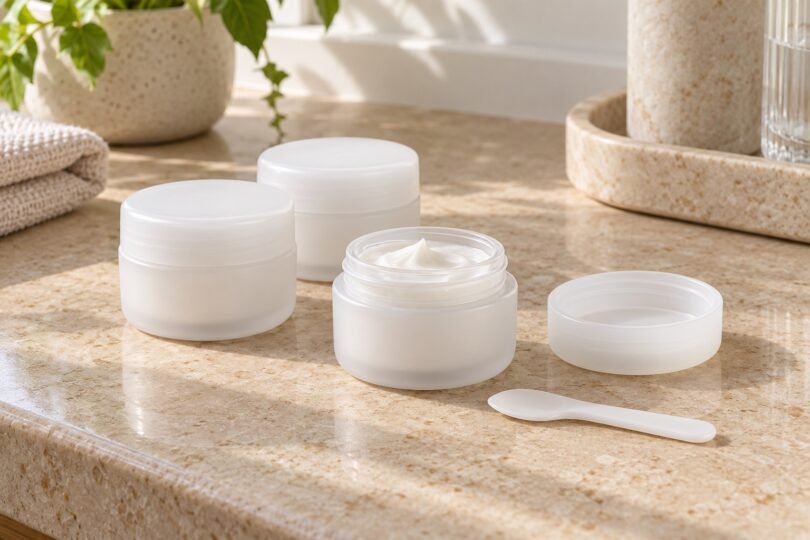

A good travel jar for cream needs to hold the amount you actually use, open wide enough to fill and clean, and close securely without product caught in the threads. The first decision, though, belongs to the cream itself: check whether its manufacturer recommends transferring it into another container. A smaller jar is convenient only when it is appropriate for the formula.
For a straightforward cream container, start with MUJI’s polypropylene jars. For an organized set with interchangeable labels, consider Cadence’s current Capsule system. Keep dry-storage tubs off the cream shortlist when their maker excludes fluids. The comparisons below use published product specifications, rather than hands-on leak testing.
Travel cream jars worth comparing
MUJI Cream Container, Medium: a compact 0.5-ounce option
The MUJI Medium Cream Container, SKU 4550344594261, is a polypropylene jar sold for lotion and skincare. Its listed capacity is 0.5 ounce; the product page’s metric line is abbreviated as “15 m.” Listed dimensions are approximately 1.7 inches in diameter and 0.8 inch high. Those are overall measurements, not a verified mouth diameter.
This is the simpler choice when a small amount of an approved cream is enough and you do not need magnetic connections or interchangeable label tiles. MUJI tells buyers to check that the cap is not loose, damaged or leaking, and says the container is not for food or beverages. Treat that inspection as part of packing, rather than assuming a new jar cannot leak.
MUJI Cream Container, Large: more capacity without a tall bottle
The Large Cream Container, SKU 4550344594278, has a stated capacity of 1 ounce/30 ml. MUJI lists its dimensions as approximately 2 inches in diameter by 0.9 inch high and identifies the material as polypropylene. The same cap-check and no-food cautions apply.
Choose this size when you have established that the smaller jar would require refilling during your trip. A wider footprint can be convenient for scooping, but check the space inside your toiletries bag. Neither the published outside diameter nor a photograph establishes the exact usable opening. MUJI does not publish a separate brimful-versus-working capacity on these pages, so leave enough room to close the lid cleanly.
Cadence Small and Medium Capsules: for an organized routine
Cadence’s current Capsule specifications list Small at 0.56 fluid ounce and Medium at 1.32 fluid ounces. The comparison identifies PP plus recycled HDPE for the current Small, Medium and Large Capsules. Cadence describes wide openings, rounded interiors, a threaded cap and a pressure seal; the label tiles work across the current Capsule Flex system.
Small makes sense for a product used sparingly; Medium gives more room for a frequently used cream. Confirm which generation you are buying: Original Capsules have different dimensions and label compatibility. The company makes leakproof claims, but this guide does not independently verify them or guarantee a leak-free trip. Its cleaning instructions call for mild soap or gentle cleanser, warm water and complete air-drying. Check the cream maker’s advice separately before filling.
A popular travel tub to exclude for creams that can flow
The official humangear GoTubb guidance says its containers are not designed for fluids and excludes products that can enter a liquid state. That is a meaningful limit even when a cream looks thick at room temperature. An easy-opening container intended for small dry items is not automatically a suitable cream jar. Choose a container whose intended use matches the contents instead of relying on a review that reports success with a different formula.
Choose the amount before choosing the set
Start with your own usage, not a seller’s “one week” estimate. Write down how many applications the trip requires, including arrival and departure days. If you already know how much you use, choose a capacity that comfortably accommodates it without packing cream into the lid. If you do not know, a manufacturer-made travel size avoids guessing at both quantity and container compatibility.
Capacity is also different from weight. An ounce of cream by weight on its original label is not necessarily one fluid ounce of volume. Likewise, the weight of an empty container says nothing about how much it holds. Use a clearly stated volume for comparisons and avoid converting a cosmetic’s net weight into jar volume without the information needed to do so.
Compare the complete packed arrangement. Three low jars may fit more conveniently than one tall bottle, or they may spread across the bottom of the bag and waste space. Try the empty containers alongside toothpaste, cleanser and other essentials before committing to a large matching set.
Check the formula maker’s decanting advice
Paula’s Choice advises against decanting its skincare into other packaging and offers travel sizes instead. Follow a product maker’s restriction even when the container seller broadly advertises compatibility. A jar supplier’s claims do not establish how a particular sunscreen, treatment or cream performs after transfer.
If instructions are unclear, ask the product manufacturer whether the exact formula can be transferred and what container it recommends. Keep sunscreen and treatment products in their original packaging unless their maker gives appropriate guidance. Do not assign a new shelf life to decanted cream, assume its original expiry remains validated in another jar, or add preservatives yourself. Retain the original label and directions so you can identify what you packed.
Clean filling and sensible packing
The FDA’s cosmetic-safety guidance emphasizes clean hands, clean containers and avoiding added water. For a refillable jar, follow its cleaning instructions and allow all parts to dry completely. Keep the work surface and any transfer spatula clean. Do not dilute a thick cream to make it easier to pour.
- Label the jar with the product name and record when you filled it.
- Check the rim, cap and threads for residue before closing.
- Do not combine leftovers from different formulas in one container.
- Inspect for cracks or cap damage before each trip.
- Use secondary containment so an unexpected spill is easier to contain.
A home check of the closure can reveal an obvious problem, but it does not prove performance during every flight, temperature change or squeeze inside luggage. Avoid calling any untested combination of jar and cream leakproof.
U.S. carry-on rules for creams
For ordinary carry-on toiletries, TSA’s published guidance limits liquids, aerosols, gels, creams and pastes to travel-size containers of 3.4 ounces/100 ml or less, fitting in one quart-size clear plastic zip-top bag per passenger. The container limit matters even if a larger jar is only partly filled. Medically necessary products have separate screening provisions.
A jar being small enough does not mean TSA has approved that particular product. Check current instructions before departure, especially when your itinerary includes screening outside the United States. For most travelers, the sound purchase is the smallest compatible jar that holds the needed amount and fits comfortably with the rest of the liquids bag.