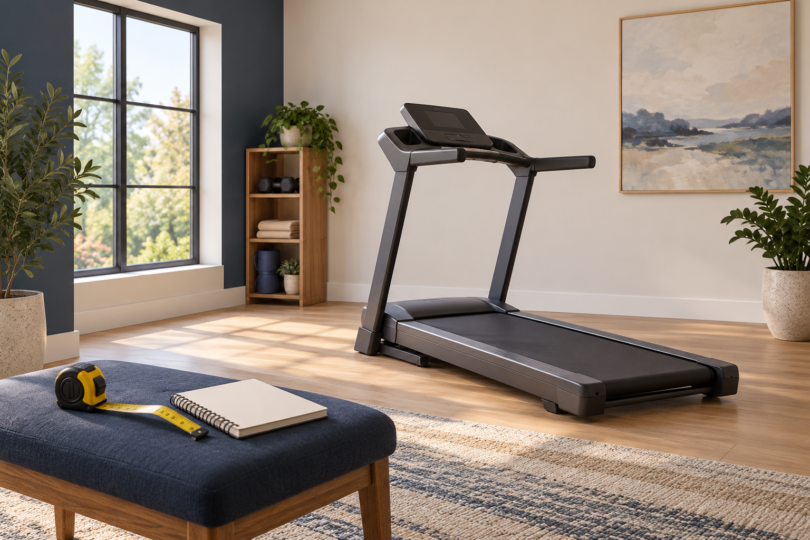

A treadmill for a low ceiling needs more than a short-looking frame. The useful measurement is the height of the moving surface beneath your feet, considered alongside the tallest user, their shoes, the floor mat, incline and movement. A low deck can help, but no model below is a guaranteed fit for a particular ceiling height.
Start with the Sunny SF-T7718SMART if your priority is the lowest published deck figure in this comparison and you do not need adjustable incline. Compare the Life Fitness F3 for a longer belt and folding frame, or the 3G Cardio Pro Runner X for its longer, wider belt and published flat/full-incline step-up figures. Make room approval the first buying decision.
Three treadmills to compare
| Exact model | Published deck or step-up height | Belt and operating limits | Important headroom limit |
|---|---|---|---|
| Sunny Health & Fitness SF-T7718SMART | 2.76 in deck-to-floor figure | 47 × 20 in belt; 0.6–9 mph; fixed, nonadjustable incline | The figure is not a clearance guarantee; confirm the measurement location and your moving height |
| Life Fitness F3 Folding Treadmill | 6 in step-up height | 55 × 20 in belt; 0.5–10 mph; 0–12% incline | A flat step-up figure does not establish maximum height at incline |
| 3G Cardio Pro Runner X | 6.5 in flat; 10 in at full incline, as described by the manufacturer | 58 × 20.5 in belt; up to 12 mph; 0–15 incline levels | Step-up measurements may not describe every standing position on the raised deck |
Use these figures to shortlist models, not to subtract a single number from your ceiling height and declare the setup safe. The brands use different measurement labels, and a console’s overall height says little about the clearance above your head.
1. Sunny SF-T7718SMART: the lowest published deck figure here
The SF-T7718SMART product page lists a 2.76-inch deck-to-floor height. Its fixed profile avoids an adjustable incline mechanism raising you during a workout. That makes it a sensible first candidate for a tight room, provided Sunny confirms the setup for your height and use.
The tradeoff is its 47-inch belt length, shorter than the other two choices. Check your stride on the exact model before committing to running use; a listed top speed does not establish that the belt suits your stride. The SMART model is distinct from the SF-T7718 Classic, so match the full model number rather than relying on a shared listing title.
Sunny’s current product page gives a 250 lb user limit, while its linked manual states 265 lb. Use the lower 250 lb figure for shortlisting and ask Sunny to resolve the model-label discrepancy before purchase. Do not infer that the higher figure is approved for the unit offered to you.
2. Life Fitness F3: a folding option with a longer belt
The Life Fitness F3 combines a published 6-inch step-up height with a 55 × 20-inch belt. It is worth comparing if the Sunny’s shorter belt does not suit your stride. The current specification lists a 350 lb maximum user weight, up to 10 mph and up to 12% incline.
The missing purchase-critical number is the highest running-surface position at the incline you intend to use. Do not treat its 6-inch step-up figure as that measurement. Ask Life Fitness for a ceiling assessment for your exact setup, including the tallest user and the maximum permitted incline.
Its folded height is also relevant: Life Fitness lists 75 inches, compared with an operating footprint of 78 × 34.5 inches. A low ceiling can interfere with storage movement even when the treadmill sits below it in operating position. Confirm the entire folding path and select the Go or Track Connect 2.0 console deliberately; this comparison does not assume their features are interchangeable.
3. 3G Cardio Pro Runner X: more belt space with an incline check
The Pro Runner X has a 58 × 20.5-inch belt and a published 350 lb user limit. 3G Cardio gives step-up heights of 6.5 inches flat and 10 inches at full incline. It also lists a 74 × 35-inch operating footprint and a 65-inch folded height.
Those two step-up figures are useful, but the page does not identify a maximum standing-surface height at every position along the inclined belt. Get that clarified before relying on the 10-inch number for headroom. The maker describes 0–15 incline levels; do not silently read that as a verified 15% gradient.
Choose this model for consideration when the larger belt matters and your room can accommodate both the frame and the required clear area. The X model’s FTMS Bluetooth console also distinguishes it from older Pro Runner listings. Neither the technology nor the maximum speed makes a cramped installation acceptable.
3G Cardio Pro Runner X Treadmill with FTMS Bluetooth Console
As an Amazon Associate we earn from qualifying purchases.
Measure the room before choosing a model
- Find the lowest obstruction. Measure at the treadmill’s intended position, including beams, ducts, sloping ceilings and light fixtures. A room’s nominal ceiling height is not enough. Keep ceiling fans and their swept area out of the exercise space.
- Use the tallest intended user. Measure in the shoes they will actually wear. Tell the manufacturer whether you will walk, jog or run, and include any mat or floor platform. Static standing clearance must leave additional room for movement; a person who barely fits while standing still is not a suitable fit for a moving belt.
- Confirm the exact deck measurement. Ask where the published height was measured and how high the belt surface reaches where you will stand, at every permitted incline. Do not substitute the motor-cover height, side-rail height or folded thickness.
- Get model-specific headroom advice. Request the manufacturer’s required margin for movement and its answer for your measured room and user height. For example, Life Fitness publishes a height-and-incline table for its Club Series+ model; that table belongs to that treadmill and must not be applied to the F3 or other brands.
- Check the floor plan too. Include rear and side clearance, safe access, doors, the delivery route and any folding movement. A compact storage footprint is not the space required while exercising.
If the maker cannot confirm adequate clearance for the intended use, choose another location or another form of exercise. Do not solve a headroom problem by crouching, changing your normal gait, removing treadmill feet or modifying the frame. A purchase that depends on avoiding a ceiling with each stride is the wrong purchase.
Allow the clear space required by the manual
Check the exact manual supplied with your unit before installation. The documents below show why “it fits on the floor” is not a complete space check; their requirements differ.
- Sunny SF-T7718SMART: its manual calls for at least 8 feet behind the treadmill and 2 feet on each side, on a solid, level surface.
- Life Fitness F3: the manual specifies an unobstructed area 6 feet by 3 feet behind the treadmill. This rear area does not replace checks for side access or overhead clearance.
- 3G Cardio Pro Runner X: the visible safety page of its manual specifies 1 foot on each side, 5 feet behind the running belt and enough room for safe access at the front.
Read the grounding, electrical and safety-key instructions as part of the room check. A nearby socket, extension cord or power strip is not evidence that the electrical setup meets the treadmill’s requirements. Confirm the installation with the manufacturer and, where needed, a qualified electrician. If the manual and required electrical protection appear to conflict, have them resolve the installation requirements before use; do not bypass required protection.
Frequently asked questions
Will one of these fit under a seven-foot ceiling?
There is no reliable yes-or-no answer from ceiling height alone. User height, shoes, deck geometry, incline, normal movement and the lowest obstruction all matter. Get approval for the exact model and setup before buying; none of these recommendations certifies a seven-foot room.
Is the lowest treadmill automatically the best choice?
No. The lowest published figure is useful only if the belt, user limit, controls, floor clearances and actual overhead space suit you. A longer-belt model may fit your stride better, while still requiring more room overall.
Can I use zero incline to make an adjustable model fit?
Only consider that after the manufacturer confirms adequate clearance and how the incline can be reliably restricted for every user and program. A promise to avoid the incline buttons is not a dependable installation plan. Automatic workouts or connected controls may change elevation.
Does folding a treadmill reduce the ceiling height it needs?
Folding changes storage dimensions. It does not lower the belt while you exercise, and an upright folded deck may need more overhead room during movement. Check the full operating and folding space separately.