
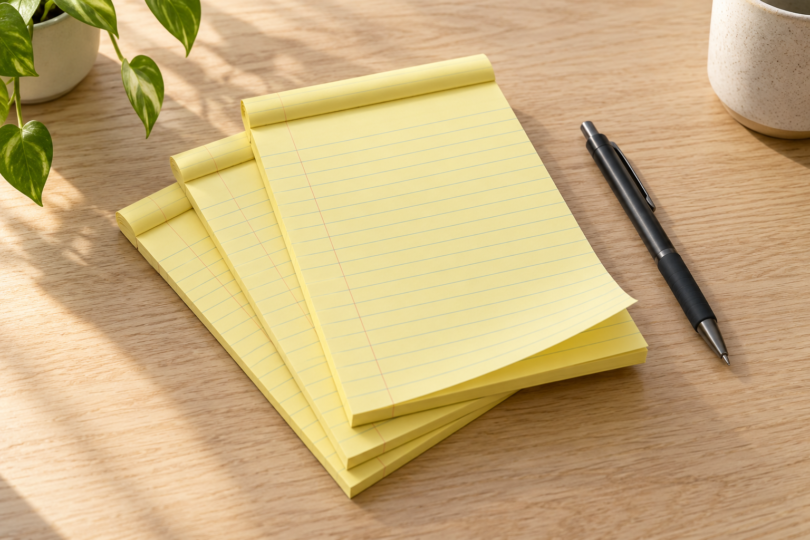

A yellow 5 × 8 note pad is useful for a shopping list, phone message or short meeting notes. The main buying trap is size: a pad advertised as 5 × 8 inches may produce a shorter sheet once you tear it away from the binding. Check the pad dimensions, finished sheet size and pack quantity separately.
For a straightforward narrow-ruled option, start with TOPS The Legal Pad 7501. Consider Mead 59382 if you want a smaller four-pad purchase, or TOPS Docket Gold 63900 if heavier paper and a thicker backing matter more. These choices are based on identifiable manufacturer specifications and product listings; they are not hands-on writing-test results.
Three yellow 5 × 8 pads worth comparing
| Exact product | Useful for | Ruling and listed paper | Pack contents | Size check |
|---|---|---|---|---|
| TOPS The Legal Pad 7501 | Short lists and compact notes | Narrow; TOPS lists 15 lb tablet paper | 12 pads × 50 sheets = 600 sheets | 5 × 8-inch pad; listing specifies 5 × 7.25-inch tear-out |
| Mead Junior Legal Pad 59382 | A smaller pack for occasional use | Wide ruled on package; 15 lb paper | 4 pads × 50 sheets = 200 sheets | Listed as 5 × 8 inches; separate tear-out size not confirmed |
| TOPS Docket Gold 63900 | A firmer backing and heavier-paper option | Narrow; 20 lb bond paper | 12 pads × 50 sheets = 600 sheets | Listed pad size 5 × 8 inches; separate tear-out size not confirmed |
TOPS The Legal Pad 7501: the practical starting point
This is the canary-yellow, 12-pad version, with 50 sheets in each top-bound pad. Its narrow ruling suits compact handwriting and short lists. The manufacturer’s 7501 specifications list 15 lb paper, stitched binding and perforated sheets. Some retailer descriptions give a different paper weight, so use the model number and current packaging when that detail matters.
The matching listing specifies a 5 × 7.25-inch detached sheet. That is useful for loose messages, but it will not fill an exact 5 × 8-inch page sleeve. Choose it when a compact pad matters more than the final loose-sheet height.

TOPS The Legal Pad 7501 — Canary, 5 × 8 Inches, 12 Pads
As an Amazon Associate we earn from qualifying purchases.
Mead 59382: a four-pad option
A dozen pads can be more than an occasional note-taker needs. Mead’s 59382 four-pack provides 50 sheets per pad in canary yellow and 15 lb paper. Mead calls it legal ruled; the matched product packaging labels it wide ruled. Its listed binding style is tape bound.
There is one specification conflict to know about: Mead’s description says the pages are perforated, while its specification table says “Perforated Sheets: No.” The matching Amazon description also says perforated. If clean tear-out is essential, check the package or ask Mead before ordering. A separate finished tear-out dimension and numerical line spacing are not confirmed here.

TOPS Docket Gold 63900: heavier paper and backing
The Docket Gold 63900 manufacturer page identifies a canary, narrow-ruled 12-pack with 50 sheets per pad. TOPS lists 20 lb bond paper and a thicker chipboard backing than the one specified for 7501. It also specifies top stitching and Letr-Trim perforations.
This is the option to compare when you often write away from a desk or want heavier paper. Those specifications do not establish how your particular pen will perform. Try a small quantity before relying on it for wet inks, broad nibs or writing on both sides. The published 5 × 8-inch pad size does not confirm the size of a detached sheet.
What does “5 × 8” actually measure?
Listings may use the same size phrase for the whole pad, a sheet still attached to the binding, or the usable sheet after removal. Treat these as three separate measurements:
- Overall pad size: the outside footprint, including the binding area. This matters for a cover, clipboard or bag pocket.
- Bound sheet size: the paper before removal. Part of its height may sit above the perforation.
- Tear-out size: the loose sheet that remains. This matters for filing, scanning and page sleeves.
Measure the inside of a pad holder, including its retaining slot. Allow room for the binding thickness as well as the paper. If you need an exact 5 × 8-inch loose page, do not assume that a “5 × 8 legal pad” will provide it. Request a finished-sheet measurement.
“Legal pad” also describes a writing-pad format; it does not mean every pad contains 8.5 × 14-inch legal-size sheets. In this guide, the small 5 × 8 format is often called junior legal.
Choose ruling for your handwriting
Narrow lines make room for more short entries on a small page. Wider spacing is worth considering for larger handwriting, checklists with annotations, or notes you will read at a glance. The trade-off is fewer lines per sheet.
Do not rely on “legal ruled” alone to compare spacing. Retailers sometimes apply that label broadly. Look for an actual distance between lines or a clear package image. Neither a product-family name nor a yellow page color tells you how tightly the page is ruled.
A left margin is useful for checkboxes, dates and reference numbers. If you draw diagrams or need full-width writing, check whether that printed margin will get in the way. Yellow paper is a visual preference; it is not a guarantee of better focus or easier reading.
Paper weight, backing and pen choice
Paper weight is a starting point, not a writing-performance score. A heavier sheet does not automatically prevent feathering, show-through or ink reaching the next sheet. Surface treatment, the pen and the amount of ink all matter.
Pound weights are based on a paper category and its reference sheet size, so avoid converting a listed “lb” value to gsm unless the manufacturer supplies the basis or conversion. Backing thickness is a separate specification: a firm back can provide a more stable writing surface without changing the paper itself.
For a first purchase, use the pen you normally carry and check a few notes on both sides of a sheet. Let the ink dry, inspect the next sheet, and try removing a page. This simple check is more useful than assuming every pad in a familiar brand behaves identically.
Count sheets before comparing value
Compare the delivered price for the exact pack, then divide by the total number of sheets. Twelve 50-sheet pads contain 600 sheets; four contain 200. A listing’s “unit count” may mean sheets, pads or one retail pack, so verify the title and package together.
A sheet has two sides. “100 pages” can therefore describe a 50-sheet pad, rather than twice as much paper. Also separate an ordinary retail pack from a distributor’s case or minimum-order quantity. The lowest cost per sheet is only useful if you will actually use the extra pads.
Before you order
- Match the full model number, yellow/canary color and 5 × 8 size.
- Confirm sheets per pad and pads per retail pack.
- Check line spacing if your handwriting needs a particular ruling.
- Confirm the detached-sheet size if the paper must fit a sleeve or filing system.
- Start with a modest quantity when pen performance or clean tear-out matters.
For everyday lists, the TOPS 7501 is an easy specification match. Mead 59382 reduces the pack size, with the perforation caveat above. Docket Gold 63900 adds heavier paper and backing. Choose between them by the notes you write and the space the pad must fit.


