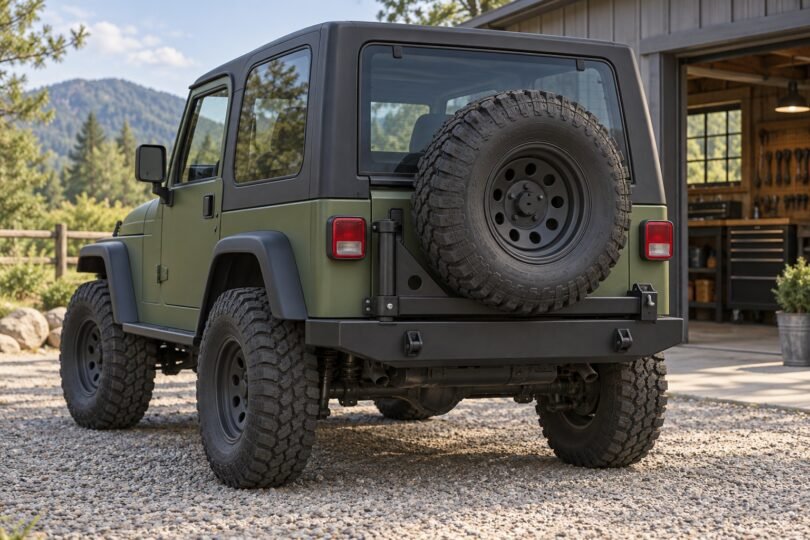

A YJ rear bumper with tire carrier should be chosen around your Jeep’s mounting points, the complete spare-wheel assembly and the way you use the tailgate. A bigger advertised tire diameter does not automatically mean a stronger carrier, and a square receiver opening does not establish a towing rating. Start with an exact part number and the installation instructions for your vehicle.
The three systems below cover the two-door Wrangler YJ, model years 1987–1995. They serve different needs, and each has a purchasing detail worth checking. This comparison uses published product information and installation documents; it does not claim hands-on testing.
Three YJ bumper and tire-carrier systems to compare
| System | Published tire diameter | Decision point |
|---|---|---|
| Smittybilt SRC 76621 | Up to 35 inches | Tubular bumper/carrier package without D-ring tabs; confirm the current installation revision. |
| Rock Hard 4×4 Patriot RH-2001-C | Up to 38 inches | Adjustable spare position and dual-stage latch; the YJ frame-brace kit requires welding. |
| Barricade Classic J20852 | Up to 37 inches | Includes D-rings, but the integrated receiver is not tow-rated. |
These diameter figures are the manufacturers’ or seller’s stated limits, not measured clearance results or weight ratings for every tire-and-wheel combination. Check the linked specifications and confirm the exact package before ordering.
Smittybilt SRC 76621: a tubular bumper and carrier package
The Smittybilt 76621 product page identifies a complete rear bumper and tire carrier for Wrangler YJ/TJ/LJ applications. It specifies 2-inch tubing with a 0.120-inch wall, a textured black finish and no D-ring tabs. Consider this model when you want that tubular design and your spare stays within its stated 35-inch diameter limit.
There is an installation-document conflict to resolve before purchase. The current page advertises no-drill installation, while the linked Smittybilt instruction sheet for bumper component 76621-01 calls for drilling inner mounting holes. The two documents also describe the receiver differently. Ask Smittybilt which instructions and receiver specifications apply to the unit being supplied for your YJ; do not choose the more generous description.
Those instructions also show adjustable tire-mount slots and call for the back of the tire to rest against the triangular carrier. That is a useful reminder to check wheel depth as well as tire diameter, but use the current supplied instructions for assembly and adjustment.
Rock Hard RH-2001-C: adjustable fit with a YJ brace consideration
The Rock Hard Patriot RH-2001-C combines a full-width bumper with a swing-out carrier. Published features include a dual-stage latch, a dual-bearing hub, a grease fitting and a safety pin intended to hold the carrier open. The spare mount adjusts vertically and in depth. Rock Hard lists a 38-inch tire limit and a 110-pound bumper-and-carrier weight; the latter is the equipment’s weight, not the carrier’s payload limit.
Pay particular attention to the RH-2001-YJ frame-brace kit. Its page calls it a required kit and explicitly says welding is needed because of the YJ’s rear shackle layout. Other text on the bumper page describes braces more conditionally. Have Rock Hard confirm the required configuration for your spare and accessories, and include qualified welding in the installation plan.
The RH-2001-C manual also discusses mounting-height choices for body lifts and drilling where factory crossmember holes are missing. “Bolt-on bumper” therefore should not be read as a promise that the entire YJ installation needs no fabrication.
Barricade J20852: check the receiver and plate clearance
The Barricade Classic J20852 listing at ExtremeTerrain explicitly names 1987–1995 YJ and 1997–2006 TJ fitment. It includes a bumper, swing-out carrier and two D-rings, with a stated tire limit of 37 inches. Construction is described as 3/16-inch steel plate and 2-inch tubing with a 0.120-inch wall.
The most consequential detail is in the technical note: its integrated 2-inch receiver is not rated for towing. The listing also warns that the swing arm can contact the license-plate bracket, requiring relocation on some applications. Check that clearance before treating the kit price as the complete project cost.
The linked manufacturer installation sheet is labeled for the TJ, despite the broader product fitment. It describes drilling inner mounting holes and greasing the pivot. Obtain the correct YJ guidance rather than assuming every illustrated TJ step carries over unchanged.
Measure the spare and the whole swing path
Write down the actual mounted tire diameter, section width and combined tire-and-wheel weight. Record the wheel bolt pattern, backspacing and the mounting hardware it needs. Send those details to the manufacturer when a pound limit or wheel-fit requirement is absent. A diameter claim alone cannot confirm that a heavy wheel, deep offset or additional accessories are supported.
Then check the space the carrier needs while moving. The spare must clear the tailgate, hardtop glass or soft-top hardware, lights, plate bracket and anything already attached to the rear. Check both the closed position and the opening arc. A carrier that closes successfully can still foul a corner or block access as it swings.
Moving a spare farther outward changes the load’s distance from the hinge and mounts. Use the maker’s approved adjustment range rather than adding improvised spacers to gain clearance. Confirm that the latch fully engages, any secondary retention works and the open-position stop can be used. Do not use a latch to pull a misaligned arm into position.
Separate spare capacity, towing and recovery
Tire diameter, carrier payload, bumper weight, receiver dimensions and towing capacity describe different things. None should be substituted for another. The reviewed pages do not establish a clear spare-assembly weight limit for every system here, so ask for one that covers your exact setup before adding a heavy spare or cargo.
If towing matters, obtain the applicable receiver’s documented trailer and tongue-weight limits and check the Jeep’s own limits and installation requirements. Use the lowest applicable limit. D-rings or welded tabs also do not establish a recovery rating for the whole vehicle-to-bumper connection; that needs its own approved configuration and guidance.
Plan installation around the condition of the Jeep
Have the rear crossmember, frame rails and mounting areas inspected for corrosion, cracks, distortion or previous repairs before hanging a heavy assembly from them. A new bumper cannot make a weakened mounting surface sound. Use a qualified installer for structural assessment, welding or unfamiliar drilling near vehicle components.
Budget for any required braces, plate or light relocation, missing hardware and labor. Follow the exact kit’s fastener specifications and maintenance instructions; there is no universal torque setting for these systems. After installation, check spare retention, latch operation and tailgate access with the actual wheel fitted. Choose the system whose documented configuration fits your Jeep and spare, with an installation plan you can complete correctly.