
A “5-sided Allen key” is usually a search for one of several different tools. A conventional Allen or hex key works with a six-sided socket. If the fastener really has five sides or five lobes, buying another ordinary hex-key set will not solve the problem.
Identify the shape before choosing a product: a straight-sided pentagon, a rounded five-lobe pentalobe, and a five-flank tamper-resistant TORX PLUS IPR recess are separate profiles. Also establish whether the tool goes into a recess or around an external head. The useful purchase is the exact matching driver, size and holder connection, rather than the largest assortment bearing the word “security.”
What does the fastener actually look like?
| What you see | Likely tool family | What to verify |
|---|---|---|
| Six straight sides inside a recess | Hex or Allen | Metric or inch size; a 5 mm hex key still has six sides |
| Five straight sides | Pentagon | Internal recess versus external head; exact specified size |
| Five rounded lobes, like a small flower | Pentalobe | Maker’s P or PL designation and device-specific tool list |
| Five-flank TORX PLUS profile with a center pin | Tamper-resistant TORX PLUS IPR | Exact IPR size and a matching bored tip |
| Six-lobe star, with or without a pin | TORX or security TORX family | Exact profile and size; this is not a five-lobe driver |
An L-shaped handle does not define the fastener profile. Manufacturers offer different tip shapes in keys, fixed-blade screwdrivers and removable bits. Likewise, a hexagonal bit shank describes the end that fits a holder, not necessarily the working tip that fits the screw.
For comparison, Wera’s ordinary Hex-Plus L-key set is intended for hexagon-socket screws. It belongs to the six-sided category even though the brand uses “Plus” in its name. That name does not make it a TORX PLUS IPR tool.
Products to consider after identifying the profile
iFixit Mako: a precision kit with three pentalobe sizes
The Mako Driver Kit, IF145-299-4, includes 64 precision bits, a 4 mm aluminum driver handle and a flexible extension. The maker’s inventory lists pentalobe P2, P5 and P6 bits, alongside separate hex, TORX and TORX Security entries.
Best fit: someone who has identified pentalobe fasteners and expects other small-electronics work. Important limitation: its listed TORX Security bits are not a promise of five-flank TORX PLUS IPR coverage, and its contents do not list a solid-pentagon driver.
The 4 mm figure refers to the precision-bit connection. It does not describe every working-tip size. The inventory also lists a quarter-inch-to-4 mm adapter; that does not make the included precision handle a native quarter-inch bit holder. Use the supplied system as specified and check any separately purchased accessories carefully.
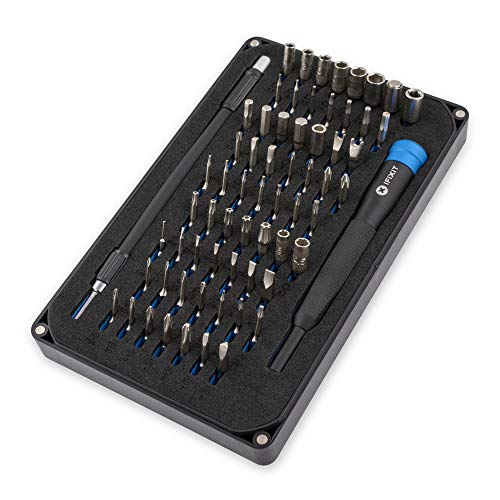
iFixit Mako Driver Kit, 64 Precision Bits with P2 P5 P6 Pentalobe, IF145-299-4
As an Amazon Associate we earn from qualifying purchases.
iFixit P2: a dedicated pentalobe screwdriver
The iFixit P2 screwdriver, IF145-096-8, is a fixed-blade precision driver with an SVCM steel shaft, polymer handle, swivel top and listed 60 mm shaft length. It is sold for pentalobe work on iPhones. Confirm the model-specific repair guide rather than assuming that every screw in a phone uses the same tip.
Best fit: a known P2 task where a dedicated handle is preferable to a full kit. Important limitation: P2 is a size designation within this product’s pentalobe system, not a two-millimeter hex size or a universal five-point profile. The product page also offers other handle variants, so match the part number if you want this exact version.
iFixit P5: a different pentalobe size for specified laptop work
The iFixit P5 screwdriver, IF145-090-8, is another fixed-blade SVCM steel tool with a polymer handle and a listed 60 mm shaft. iFixit describes its use with the bottom-case pentalobe fasteners on some Apple laptops.
Best fit: an exact repair procedure that calls for P5. Important limitation: P5 is not interchangeable with P2 simply because both tips have five lobes. It also does not mean that the remaining screws in a laptop use P5. A dedicated driver makes sense for repeated work on the same confirmed fastener; it is an expensive way to guess through unknown profiles.
Wera 867/1 IPR: for confirmed five-flank TORX PLUS IPR
Wera’s 867/1 IPR range uses a five-flank working profile with a center bore and a quarter-inch hex drive for compatible DIN ISO 1173-D 6.3 holders. For a concrete example, part 05134701001 is 15 IPR with a 25 mm blade length. Other sizes in the same family are separate variants.
Best fit: authorized service work whose documentation specifies that exact IPR profile and size. Important limitation: 15 IPR is not a 15 mm pentagon, P5 pentalobe or ordinary T15 bit. A center hole alone does not establish compatibility; six-lobe security TORX tips also exist.
Check whether a seller is offering an individual bit or a trade pack, and whether a holder is included. The series name does not define the quantity. Use the maker’s part number to resolve ambiguous listings before ordering.
Laser Tools 7811: a solid-pentagon socket and bit example
The Laser Tools 7811 product sheet specifies a five-piece, half-inch-drive pentagon socket-and-bit set. It contains 10, 12.5, 14 and 19 mm pentagon sockets, each 38 mm long, plus a 10 mm pentagon socket bit that is 55 mm long.
Best fit: a documented mechanical-service job requiring one of those straight-sided pentagon tools. Important limitation: the sockets surround an external head; the projecting socket bit serves a recessed profile. Those are different functions. This is not a precision-phone screwdriver set, and “half-inch drive” describes its ratchet connection rather than the fastener size.
Why size names are easy to misread
Keep four details separate in your notes: profile, working size, tool length and holder drive. A listing such as “15 IPR, 25 mm, 1/4-inch hex” provides three different specifications. The middle number is length; the final measurement is the connection to the holder. Neither is a substitute for the IPR working size.
Pentalobe naming also needs care. Wiha’s Apple repair-tool guide uses PL and P descriptions across its model-specific lists. Do not assume a number printed by one brand maps directly to the same number from another. Prefer an explicit manufacturer cross-reference tied to the device and part number.
Some iFixit pentalobe descriptions also use “5IPR” wording. That is not enough to establish interchangeability with Wera’s five-flank, center-bored TORX PLUS IPR family. Treat the product’s actual profile, size and documented application as the deciding evidence. If a seller calls the same tool “Allen,” “pentalobe,” and “Torx Plus” without distinguishing them, ask for clarification.
A practical identification checklist
- Find the equipment model and service procedure. A general brand name is rarely enough. Note the exact fastener location and the driver named for that step.
- Inspect an intact head in good light. A clear close-up is more useful than trying nearby bits. Count sides or lobes, note straight versus curved surfaces, and check for a central post.
- Establish internal or external engagement. A solid male bit enters a recess; a female socket fits around a head. Similar wording in listings can conceal this difference.
- Match the full product specification. Record the tip profile and size, manufacturer’s part number, reach and holder connection. Ask the equipment maker when documentation is incomplete.
- Stop if the fit is uncertain. A damaged or rounded head may no longer show its original geometry clearly. More force is not an identification method.
Before beginning any repair, follow the equipment’s power-isolation, battery and other safety instructions. A matching bit does not make a service procedure safe for an untrained person. Use these tools only on equipment you own or are authorized to service; protected or safety-critical assemblies may require qualified service.
Buying mistakes worth avoiding
Do not buy a kit solely because its case has dozens of positions. Read the actual inventory: duplicate sizes, extensions and adapters can inflate the piece count without adding the profile you need. A smaller exact driver can be the better purchase for one confirmed job.
Do not force a nearly fitting hex, star or slotted driver into an unfamiliar head, modify a tip to approximate another profile, or remove a center post to accommodate the wrong tool. If the correct tool still will not seat normally, pause and reassess the fastener’s condition and service instructions.
The bottom line
If you mean a five-lobe precision screw, start with the documented pentalobe size and consider the matching iFixit driver or Mako kit. For five-flank TORX PLUS IPR, select a correctly sized IPR bit and compatible holder. For five straight sides, look for the specified pentagon bit or socket. If you actually mean a 5 mm Allen key, choose a 5 mm six-sided hex tool instead.