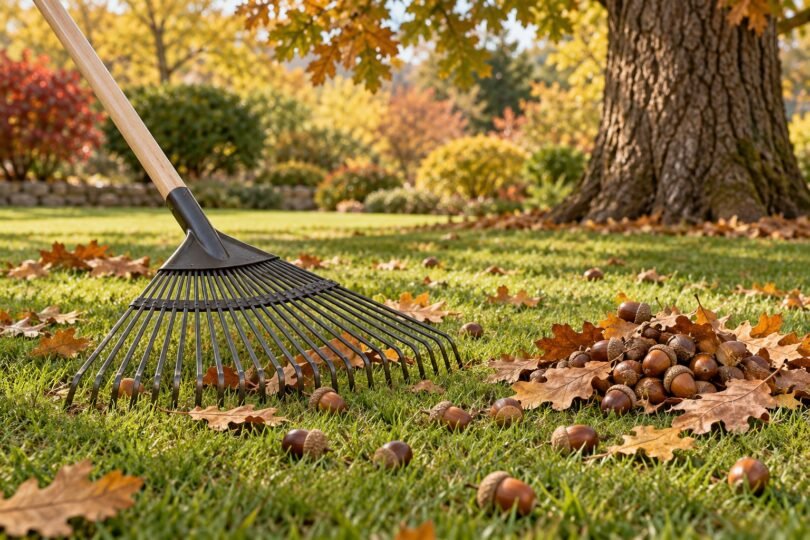

The best rake for acorns depends on what is covering them. For a small area with leaves mixed in, start with a spring-steel leaf rake. For exposed acorns on accessible ground, a nut gatherer sized to the nuts is worth considering. A lawn sweeper is a more conditional choice: a large hopper does not guarantee that its brushes will collect hard nuts buried in grass.
Before buying anything, measure a handful of your acorns and try the rake you already own on a small patch. The size of the nuts, the grass around them, and the amount of cleanup matter more than a long list of nominally similar tools.
Which tool should you use for acorns?
| Your cleanup job | Start with | Main limitation |
|---|---|---|
| A small lawn patch with acorns, leaves, and twigs | A flexible leaf or lawn rake | Small nuts can pass between the tines; you still need to lift the pile |
| Loose, exposed acorns within a gatherer’s stated size range | A correctly sized rolling nut gatherer | It needs contact with each nut and periodic emptying |
| Acorns around borders, roots, and narrow spaces | A narrow shrub rake and hand cleanup | A narrow head takes more passes across open lawn |
| A large open lawn with mostly leaves and clippings | A lawn sweeper, with a separate plan for missed acorns | Acorn collection varies; embedded nuts may remain |
| Mixed tiny nuts, large nuts, loose caps, and broken shells | A rake followed by targeted pickup | One roller size may not retain every type of debris |
Rakes and nut gatherers to consider
Corona RK 62061: a leaf rake for mixed debris
The Corona RK 62061 has a 19-inch head, 25 tines, a tempered spring-steel head, and an aluminum handle. That makes it a practical conventional-rake option when acorns are mixed with leaves and other loose garden debris.
Use it to draw material into manageable piles, then lift those piles into a container. Its usefulness for acorns depends on the nuts and the spaces between the tines; Corona does not publish a guaranteed acorn-diameter range for this rake. Try light, short strokes rather than pressing harder when nuts escape. A rake is also useful for the preparation pass before a roller.
Choose it for: general lawn cleanup and a tool that can also handle leaves. Consider another approach if: your main problem is many tiny, isolated acorns slipping between the tines.

Corona RK 62061 Fixed Tine Leaf Rake, 19-Inch Head, Aluminum Handle, 1 Rake
As an Amazon Associate we earn from qualifying purchases.
Corona RK 62060: a narrow rake for awkward spots
The Corona RK 62060 is the 8-inch, 11-tine shrub rake with an aluminum handle. Its narrower head is the reason to consider it for borders and spaces a broad lawn rake cannot easily reach.
It is a supplementary cleanup tool for acorns around obstacles. It will take more strokes to cover the same open area as a wider rake, and the narrow head does not establish a minimum nut size it will capture. Work carefully around exposed roots and plants, and pick out trapped nuts by hand when necessary.
Choose it for: confined areas and finishing work. Skip it as your only tool if: the entire open lawn needs repeated heavy cleanup.

Garden Weasel Small Nut Gatherer 95334: for smaller acorns
Garden Weasel specifies a 3/8- to 3/4-inch object-diameter range and a half-gallon cage for its Small Nut Gatherer, model 95334. This is the size to investigate when the acorns in your yard fall within that band.
The flexible wire cage collects suitable objects as it rolls over them. Choose the tool by the nuts’ width, not by the word “acorn” in a listing. Loose caps, fragments, and nuts outside the specified range may need another method. The half-gallon capacity also means stopping to empty the cage during a heavy fall.
Choose it for: measured small acorns that the cage can reach. Check first: whether your sample includes nuts smaller than 3/8 inch or wider than 3/4 inch.

Garden Weasel Medium Nut Gatherer 95314: for larger acorns
The maker’s current specification for the Medium Nut Gatherer, model 95314 is a 3/4- to 2-inch diameter range with a one-gallon cage. Consider this version only when the nuts you want to collect fit its range.
Its larger capacity does not make it an upgrade for every yard. If most of your acorns are below its minimum size, buying the medium version can leave the central problem unsolved. Check both the model number and the stated pickup range on the item you order; similarly named variants and older listings can show different specifications.
Choose it for: larger measured acorns and other debris within the maker’s stated range. Skip it for: a yard dominated by smaller acorns.
Small, medium, and large nut gatherers are different tools
The size name describes the intended pickup range as well as the collection capacity. These are the ranges on Garden Weasel’s current product pages:
| Exact model | Stated object diameter | Buying implication |
|---|---|---|
| Small 95334 | 3/8 to 3/4 inch | Check against smaller acorns |
| Medium 95314 | 3/4 to 2 inches | Check against larger acorns |
| Large 95404 | 1.5 to 3 inches | Do not choose it simply to get more capacity for small acorns |
Take samples from different parts of the yard, especially if more than one oak is dropping nuts. Measure across the nut rather than from the cap to the pointed end. Note any attached caps that increase its overall width, and check loose caps separately. At a size boundary, shape and orientation can still affect pickup, so a small trial is more useful than assuming every nut will behave identically.
Will a lawn sweeper pick up acorns?
It may collect some, but it should not be the default purchase for an acorn-only problem. In its 26-inch Push Lawn Sweeper 45-0218 product Q&A, Agri-Fab says its sweepers are primarily intended for grass and leaves and reports mixed customer results with nuts and pine cones. Treat that as a reason to verify suitability for your conditions.
A sweeper makes more sense when you also need to collect substantial amounts of leaves or clippings from an open lawn. Before buying one mainly for acorns, look for a demonstration on comparable grass and nut sizes, or try a borrowed machine with its owner’s permission.
Brush setup matters. The 45-02183 manual linked from Agri-Fab’s product page specifies an even grass height and brushes set about 1/2 inch into the grass. That means into the grass, not into the soil. Use the instructions for the exact machine you own; lowering brushes until they scrape the ground is not a dependable fix for missed nuts.
Match the tool to your lawn
Grass length and leaf cover
A roller needs to reach the acorns. Clear a blanket of leaves first so you can see the nuts and judge whether the cage is passing over them. Dense or long grass can keep nuts below the roller’s working surface. Maintain an appropriate mowing height for your grass rather than scalping it for this job, and follow your mower’s instructions for clearing hard debris before mowing.
For buried or tangled nuts, gently loosen a small patch with a rake and see whether pickup improves. If the tool keeps pulling grass or snagging, stop and change the method instead of increasing pressure.
Roots, dips, gravel, and slopes
A rolling head follows the surface it contacts; a depression or root can leave acorns out of reach. Work awkward areas separately with a narrow rake or hand pickup. On gravel, a gatherer may also collect similarly sized stones, so test before committing to the whole area.
Choose a method you can control on the terrain. Avoid pushing loaded equipment across ground that is too soft or slippery, and follow any slope restrictions in its manual. Neither a metal rake nor a wire roller comes with a blanket guarantee against turf damage in every condition.
Cleanup volume and emptying
For a light scattering, a bucket and the rake already in the shed may be sufficient. During repeated heavy drops, the important workload includes walking the area, making extra passes, lifting piles, and emptying containers. A roller’s capacity helps estimate how often you will stop, but only after its pickup range matches the nuts.
Keep the collection container nearby and work in sections. If acorns are still falling, use shorter cleanup sessions focused on the areas you use most, rather than expecting one pass to finish the season.
A practical acorn-cleanup routine
- Inspect a small area. Check nut sizes, grass cover, roots, and loose stones.
- Remove the cover. Rake away loose leaves and twigs to expose the nuts.
- Try your chosen tool on one patch. Check what it leaves behind and whether it disturbs the lawn.
- Adjust the approach. Use a correctly sized roller for exposed nuts, a rake for mixed debris, and hand pickup around obstacles.
- Collect and empty as you go. Avoid creating oversized piles or carrying more than you can comfortably manage.
- Finish the missed spots. Check borders and depressions, then follow local yard-waste guidance for disposal.
Frequently asked questions
Can a regular leaf rake collect acorns?
It can move acorns into piles, especially when they are mixed with leaves. Whether it catches the smallest nuts depends on tine spacing, nut size, and how the nuts sit in the grass. Try a small area before buying a second rake.
Is a rigid bow rake better than a leaf rake?
A rigid bow rake is useful for working soil and heavier material, but it is not the first choice for routine cleanup on established turf. Start with lighter passes from a flexible leaf rake and reserve more aggressive tools for jobs they are designed to do.
Will a nut gatherer collect acorn caps and shells?
Do not assume so. Empty caps and broken shells have different shapes and dimensions from whole nuts. A roller that collects the nuts can still leave smaller fragments behind, requiring a rake or hand cleanup.
Should I buy the largest nut gatherer?
Only if the debris fits its pickup range. For acorns, choose by measured diameter first. A bigger cage is useful only when it retains the objects you actually need to collect.
The best starting point
For mixed leaves and acorns, try a conventional spring-steel leaf rake such as the Corona RK 62061. For exposed nuts, match a gatherer to your measurements: Garden Weasel Small 95334 covers 3/8 to 3/4 inch, while Medium 95314 covers 3/4 to 2 inches. Keep a narrow rake or hand-pickup method for difficult spots. Consider a lawn sweeper mainly when your broader leaf-and-clipping workload also justifies it.