
The right T-slot hold-down clamps are the ones that match your table, hardware and operation. Start with the track or machine-table specification, then choose a clamp with enough reach and clearance for the work. A familiar-looking knob or a description that says “universal” is not proof of fit.
For a woodworking fixture, a padded aluminum hold-down can be a practical choice. For a metalworking mill, choose the machine maker’s specified workholding system and hardware. This guide compares documented examples and explains what to check before ordering; it does not assign test scores or a universal load rating.
Quick choices by job
- For a compatible woodworking T-track: consider Rockler item 35283 or POWERTEC 71083 after checking the supplied bolt against the track’s specification.
- For a Sherline mill: the Sherline 3012 Standard Hold-Down Set is a machine-specific option to investigate.
- For a larger machine table: identify the table slot dimensions, thread system and approved clamp arrangement before choosing a T-nut or clamping kit.
These are starting points for different applications. A small woodworking clamp and a machine-table strap clamp should not be treated as interchangeable just because both anchor in a T-shaped channel.
Manufacturer-documented options
Rockler 35283: a padded woodworking hold-down
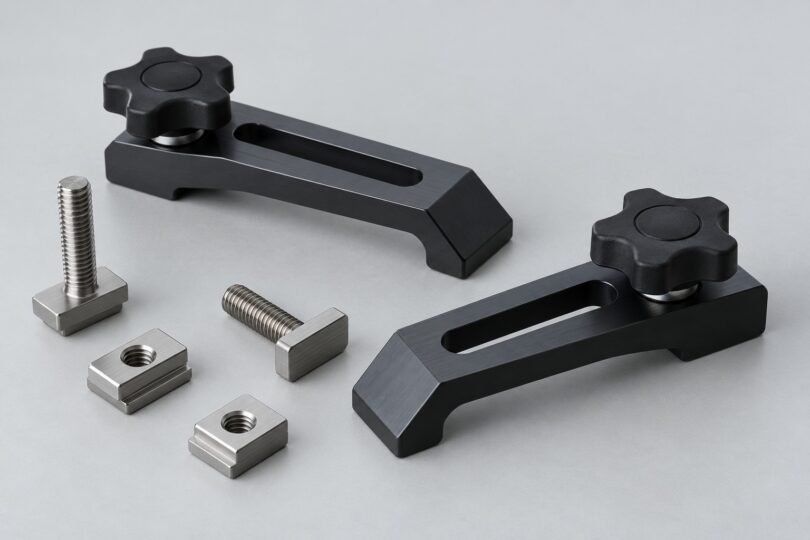
Rockler lists its 35283 hold-down clamp as 5-1/2 inches long and 1-1/8 inches wide, with an anodized aluminum body and rubber tips. The stated material capacity is up to 2-1/2 inches thick. Its package contains one clamp, two rubber tips, a washer, a five-star knob and a 3-inch-long, 5/16-inch T-bolt.
Rockler specifically identifies compatibility with its Universal T-Track. That is useful if you already own that system, but it does not establish compatibility with every track sold elsewhere. The published bolt diameter is also not a complete drawing of the bolt head. Check the track documentation before mixing brands.
POWERTEC 71083: check the exact hardware and pack
The POWERTEC 71083 has a 5-1/2 by 1-1/8-inch aluminum clamp body with padded contact faces. The manufacturer identifies one clamp, one 5/16-18 T-bolt measuring 3-1/2 inches long, one washer and one matching five-star knob in this package.
That threaded specification is valuable when checking replacement knobs or bolts. It also distinguishes the package from a superficially similar clamp supplied with different hardware. POWERTEC’s T-track catalog separates its single-clamp 71083 from the two-clamp 71168 and four-clamp 71168-P2 packages. Compare the selected model number and contents rather than assuming every listing photograph represents the same quantity.
Sherline 3012: a machine-specific strap-clamp set
The Sherline 3012 Standard Hold-Down Set uses two strap clamps, supporting carriage bolts, washers, T-nuts and socket-head screws. Sherline states that the supplied hardware provides approximately 1-3/16 inches of maximum height adjustment.
Its parts list identifies 10-32 T-nuts and clamping screws, while the support carriage bolts are 10-24. Those are different threads with different jobs in the assembly. Follow the set’s instructions rather than swapping screws because their diameters look alike. This set is a useful example of matching the clamp to a particular mill system, not a recommendation for all machine tables.
Measure the slot, then match the fastener
Write down the track manufacturer and model before measuring. The visible opening is only one part of the profile. A compatible head or nut must also fit the wider cavity below it, sit correctly beneath the shoulders and have sufficient vertical clearance. The machine or track drawing is the best starting point.
Do not confuse the outside width of an aluminum track with its slot opening, or the diameter of a bolt with the width of its head. Likewise, “5/16-inch hardware” does not tell you everything about the shape of the track. A bolt can have the right thread and still be the wrong anchor.
Jergens’ T-slot nut dimensions show why both measurements matter. Its inch-series 43301 and 43302 nuts both use 3/8-16 threads, but list different T-slot widths: 9/16 inch and 7/16 inch respectively. The same thread is therefore not a universal slot-fit specification.
- Match the complete T-nut or T-bolt profile to the table or track.
- Match the thread diameter and pitch across the stud, nut and knob.
- Use the specified engagement and fastener length; do not force a fastener that binds.
- Keep the stud from bearing against the bottom of the table slot.
- Confirm that the clamp can be installed through the track’s intended access point.
Jergens describes a safety-stop feature on its T-slot nuts intended to prevent studs being turned into the tableways. Do not defeat a manufacturer’s stop feature to obtain more travel. If the fastener or support arrangement cannot accommodate the job correctly, choose the specified alternative.
Check reach, height and the whole tool path
A clamp’s overall length is not the same as its useful reach from the anchor. Before buying, sketch where the track sits relative to the workpiece edge. Allow room for the contact pad, the knob, the supporting end and your hands during setup. Thick stock may need a different approved bolt or clamp arrangement; a longer bolt alone does not prove suitability.
Height capacity is only one clearance check. On a drill press, consider the drill, chuck and their travel. On a CNC machine, include the cutter, collet, spindle body and planned movements. A clamp that clears the tool at the start can still obstruct a later move.
On a router table, distinguish between securing a fixture and restraining stock that must feed past the cutter. Do not clamp the moving workpiece immovably to the table for an operation that requires feeding it. Use the router-table manual’s specified guards, guides and workholding arrangement. A hold-down is not a substitute for those instructions.
Pressure, pads and track installation
Use the clamp and machine manufacturers’ limits. There is no single tightening torque or safe cutting load that can be assigned to every T-slot clamp. The anchor, track, mounting screws, supporting surface, workpiece and clamp arrangement all need to be appropriate for the operation.
Sherline’s machine instructions warn that overtightening hold-down screws and T-nuts can distort the cross-slide or mill table. A longer handle or extra leverage is not a sensible fix for poor workholding.
Padded contact faces can be useful on finished wood, but inspect them for damage and trapped chips. A pad does not guarantee that a soft surface will remain unmarked. Use an appropriate protective piece when the clamp instructions allow it, and confirm that the resulting arrangement remains stable.
A short pre-purchase checklist
- Identify the task: assembly, drilling, holding a fixture or machine workholding.
- Record the system: exact table or track model and the hardware it accepts.
- Compare the package: clamp count, thread pitch, bolt length, washers, pads and supports.
- Check the setup: workpiece thickness, contact position, reach and complete tool clearance.
- Read the limits: installation instructions and any applicable clamping or machine restrictions.
Before adjusting clamps, disconnect power as directed by the machine manual and wait for all motion to stop. Inspect the installed hardware and workpiece before operating the machine. If you cannot establish compatibility or a secure setup, pause and ask the manufacturer rather than testing a questionable fit under power.
The practical choice
Choose a documented match over a large assortment of unidentified hardware. Rockler 35283 and POWERTEC 71083 provide specific woodworking-clamp options to compare, while Sherline 3012 illustrates a dedicated mill setup. Once slot fit, threads and tool clearance are settled, pack size and convenience become useful deciding factors.