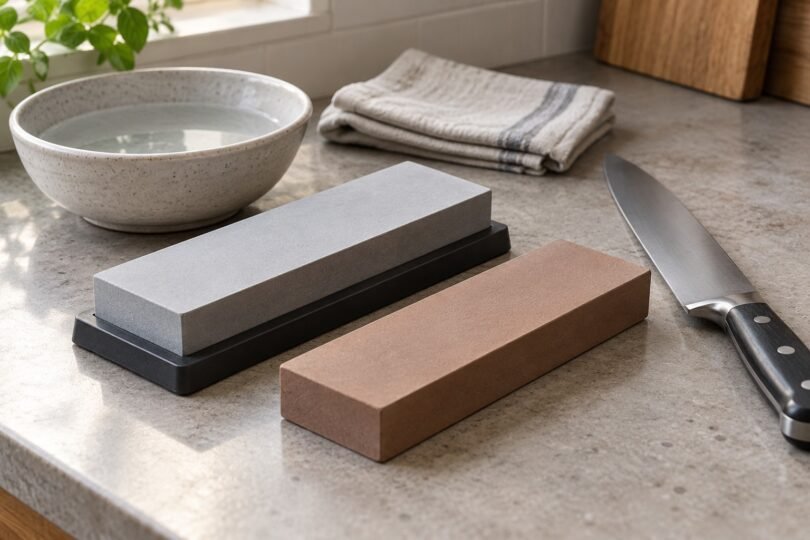

For routine sharpening of a plain-edge kitchen knife, start with one medium-grit waterstone and a stable holder. A 1,000- to 1,500-grit stone is a practical first purchase; a fine polishing stone can wait until you can form and finish an even edge. Repairing a chipped blade is a different job and may call for a coarser stone or professional sharpening.
The Shapton Kuromaku Blue 1500 is a sensible single-stone starting point, and Shapton itself recommends it for people buying just one stone. The Suehiro New Cerax CR-1000-B is an alternative if you prefer a soaking stone. The useful distinction is how the stone fits your routine, not how many accessories come in the box.
Waterstones worth comparing
| Stone | Grit | Stone dimensions | Role |
|---|---|---|---|
| Shapton Kuromaku Blue K0707 | 1500 | 210 × 70 × 15 mm | One-stone routine sharpening |
| Suehiro New Cerax CR-1000-B | 1000 | About 206 × 73 mm; thickness note below | A soaking-stone alternative |
| Shapton Kuromaku Orange K0702 | 1000 | 210 × 70 × 15 mm | A lower-grit alternative to Blue |
| Shapton Kuromaku Wine K0704 | 5000 | 210 × 70 × 15 mm | Optional finishing after medium sharpening |
The Shapton specifications come from its Kuromaku product range. Each of these models has a plastic storage case that can serve as a sharpening base. Match the model number as well as the color when comparing a seller’s listing.
Choose your first stone by the job
Shapton Blue 1500: a straightforward single-stone choice
If your knives have lost cutting ability but do not need substantial edge repair, begin here. Shapton’s FAQ recommends Blue Medium 1500 for a one-stone setup. That is a useful starting recommendation, not a promise that it is ideal for every steel or blade geometry.
A single stone gives you fewer variables while learning: you can concentrate on reaching the whole edge, keeping the angle steady and removing the burr. Add another grit when you can identify a job your existing stone does not do efficiently.
Suehiro New Cerax CR-1000-B: allow time for soaking
The CR-1000-B product page identifies a #1000 medium stone, a storage case and an included cleaning stone. Its sharpening surface is approximately 206 × 73 mm. The product page gives a thickness of 23 mm, while Suehiro’s 2026 catalogue gives approximately 22 mm. Check the supplied dimensions if a particular holder’s fit is important.
The catalogue classifies this New Cerax series as water-absorbing and specifies about five to ten minutes of soaking before use. Choose it if setting up a water bowl and waiting briefly fits your sharpening routine. Do not mistake the small included cleaning stone for an automatically complete flattening system; follow the maker’s maintenance instructions.
Shapton Orange 1000: an alternative starting grit
Orange is a reasonable choice when you want a 1000-grit starting stone in the same Kuromaku format. Blue and Orange perform overlapping medium-sharpening jobs, so a beginner need not buy both immediately. Choose one, learn how your knives respond and keep the money for a suitable flattening tool.
Shapton Wine 5000: an optional next step
Wine belongs after the edge has been established on a medium stone. It is a finishing option, not the first purchase for a knife that struggles to cut. A polished-looking bevel also does not prove that the cutting edge is finished: angle control and burr removal still matter.
Which grit do you actually need?
- Chips or a changed edge shape: a coarse repair stage may be needed. Avoid removing more metal than necessary, especially while learning.
- A dull but otherwise sound kitchen knife: begin with a medium stone. Around 1000–1500 is a useful starting range for the models discussed here.
- A functioning edge you want to refine: consider a finishing stone after the medium stage. It is an optional purchase for many ordinary kitchen tasks.
Suehiro’s selection guide distinguishes repair, medium sharpening and finishing. It also notes that a finishing stone is not usually necessary for stainless-steel kitchen knives. Let the knife and the result you need decide the progression, rather than assuming the highest grit number is always the best choice.
Soaking instructions: check the exact stone
There is no single soak time for every waterstone. Suehiro’s New Cerax instructions above differ from Shapton’s general guidance, and Shapton also publishes separate instructions for fine stones.
- Shapton’s general FAQ: routine pre-soaking is unnecessary, but it recommends a five- to six-minute soak for the very first use.
- Shapton fine stones: its fine-stone instructions call for five to six minutes in water before sharpening. Read these when using Wine 5000 rather than assuming all Kuromaku grits follow an identical preparation routine.
- Suehiro CR-1000-B: the current catalogue calls for roughly five to ten minutes before use.
Follow the instructions supplied with your exact stone if they differ from a general guide. Keep the working surface wet as instructed; do not interpret “waterstone” as permission to store a stone permanently underwater.
A practical sharpening routine for beginners
This routine is for an ordinary double-bevel, plain-edge steel kitchen knife. Use the knife maker’s directions for single-bevel knives, serrations, ceramic blades or unusual edge shapes.
- Prepare a stable work area. Put the stone in a secure holder on a firm surface. Clean the blade, prepare the stone as instructed and keep water within reach.
- Use the knife’s intended angle. Follow its maker’s specification rather than treating a generic angle guide as universal. Keep your fingers on the blade face and away from the edge and travel path.
- Work along the entire edge. Use controlled strokes and an even angle from heel to tip. A burr is the thin ridge of displaced metal produced as the two sides meet; do not slide a finger along the edge to look for it.
- Sharpen the other side and finish the edge. Maintain the appropriate geometry, then remove the burr with controlled finishing strokes. There is no universal stroke count.
- Clean and check the result. Rinse away sharpening residue, dry the knife and try a careful paper cut with fingers clear. If it catches repeatedly, inspect your technique before moving to a finer grit.
ZWILLING’s sharpening guide illustrates stone technique and burr removal. Use your stone’s own preparation rules alongside the knife maker’s guidance.
Flatness, drying and oil
A hollowed stone makes consistent contact harder. Check the surface regularly and use a flattening method compatible with its grit. A cleaning accessory and a tool for restoring the whole face to flatness are not necessarily interchangeable. Clean away coarser residue before moving to a finishing stone.
Shapton’s care guidance says to avoid soaking longer than 30 minutes, hot water, detergents, dishwashers, direct sunlight and forced rapid drying. Let stones dry gently and follow their storage instructions. These restrictions are a good reason to keep the original care sheet instead of relying on generic kit advice.
Water is the simplest starting choice for these stones. Shapton allows oil, but says a stone used with oil should continue to be used with oil. Do not assume that permission applies to another manufacturer’s waterstone, or add oil simply because it is sold as honing oil.
Before ordering a whetstone kit
Confirm the exact model, grit and stone dimensions; package dimensions are not the sharpening surface. Check whether the offer includes one stone or several, a holder, a cleaning accessory and a genuinely suitable flattening tool. A photograph of a large bundle is not enough to establish the contents of the selected option.
A basic setup can be one medium stone, a secure base and a maintenance plan. A large kit makes sense when its additional grits and tools solve specific needs. It does not remove the need to learn a steady angle.
Common questions
Is a “wet stone” the same as a whetstone?
“Whet” means sharpen. A whetstone is a sharpening stone; it does not necessarily use water. The stones discussed here are waterstones, but their preparation instructions still differ.
Do I need a 5000- or 8000-grit stone to get started?
No. Start with a medium stone and learn to finish the edge on it. Buy a finer stone when you want a particular finish and already have a repeatable sharpening technique.
Why is my knife still dull after polishing?
Check whether you reached the edge along the whole blade, kept the angle consistent, removed the burr and used a flat stone. A finer grit cannot reliably make up for those missed steps. For a damaged or valuable knife, a professional sharpening service can be the better next step.