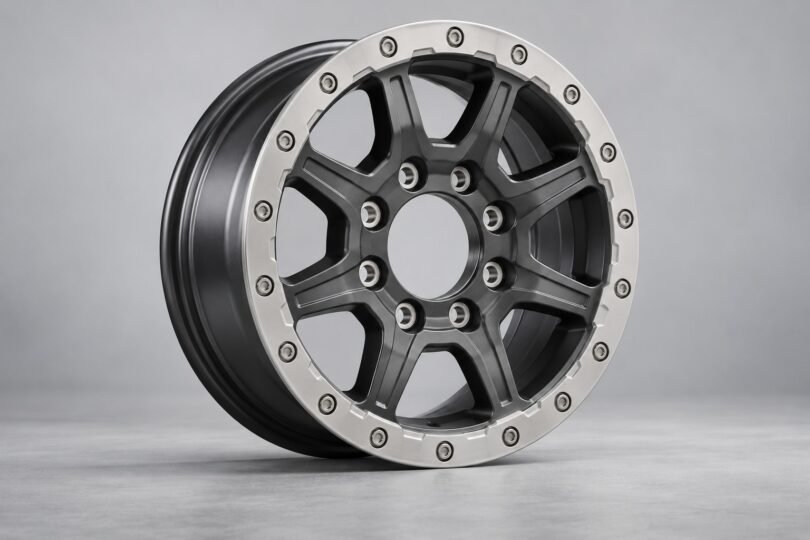

8×6.5 beadlock wheels use eight lug holes on a 6.5-inch bolt circle, also written 8×165.1. That pattern is only the first fitment check. The wheel must also match the vehicle’s load requirements, hub, brakes, mounting hardware and tire, and the manufacturer’s permitted use.
For a functional beadlock, start with the exact part number and its installation guide. Perimeter bolts alone do not identify one: several wheels use a simulated beadlock lip for appearance.
Actual beadlocks versus beadlock-style wheels
An external beadlock uses a bolted ring to clamp the tire’s outer bead. A simulated beadlock wheel has decorative perimeter hardware without that clamping function. Method’s beadlock guide explains the functional construction and its additional assembly and maintenance requirements.
- Functional examples: Method 105 Beadlock and Raceline RT951 Ryno Beadlock.
- Simulated example: Raceline 951BZ Ryno, whose product description specifies a simulated beadlock lip. The 951BZ-79080-12 is a 17×9, 8×165.1, -12 mm variant; it is a different product from the RT951 beadlock.
Neither the word “Ryno” nor a ring of bolts resolves the difference. Match the full model and SKU. A UTV beadlock or a scale-model RC wheel is also a different category from a full-size vehicle wheel.
8×6.5 manufacturer-listed beadlock examples
These entries show how much specifications can differ within one bolt pattern. They are catalog references for comparison, not confirmed fit recommendations for a truck.
| Exact part | Size | Pattern | Offset | Published backspacing |
|---|---|---|---|---|
| Method 105 MR10578580500B, matte black | 17×8.5 in | 8×6.5 | 0 mm | 4.75 in |
| Method 105 MR10579080538B, matte black | 17×9 in | 8×6.5 | -38 mm | 3.5 in |
| Raceline RT951M-79080-12, machined | 17×9 in | 8×165.1 | -12 mm | Confirm exact specification |
| Raceline RT951M-79080-38, machined | 17×9 in | 8×165.1 | -38 mm | Confirm exact specification |
The Method 105 page lists its variants and a 3,600 lb product-family load rating. Confirm the load rating for the exact wheel and application. The Raceline RT951M page lists the two eight-lug variants above but does not establish all the dimensions needed here.
Unresolved specifications: exact center bore for these examples, and Raceline’s exact backspacing and per-wheel load rating, still need manufacturer confirmation. Do not fill those gaps with a number from a different size, finish or bolt pattern. No vehicle or tire combination is cleared by this table.
Use restrictions come before fitment
Method’s beadlock installation guide specifies off-road use. Raceline also specifies off-road-only use for RT951 beadlocks and says they are not suggested for 3/4-ton and larger vehicles weighing over 6,500 lb. That restriction matters even if an eight-lug wheel bolts onto a heavy truck. Adding four individual wheel ratings does not override it.
If the vehicle will travel on public roads, have the wheel manufacturer confirm a suitable road-use product for the exact application. Do not treat these off-road-only examples as daily-driving or towing recommendations. A simulated beadlock may provide the appearance you want, but its load, fit and intended use still need checking.
What must match besides 8×6.5?
- Exact bolt pattern. 8×6.5 and 8×165.1 express the same nominal circle. 8×170 and 8×180 are different patterns.
- Diameter and width. Match the wheel diameter to the tire and confirm the tire maker’s permitted rim-width range. Check the wheel’s maximum tire-size restrictions too.
- Offset and backspacing. These affect where the assembly sits relative to suspension and bodywork. Use the exact published dimensions, then verify clearance. Do not estimate backspacing from nominal width alone.
- Center bore and hub clearance. Confirm bore diameter, hub protrusion and center-cap clearance, including any locking hub. A matching lug pattern does not prove the wheel can sit flush.
- Load capacity. Check both wheel and tire ratings against the vehicle’s axle requirements and intended load. Use the actual axle ratings and manufacturer application limits rather than dividing curb weight by four.
- Brakes and mounting hardware. Confirm caliper clearance, lug-seat type, stud or bolt thread and adequate engagement. A wheel of the right diameter may still contact a brake component.
- Tire and suspension clearance. Check the proposed tire through steering and suspension movement. A wheel that clears while parked may not clear when the vehicle moves.
Raceline’s linked wheel installation guidelines call for a fit check before tires are mounted, correct fasteners and suitable load ratings. They also warn against modifying a wheel or using spacers or adapters to solve fitment problems.
Plan for beadlock installation and maintenance
Use a trained tire-and-wheel installer with the current instructions for the exact wheel, tire and hardware. Tire-bead thickness affects compatibility; the correct diameter alone is insufficient. Method specifically warns against mixing LT tires with UTV wheels, or UTV tires with LT wheels.
There is no universal beadlock-bolt torque. Method’s installation manual varies its specifications with bolt size and lubrication. Ring-bolt torque is also separate from the wheel-to-hub lug-nut torque. Never loosen beadlock clamp bolts while the tire contains air pressure.
Inspection schedules differ by maker. Method calls for clamp-bolt torque checks after the initial 5–10 miles and every 250 miles afterward. Raceline’s mounting instructions call for visual bolt inspection after first use and every 100 miles, plus genuine approved replacement bolts yearly or at a tire change. Follow the applicable instructions instead of transferring one brand’s interval to another.
Check quantity, photos and warranty before ordering
Confirm whether the selected offer contains one wheel, a set, or a wheel-and-tire package, and whether the ring, correct bolts, valve and cap are included. A photo of several wheels does not establish the quantity. A shared product-family image may even show a different lug count from the selected variant.
Warranty wording also needs care. Method’s current general warranty page describes structural and finish coverage with exclusions, while its older, still-linked beadlock guidelines exclude structural and cosmetic warranty. Obtain written confirmation for the exact beadlock and intended use; do not assume the general warranty settles that conflict.
Questions to send your wheel supplier
Provide the vehicle’s year, make, model, trim, axle ratings, brake or axle changes, intended load and use, plus the complete tire specification. Ask the supplier to confirm the exact wheel SKU, bore, load rating, offset/backspacing, hardware, brake clearance, tire compatibility and package quantity. If any of those remain unknown, resolve them before having tires mounted.