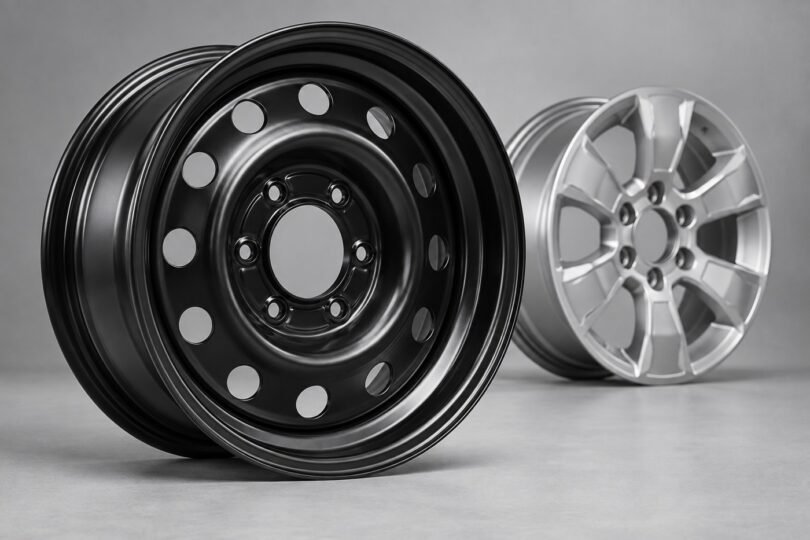

The best way to buy cheap truck rims is to identify a wheel that fits safely, then compare its complete installed cost. A low advertised price means little if the wheel needs different tires, extra hardware or suspension changes. For a straightforward replacement, start with an application-specific steel wheel. For a change in appearance, compare an aftermarket wheel only after checking every relevant dimension.
This guide uses two identifiable steel-wheel examples to show the difference. Both are sold as single wheels, and neither is a universal recommendation. Your truck’s year, model, trim, brake package, axle ratings and modifications must be checked before ordering.
Start with these five fitment checks
- Bolt pattern: match both the number of holes and the bolt-circle diameter. Six lugs alone are not enough information.
- Diameter and width: the wheel must accept the intended tire and clear the brakes.
- Offset and backspacing: these determine where the wheel sits relative to suspension and bodywork.
- Center bore and mounting hardware: verify the hub arrangement, lug-seat style, thread size and required hardware.
- Load rating: the exact wheel variant must support the vehicle’s required load. A listing that merely says “truck wheel” proves nothing about capacity.
Tire Rack’s fitment explanation also checks the brake-caliper profile, hub interference and suspension clearance. This is why a wheel with the right diameter and bolt pattern can still be unsuitable.
Two steel-wheel options worth pricing
Dorman 939-186: investigate for an original-style replacement

Dorman 939-186 Steel Wheel, Black 17x7.5 6x139.7 +30mm, 1 Wheel
As an Amazon Associate we earn from qualifying purchases.
Dorman 939-186 is a black painted steel wheel designed as a replacement for specific Cadillac, Chevrolet and GMC applications. It is the kind of product to investigate when replacing a damaged wheel or finding a correctly matched spare, rather than trying to give the truck a wider stance.
Dorman’s specification page lists a 17-by-7.5-inch size, 6-by-139.7 mm bolt pattern, +30 mm offset, 78.4 mm bore and 139 mm backspacing. The package contains one wheel. The maker lists GM OE references 9595247 and 9596426; an OE reference is useful supporting information, but still needs an exact vehicle application check.
Important capacity limit: Dorman lists 1,710 lb per wheel. Do not assume that is sufficient for your pickup because the application summary includes a familiar model. Confirm the axle-rating requirement and intended wheel position with the supplier before buying. This is not a general heavy-duty or towing-wheel recommendation.
Rough Country RC51-7655: investigate for a wider aftermarket setup

This is a 17-by-9-inch, gloss-black D-window steel wheel with a 6-by-5.5-inch bolt pattern, also written 6-by-139.7 mm. The exact part is RC51-7655. Its selected listing specifies -12 mm offset and 4.5-inch backspacing. A product title may omit the minus sign, so verify the part number and detailed specification before purchasing.
National Tire & Wheel’s exact-part listing gives a 108 mm center bore and a 2,000 lb wheel load rating. The listing also describes the bore as 4.25 inches, a nominal inch equivalent. Those figures do not establish that it fits any particular truck.
Budget for the missing pieces: the manufacturer’s steel-wheel range specifies that center caps, lug nuts and valve stems are not included. A photograph can show a cap for illustration. This card is for one wheel, without a tire.
Main trade-off: its width and negative offset make it a substantial fitment change from many original wheels. Have a shop evaluate the complete tire-and-wheel combination, steering clearance and suspension setup; the shared six-lug pattern does not make it a substitute for the Dorman wheel above.
Understand offset, backspacing and bore before changing styles
Offset is the distance between the wheel’s centerline and its hub-mounting surface, expressed in millimeters. Backspacing measures from that mounting surface to the inner wheel lip. They describe related geometry, but the numbers are not interchangeable. Wheel width also matters: two wheels with the same offset can have different inner and outer clearance.
The center bore is the hole that fits around the hub. Some wheel applications use a centering ring; others are designed around a lug-centric mounting arrangement. A larger bore is not an invitation to improvise, and a wheel must seat correctly against the hub. Tire Rack’s wheel FAQ explains the distinction and why the correct installation hardware matters.
For either wheel in this guide, ask the seller to confirm the complete configuration in writing. Provide the tire size, brake upgrades, lift or leveling kit, and whether the truck has single or dual rear wheels. Dually applications require their own verified wheel specification; these examples should not be assumed suitable.
Check capacity against axle ratings, not the truck’s empty weight
A wheel’s maximum load is a per-wheel rating. For a normal four-wheel vehicle with two wheels per axle, Wheel Pros recommends using the higher front or rear gross axle weight rating and dividing by two to establish the minimum required rating per wheel. Do not divide the vehicle’s overall GVWR by four and assume the result covers unequal axle loads.
For example, a 4,200 lb axle rating requires at least 2,100 lb per wheel under that check. Neither the 1,710 lb Dorman nor the 2,000 lb Rough Country example would meet it. This is an illustration, not a rating for your truck. Read its certification label and owner’s manual, then have the supplier verify the selection.
Stronger wheels do not raise the truck’s permitted payload or towing capacity. Tires, axles and the vehicle’s own limits still apply. If published numbers conflict, pause the purchase and obtain the specification for the actual part being supplied.
Compare the full bill
Request a written quote using the exact wheel part number and quantity. Ask for the following items to be separated so that a wheel-only listing is not compared with a ready-to-install package:
- One, four or five wheels, depending on the replacement plan
- Suitable tires if the existing size or approved rim-width range will not work
- Correct lug nuts or bolts, any required centering rings and optional caps
- Valve stems, TPMS sensor transfer or replacement, and any required setup
- Mounting, balancing, installation, tax and shipping
- Any return freight or restrictions after tires have been mounted
Changing to a larger wheel can trigger a tire purchase that overwhelms the saving on the rims. If the goal is simply replacing one damaged original wheel, an exact replacement quote may be the most useful comparison. If replacing a set, keeping a verified existing size simplifies the quote, although it still does not guarantee that every wheel of that size fits.
Steel, alloy and used wheels: keep the comparison specific
Steel is worth considering for a modest-looking replacement or a simple painted finish. Alloy wheels offer more design choices, but material alone does not establish strength, weight, price or suitability. Compare the actual part’s capacity, dimensions, finish and warranty instead of assuming every steel wheel is tougher or every alloy wheel is lighter.
A used original wheel may reduce purchase cost, but its condition matters as much as its part number. Ask a wheel professional to inspect any candidate for cracks, deformation, damaged bolt seats, corrosion around sealing surfaces and previous repairs. Reject an unidentified wheel if its specifications and history cannot be established well enough for a safe purchase. Cosmetic caps, wheel lights and rim decals are not replacement wheels.
Inspect and test-fit before mounting tires
On arrival, check each wheel’s part number, dimensions and finish against the order, and report shipping damage before installation. Have the installer test-fit the wheel to confirm seating and brake, suspension and balance-weight clearance. A fitment problem is easier to resolve before a tire is mounted and the wheel is put into service.
Tire Rack’s installation manual emphasizes matching lug hardware and using the vehicle’s specified torque. Its guidance calls for a torque recheck after the first 50–100 miles with newly installed wheels. Follow the instructions for your vehicle and wheel package, including any earlier inspection requirement from the installer.
Do not use a spacer or bolt-pattern adapter as an automatic rescue for a mistaken order. That creates another fitment decision involving position, hardware and clearance. Return the unsuitable wheel or obtain a professionally specified solution.
The practical buying decision
If you need an original-style replacement, use the Dorman example to compare an exact application-specific part with other matching replacement quotes. If you want a wider aftermarket look, use the Rough Country example to start a fitment discussion before buying tires or hardware. If either wheel fails the capacity or clearance checks, remove it from consideration regardless of price. Cheap truck rims are only good value when the completed installation is correct for the truck.
Image note: AI-generated editorial illustration; not a photograph of the named product or a compatibility/installation diagram.