
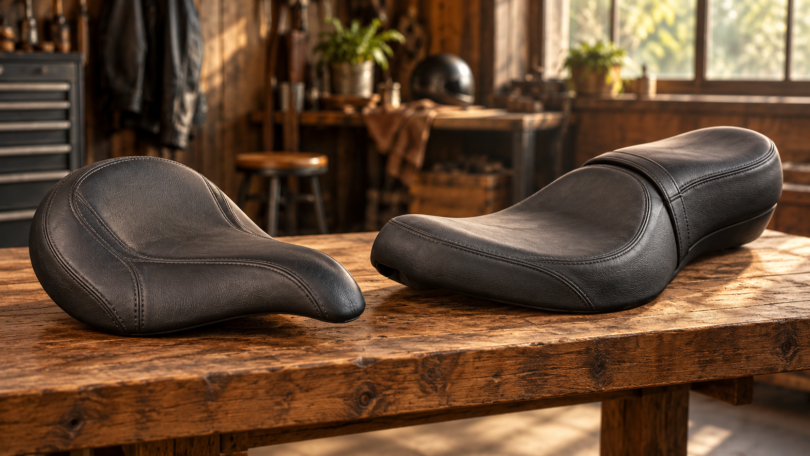

Choosing a seat for a Heritage Softail Classic starts with the motorcycle’s exact model year and model code. Decide whether you need a solo saddle or room for a passenger, then compare the correct seat and mounting hardware. A familiar brand name, a similar silhouette or a listing that merely says “fits Harley” is not enough to make a buying decision.
The options below are a focused comparison of manufacturer-listed applications, not a comfort ranking. Start with the entry that matches your motorcycle, then confirm the current part number, instructions and any changes to your bike with the manufacturer or a knowledgeable dealer. No seat here is promised to solve discomfort for every rider.
Identify your bike before comparing seats
Write down the model code, year and whether the rear fender, fuel tank, seat mounts, luggage rack or passenger setup has been changed. Include photographs of the existing mounting points when asking for fitment help. If the bike predates the applications below, seek a separate verified match rather than extending a later seat’s year range backward.
Mustang’s installation library separates older frame-mounted Softails, later fender-stud arrangements, 2016–2017 models and 2018 models. Treat those divisions as a reason to check the actual hardware. An article heading or a broad “Softail” filter should never replace the precise application list.
Seat candidates for the listed Heritage Softail Classic years
Harley-Davidson 51764-06: a two-up candidate for 2000–2017 FLSTC
The Sundowner Smooth Deep Bucket Seat, part 51764-06 lists 2000–2017 FLSTC among its applications. Harley specifies a 16.5-inch rider section, a 12.5-inch passenger section and a smooth vinyl finish. Its listed package includes a seat bracket, grab strap and mounting hardware. It is a useful starting point if you want a rider-and-passenger seat rather than buying a solo and separate rear pad. Those dimensions describe the product, not a guarantee that it will suit your reach or riding position.
Check the bracket before installation. Harley’s J04033 instructions distinguish FLSTC 2000–2005, which reuses the stock rear bracket and rear mounting screw, from 2006 and the later years covered by the product listing, which use the kit’s bracket and screw. Follow the complete instructions for your year; do not substitute a decorative bolt simply because its listing mentions Harley-Davidson.
Mustang 79120: an early-year solo candidate that needs an instruction check
Mustang’s Wide Touring Solo page for the early Heritage Classic identifies part 79120 as the black, chrome-studded and concho-trimmed version with a driver backrest. It lists 2000–2006 FLSTC and 2001–2006 FLSTCI, with a 17.5-inch rider width. This is a solo seat; plan any passenger arrangement separately and confirm the matching rear seat and backrest clearance.
Before ordering this candidate, ask Mustang for the installation sheet covering your exact year and SKU. The library’s frame-mounted 2000–2006 solo link currently opens a sheet headed 1984–1999. That older document is not sufficient to clear a later installation. The product page supplies the listed application; the missing year-specific installation confirmation remains a reason to pause.
Mustang 76233: a solo option for 2016–2017 FLSTC
For these two model years, the Mustang Wide Touring Solo page lists part 76233 as the black version with chrome studs and conchos, without a driver backrest. Its rider section is 16.5 inches wide, and Mustang describes the riding position as similar to stock. The product family offers other finishes and backrest configurations, so check the selected part number rather than ordering from a generic photo. The page also covers certain Deluxe applications but excludes the Deluxe’s standard rack; that is not an instruction to remove equipment from a Heritage.
The 2016–2017 mounting sheet explicitly lists FLSTC Heritage Classic. It calls for specific retaining washers and fender hardware and treats the solo and passenger mounts separately. Have the correct hardware ready before removing the old seat. In particular, the instructions warn against removing both fender-stud retaining washers at once. Use the full sheet for the procedure, not this buying guide.
If your bike is a 2018-or-later Heritage Classic
Start a separate fitment search for FLHC or FLHCS rather than carrying over an FLSTC recommendation. For example, Harley’s Sundowner 52000748 lists 2018-later FLHC and FLHCS, with a 15.25-inch rider section and 10-inch passenger section. This is a different part from 51764-06. Verify your exact model year against the current listing before purchase; an open-ended year range should not be treated as a promise about every future motorcycle.
Compare the fit for both people, not just the seat width
Use a dealer fitting or an approved demo opportunity to answer practical questions: Can you reach the bars and operate the controls without stretching? Can you support the motorcycle comfortably when stopped? Does the seat hold you in a position you actually want? If you carry a passenger, include them in the evaluation rather than assuming a rear pad that looks larger will be comfortable. Keep the same riding boots and typical gear when comparing positions. These checks help you choose between documented options; they do not establish fitment by themselves.
Decide about a driver backrest before buying a Mustang solo. Mustang’s FAQ says the receiver cannot be added to an existing seat base, and warns that a stock passenger pad may interfere with a built-in backrest. Ask for the exact compatible recessed passenger seat where required. Do not assume that a solo, rear pad and backrest can be mixed simply because each is advertised for the same motorcycle.
What to confirm before paying
- One exact configuration: record the motorcycle year/code, seat SKU, finish, backrest choice and passenger component.
- Everything needed to mount it: confirm which bracket, screws, washers, strap and other parts are included, reused or purchased separately.
- The complete cost: compare the seat plus any required rear pad, compatible hardware, delivery and installation, rather than a headline seat price.
- Fit and returns: ask whether a fitting or demo is available and what the actual seller permits after opening or test-fitting the seat.
- Used-seat condition, if applicable: request clear photographs of the part label, underside, mounting tabs and fasteners. Have damage or modifications assessed before use; a seller’s compatibility claim is not a condition inspection.
For Mustang purchases through a dealer or another supplier, the manufacturer says the seller’s return policy applies. Get those terms before ordering instead of assuming the manufacturer’s direct-sales policy follows the product to every retailer.
Mounting and passenger safety come before appearance
A two-up seat requires a complete passenger setup. The J06436 instructions covering 52000748 require appropriate passenger footpegs and a grab strap, and direct installers to the correct service procedures. Harley also requires checking that the installed seat is secure. If the work or tools are beyond your experience, use a qualified installer. Do not ride with an uncertain mounting arrangement or use a passenger space before its required supporting equipment is in place.
Before the first ride, check the complete assembly against the relevant instructions and the motorcycle’s owner’s manual, including its loading limits. Keep the part numbers and fitting paperwork for later maintenance. A successful order is not the end of the job: the seat has to be correctly installed and suitable for the people using it.
Frequently asked questions
Will a 2018 Heritage Classic seat fit my 2017 Heritage Softail Classic?
Do not assume it will. The documented examples use different applications: 51764-06 lists FLSTC through 2017, while 52000748 lists later FLHC/FLHCS models. Match the exact motorcycle and seat part number; a shared Heritage name is not fitment confirmation.
Can I keep my stock passenger seat when fitting a Mustang solo?
It depends on the exact solo and backrest configuration. Mustang warns about interference between stock passenger pads and built-in driver-backrest hardware. Obtain confirmation for the specific combination, including any required recessed rear seat, before buying.
Is the widest seat automatically the most comfortable?
No single width settles the choice. Treat dimensions as a comparison aid and assess your position, reach, support and passenger needs on the actual bike. A fitting or demo, when available, is more useful than assuming one measurement guarantees comfort.
Can I use any aftermarket Harley seat bolt?
Use the fastener specified for your seat and motorcycle, not a broad compatibility label. Harley’s instructions for 51764-06 use different rear mounting arrangements across the listed FLSTC years. Confirm the correct hardware and complete installation procedure before riding.
What should I do if the instructions do not list my model year?
Pause and ask the seat manufacturer for an exact-year, exact-SKU confirmation and the correct instructions. Do not extend a year range, borrow a similar model’s installation steps or modify the mount to force a fit. Keep the answer with your purchase records.


