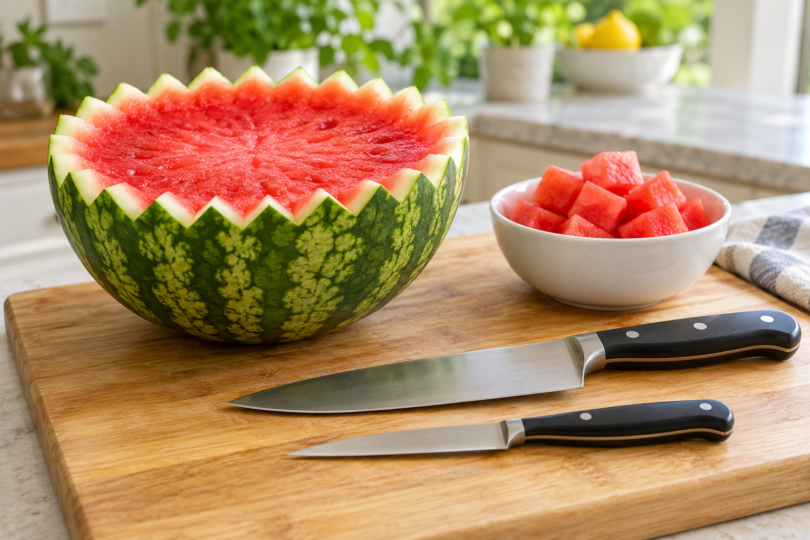

For decorative watermelon carving, the Mercer M12611 Thai Fruit Carving Knife Set is our two-size starting point, while the triangle Thai knife is the single-tool option for fine contours. If you mainly need to prepare pieces or cut serving portions, the Mercer Millennia M22608 chef’s knife fills a different role. The most useful choice depends on whether “carving” means a detailed rind design or ordinary kitchen cutting.
These recommendations compare documented blade types, sizes, handles and care instructions. We have not cut watermelons with these knives or tested their sharpness, grip or durability. “Best” means the best match to the stated task within this shortlist, rather than a measured performance ranking.
Choose by the job you want the knife to do
| Knife | Best fit in this shortlist | What you get | Main limitation |
|---|---|---|---|
| Mercer M12611 Thai Fruit Carving Knife Set | Trying detailed fruit carving with two blade sizes | Two knives: 2-inch and 2½-inch blades; black polypropylene handles | Small detail blades are not a substitute for a larger preparation knife |
| triangle Thai knife, 25 836 50 00 | A single pencil-style tool for fine contours | Pointed flexible blade; Santoprene grip area | One specialist detail knife; confirm the exact model |
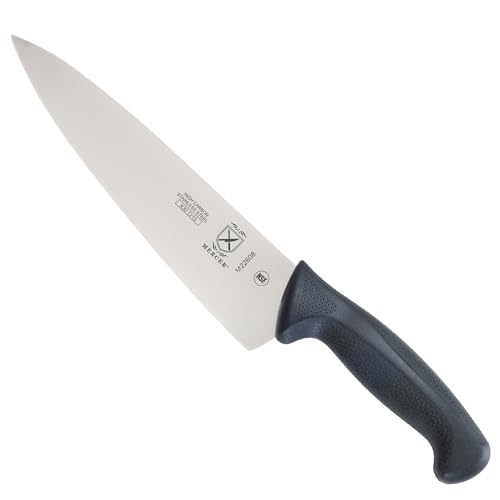
| Mercer Millennia M22608 | General fruit preparation and serving cuts | One 8-inch stamped chef’s knife with a black handle | Broad chef’s blade is not the first choice for intricate patterns |
1. Mercer M12611: best two-size detail-carving set
The M12611 set includes 2-inch and 2½-inch fruit-carving knives. Mercer specifies semi-flexible high-carbon German-steel blades and textured polypropylene handles. The small pointed blades are intended for intricate shapes and precise cuts, which makes this the most direct match here for someone starting decorative rind work.
Its practical advantage is having two blade lengths to choose from without buying a large carving roll. We would start here if you already own a suitable kitchen knife for preparation and want dedicated detail tools. Expect to learn control and depth gradually; a smaller pointed blade does not by itself make a cut safe or a design easy.
Check for M12611 and both included knives. The selected Amazon size label reads “2.5 inches,” but the title, model number, included components and two-count specification identify the two-knife set. The selected listing instructs hand washing and drying, with no dishwasher use or prolonged soaking.

Mercer M12611 Thai Fruit Carving Knife Set, 2 and 2.5 Inches
As an Amazon Associate we earn from qualifying purchases.
2. triangle Thai knife: best single tool for fine contours
The triangle Thai knife, product 25 836 50 00 is the alternative if you prefer one dedicated detail knife. The manufacturer describes a pointed, flexible blade for shaping contours and trimming edges, with a Santoprene grip area that can be guided like a pencil. Its product page specifies hardened stainless steel.
Choose it for the single-tool format and the stated grip style, rather than an expectation that it will outperform the Mercer set. The product is a specialist option for controlled detail work. It still belongs alongside a suitable preparation knife when your project calls for larger cuts.
Use the product number when comparing sellers: triangle makes several differently shaped carving tools. This recommendation is for 25 836 50 00. The manufacturer lists it as dishwasher-safe; follow the current care instructions supplied with the exact knife. Confirm delivery to your region and the complete checkout cost through the linked manufacturer page or a suitable local stockist.
3. Mercer Millennia M22608: best for preparation and serving
The Millennia M22608 is an 8-inch chef’s knife with a stamped high-carbon Japanese-steel blade. Its black handle combines Santoprene and polypropylene. This is the choice here for ordinary preparation rather than tiny decorative cuts: Mercer’s cutlery guide assigns chef’s knives to cutting fruit and vegetables, while paring and tourné knives handle detailed garnishes.
Consider it if your immediate goal is prepared pieces for a bowl or platter and your existing kitchen knife is unsuitable. Its broader blade serves a different job from the two detail options. Match knife size and handling to the melon and your comfort; do not assume an 8-inch knife is ideal for every whole watermelon. If you already own a suitable sharp chef’s knife, adding another may not improve the project.
The selected version is M22608, 8-inch Chef’s Knife, black, one knife. Its retail family includes many other shapes and sizes, so check both size and style. Mercer directs users to wash it by hand, dry it thoroughly and store it in a knife block or sheath.
What matters when choosing a watermelon carving knife
Separate fine detail from large cuts
A long meat-carving or slicing knife may be appropriate for larger fruit cuts, but that is a different task from tracing small decorative shapes. Mercer’s selection guide distinguishes those uses. For a first decorative project, think in terms of a preparation knife plus a small detail tool, rather than expecting one blade to do everything.
Choose a manageable grip and point
A pointed detail blade helps place a cut precisely, but the handle also has to suit your hand. Compare the two-size Mercer format with the triangle’s pencil-style guidance. If you can inspect a knife in person, check whether you can hold it comfortably without reaching toward the edge. Treat manufacturer grip claims as design descriptions, not promises that wet hands cannot slip.
Keep the setup steady
Wash the watermelon under cool running water and dry it before cutting. Use a stable cutting board and keep the fruit from rolling. The National Watermelon Promotion Board’s carving guidance recommends a thin flat base for stability; choose a project and melon size you can control comfortably. Keep your free hand out of the cutting path and stop to reposition if the work becomes awkward.
Buy the small kit you will use
Before ordering a large set, decide which cuts your design actually needs. Start with an appropriate knife, a stable board and a plan. Add a dedicated channel tool or scoop only when the design calls for it. Check whether storage protection is included, since a product photo of a knife alone does not establish that a guard or case comes in the box.
Frequently asked questions
What is the best knife for carving a watermelon?
For decorative detail in this shortlist, start with the Mercer M12611 two-knife set or the single triangle Thai knife. For general preparation, consider the M22608 chef’s knife or a suitable knife you already own. The task is the deciding factor.
Can I use an ordinary kitchen knife?
Yes, an appropriate chef’s knife can handle general fruit preparation, while a small paring knife is useful for decorative cutting. A specialty Thai knife is an option for more focused detail work, not a requirement for every watermelon project.
Does the Mercer M12611 listing contain one knife or two?
The exact selected M12611 listing is a set of two, with 2-inch and 2½-inch blades. Check the model and included-components description rather than interpreting its “2.5 inches” size selector as the number or length of every knife in the set.
Do I need a long carving knife for decorative patterns?
Not usually for fine details. Mercer’s guide associates paring and tourné blades with decorative garnishes and long carving blades with larger food cuts. Choose the tool for the cut rather than relying on the word “carving” in a product title.
Can these knives go in the dishwasher?
The selected Mercer carving-set listing and the M22608 manufacturer page call for hand washing. triangle lists the exact Thai knife here as dishwasher-safe. Follow each knife’s own instructions, and protect the edge during storage.