
The best oven for baking cakes is one that fits your actual pans, offers a conventional Bake setting and leaves enough room for the cake to rise. For everyday single-pan baking, start with the Breville Smart Oven Pro BOV845. For a 9-by-13-inch cake, compare the KitchenAid KCO224 with the larger Breville Smart Oven Air Fryer Pro BOV900.
This guide focuses on U.S. household countertop ovens. If you regularly bake several cake layers together, a full-size range or wall oven may suit your workload better. These are research-based recommendations from manufacturer specifications and manuals, not results from hands-on cake tests.
Compare the three ovens
| Oven | Best fit | Relevant capacity information | Main trade-off |
|---|---|---|---|
| Breville Smart Oven Pro BOV845BSS | Everyday cakes in one suitably sized pan | Includes a 12-by-12-inch baking pan and one oven rack | Check your cake pan separately; pizza diameter does not prove rectangular-pan fit |
| KitchenAid Dual Convection KCO224BM | Sheet cakes with an included 9-by-13-inch pan | Manufacturer specifically describes sheet-cake use with the supplied pan | Air-fry accessories and the meat probe add little to cake baking itself |
| Breville Smart Oven Air Fryer Pro BOV900BSS | Larger bakeware and a more versatile second oven | One-cubic-foot cavity; manufacturer says it fits most 9-by-13-inch pans and 12-cup muffin trays | Largest stated footprint of the two Breville options here; still needs ventilation space |
Pan sizes above are manufacturer descriptions, not a guarantee that every pan carrying that size will fit. Handles, rolled rims, depth and the usable rack position all matter.
1. Breville Smart Oven Pro BOV845: sensible for everyday cakes
The Smart Oven Pro is worth considering when you want a dedicated countertop baking appliance without the larger BOV900’s full set of air-frying and dehydrating features. It has an interior light and a separate Bake function. The reviewed Amazon version is BOV845BSS in brushed stainless steel.
Its instruction book identifies Bake as suitable for cakes and lists convection as an optional setting. The suggested cake-baking rack position is the bottom position, with the pan centered so air can circulate. Use the manual’s position rather than assuming the middle shelf is right for every small oven.
- Pros: dedicated Bake controls; interior light for checking progress; a smaller exterior than the BOV900.
- Cons: one included rack; its supplied baking pan does not establish compatibility with a handled 9-by-13-inch dish; limited appeal if your main goal is simultaneous multi-layer baking.
Choose it if: you usually bake one cake at a time and have confirmed pan fit. The exterior measures 18.9 inches wide, 15.9 inches deep and 10.9 inches high before allowing for operating clearances.
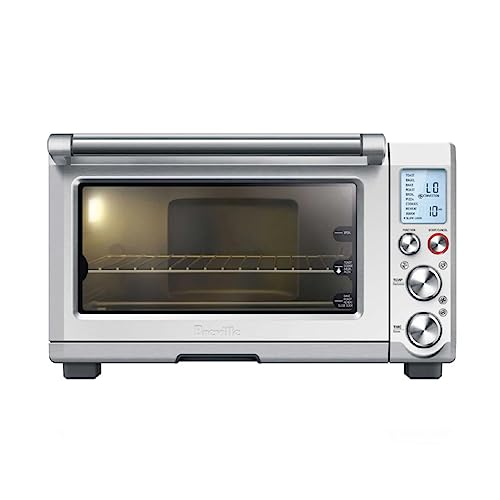
Breville Smart Oven Pro BOV845BSS, Brushed Stainless Steel, 1 Oven
As an Amazon Associate we earn from qualifying purchases.
2. KitchenAid KCO224: useful for 9-by-13-inch sheet cakes
The KitchenAid Dual Convection Countertop Oven with Air Fry and Temperature Probe, model KCO224BM in Black Matte, includes a 9-by-13-inch pan. KitchenAid specifically presents that pan as suitable for sheet cakes. That is a more useful buying signal than a toast-slice count.
The KCO224 manual distinguishes standard Bake from Convection Bake. Both are listed for cakes, but the convection setting runs the fans as well as the heating elements. This gives you a straightforward choice when following a recipe written for conventional heat.
- Pros: included pan with explicit sheet-cake support; separate Bake and Convection Bake functions; interior light.
- Cons: the supplied pan’s fit does not mean your larger-handled glass dish will fit; the temperature probe is designed for meat and other proteins, so it is not a reason to buy this oven for cakes.
Choose it if: a family-size rectangular cake is your priority and you also want the appliance for other meals. Confirm the exact KCO224 model: specifications for KitchenAid’s KCO124 or KCO128 should not be substituted. Check the KCO224 with KitchenAid.
3. Breville Smart Oven Air Fryer Pro BOV900: for larger bakeware
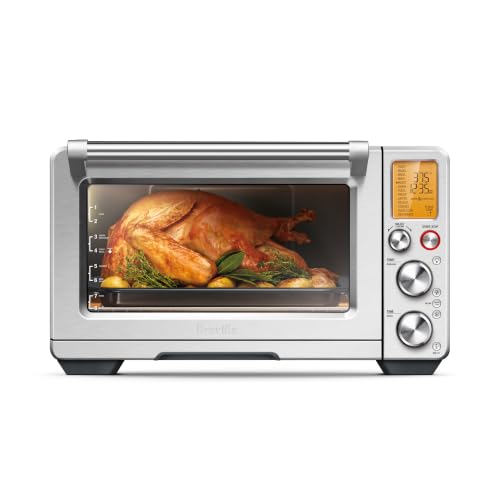
The Smart Oven Air Fryer Pro makes sense when the smaller oven’s pan space is the deciding limitation. Breville specifies a one-cubic-foot interior that accommodates most 9-by-13-inch pans and 12-cup muffin trays. It includes two racks and has an interior light. The reviewed finish is brushed stainless steel, BOV900BSS.
Its manual allows no convection, convection or super convection, and identifies Bake as the cake setting. Air Fry is a different function. Buying this model does not require exposing every cake batter to its strongest fan mode.
- Pros: clearer manufacturer support for common rectangular bakeware; selectable fan settings; useful extra functions if it will serve as a general second oven.
- Cons: measures 21.4 inches wide, 17.3 inches deep and 12.7 inches high; extra functions may be unnecessary for occasional cakes; two racks do not guarantee that two tall cakes can bake together successfully.
Choose it if: you have the counter space and will use its larger cavity. Check the pan and rack configuration before assuming it can replace a full-size oven for birthday-party baking.
How to choose an oven for the cakes you bake
Measure the pan, including its handles
Write down the outside width, depth and height of your most-used cake pan. A nominal 9-by-13-inch measurement often describes the cooking area rather than the outer handles. A 13-inch pizza claim describes a round, relatively flat food and cannot establish clearance for a rectangular dish or tall Bundt pan.
Check space above the pan for the rising cake, the distance from the upper element and whether the door closes normally. Leave the airflow clearance required by the oven maker. If the manufacturer cannot confirm fit from your measurements, choose a returnable option and check with an empty pan before baking.
Prefer control over a long list of presets
For cakes, the useful essentials are an adjustable temperature, a suitable Bake mode, a timer you can extend and a rack position that keeps the top from sitting too close to the element. A light is helpful because you can watch browning without repeatedly opening the door. An app, pizza setting or meat probe is secondary.
Match capacity to your real baking schedule
A single-pan oven can be convenient for a loaf cake or one small birthday cake. If your usual recipe makes two or three layers, decide how you will bake them before buying. Multiple racks add flexibility, but usable vertical spacing and the manufacturer’s multi-rack guidance matter more than the number of racks in the box.
If your existing full-size oven works well, there may be no reason to replace it just for cakes. A countertop model is most compelling when you need another baking space, have a small kitchen or prefer a smaller appliance for modest batches.
Conventional Bake or convection for cakes?
Start with standard Bake for a recipe written for a conventional oven, unless that recipe or your oven’s instructions recommend otherwise. King Arthur Baking’s convection guide recommends fan-off baking for layer cakes, angel-food cakes and loaf cakes. Its more recent convection advice also notes that strong airflow can disturb thin batters.
Convection can work well with an appropriate recipe and adjusted settings. It is not a universal upgrade for every cake. If converting a conventional recipe, check the oven’s instructions and whether it already applies a temperature adjustment before lowering the setting yourself. Check doneness earlier while learning the appliance; do not automatically cut the recipe time by an advertised cooking-speed percentage.
Use a known recipe for the first bake and keep notes on the pan, mode, rack position, temperature and finished result. Change one variable at a time. A cake that browns too quickly on top may need a different permitted rack position or setting, rather than simply more baking time.
Countertop placement and safe bakeware
Read the manual before deciding where the oven will live. The linked Breville manuals specify at least 4 inches of clearance on both sides and 6 inches above. KitchenAid’s setup instructions specify 4-inch spacing around the KCO224. These are operating clearances in addition to the appliance’s footprint; do not squeeze an oven into a tight cabinet opening.
Use a stable, dry, heat-resistant surface and follow the model’s electrical instructions. Keep curtains and other combustible objects clear. Use oven mitts, keep vents unobstructed and let the appliance cool before cleaning. The Breville manuals prohibit covering the crumb tray or oven parts with foil because of overheating risk.
Check both the pan maker’s and oven maker’s instructions for glass, ceramic, silicone and paper products. A dish approved for a conventional oven is not automatically approved for a countertop toaster oven. Use the supplied compatible pan if you are unsure, and never let bakeware or food touch the heating elements.
Frequently asked questions
Can a countertop oven bake a proper cake?
Yes. All three models above have manufacturer-documented cake-baking functions. The important limits are pan fit, usable height and the settings for your recipe. A small cavity does not remove the need to preheat.
Is an air-fryer oven a good choice for cakes?
It can be if it has a suitable Bake mode and enough room for the pan. Buy on those details rather than the Air Fry label. A small basket-style air fryer presents different pan and airflow constraints from the oven-shaped appliances compared here.
Do I need a special cake preset?
No. A controllable Bake function is more useful than a preset name. The recipe still determines the pan, batter amount, temperature and doneness checks.
Which oven is best for a home baking business?
This shortlist covers household appliances. Frequent production, several layers per batch and commercial warranty requirements need a separate assessment. Check the manufacturer’s permitted use and local business requirements before buying a domestic countertop oven for paid production.
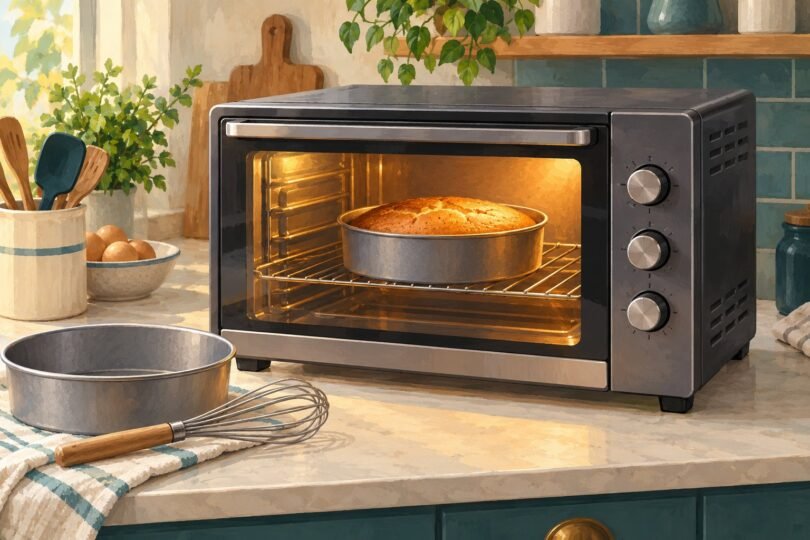
Featured image: AI-generated editorial illustration; not a specific reviewed product.