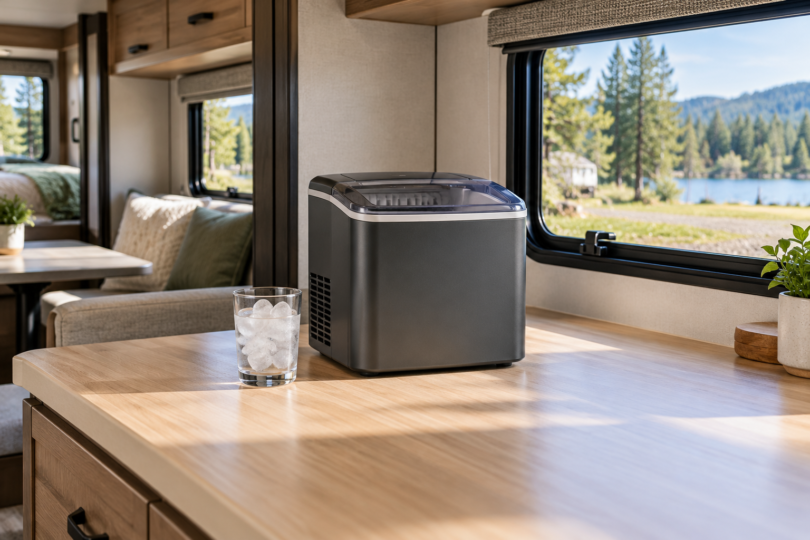

A portable ice maker can be useful in a parked RV when you have suitable AC power, a ventilated counter and a plan for using or freezing the ice. The most useful buying checks are the exact model’s electrical requirements, working space and cleaning routine. A large daily-output number tells you surprisingly little about whether the machine will fit your trip.
Start with this decision: if you only need ice for a few drinks and already have freezer space, a covered ice tray may do the job. If you want repeated batches while staying at a powered campsite, a countertop machine deserves a closer look. For travel without a confirmed power arrangement, plan around the ice you can carry or freeze until you have checked the appliance and power-system requirements.
What makes an ice maker suitable for an RV?
| Your situation | What to prioritize | What to check before buying |
|---|---|---|
| Parked at a campsite with hookups | Counter space, ventilation and accessible cleaning | The appliance label, outlet and circuit capacity alongside other RV loads |
| Using an inverter or portable power station | Electrical compatibility and usable energy | Continuous output, compressor starting requirements and the manufacturer’s permitted supply |
| Very little counter space | Total operating footprint | Side and rear clearances, open-lid height and room to lift out the basket |
| Wanting ice ready later | Separate frozen storage | Freezer capacity and containers for transferring finished ice |
| Occasional drinks on short trips | A simple supply plan | Whether trays or purchased ice meet the need without another appliance |
“Portable” describes something you can move. It does not, by itself, establish that an appliance works from a 12-volt socket, can run outdoors or is approved for operation while the vehicle is moving.
Two documented models show why the exact label matters
The examples below illustrate the specifications worth finding before you order. They are document-based comparisons, not results from hands-on RV testing. Match the full model designation and manual revision to the unit being sold.
Silonn SLIM01B: check the revision before relying on a listing
The Silonn SLIM01W/SLIM01B instruction manual, Rev(02)A, provides these specifications:
| Supply | 115 V, 60 Hz AC |
|---|---|
| Current and working power | 1.7 A during ice making; 2.0 A during harvesting; working power at or below 160 W |
| Water and basket | 2-liter reservoir; 1.32-pound ice basket |
| Published output | 26 pounds per day; small or large bullet ice |
| Placement | Indoor household use. The safety section specifies at least 3 inches at the sides and back; troubleshooting calls for 6 inches on all sides. Plan for the larger clearance. |
| Temperature guidance | Room: 10–32°C (50–90°F, rounded). Troubleshooting water range: 8–25°C (46–77°F, rounded). |
| Cabinet dimensions | Not stated in this manual; confirm the exact revision’s dimensions before ordering. |
The manual calls for 24 hours upright before first use, drinking water, discarding the first four ice cycles, weekly cleaning and draining and drying for extended storage. Its self-clean cycle takes 30 minutes; manual cleaning is also described.
There is an unresolved buying caveat: the Amazon page associated with SLIM01B mixes a 26-pound title with a 26.5-pound selected variation and links a manual naming other suffixes. Those details are not interchangeable. Ask the seller for the rating-label photo and matching manual rather than assuming every black Silonn machine has the specifications above.
Frigidaire EFIC189-SILVER: compare the manual with the selling page
Curtis International’s Frigidaire EFIC189 product page identifies the silver model by UPC 058465817718. It advertises up to 26 pounds daily, a 2.3-quart reservoir and roughly 1–1.5 pounds in the collection bin. Its linked family manual explicitly includes EFIC189-SILVER:
| Supply and rated power | 120 V, 60 Hz; 105 W. Operating current and starting surge are not stated. |
|---|---|
| Manual dimensions, depth × width × height | 310 × 230 × 325 mm, approximately 12.2 × 9.1 × 12.8 inches |
| Placement | Indoor use on a dry, level surface; about 6 inches of ventilation clearance on all sides |
| Temperature guidance | Recommended room range in troubleshooting: 10–32°C (50–90°F, rounded); do not operate below 5°C (41°F). |
| Water and upkeep | Drinking water below the maximum line; no hot water. Weekly cleaning, then draining and drying for prolonged storage. |
| Frozen storage | The manual explicitly says the machine does not keep ice frozen. |
The manual’s dimensions differ from the Amazon page’s 15 × 11 × 14.5-inch dimensions; the listing also gives 200 W and combines EFIC189/EFIC206 in its model field. Treat those as unresolved discrepancies. Get the actual unit label and measurements before committing scarce RV counter space or sizing a power supply.
Measure the working footprint, not just the box
Make a cardboard template of the appliance’s confirmed base dimensions. Add the clearances specified in its manual, then check whether the lid opens fully without hitting a shelf. Leave enough room to remove the basket and access the drain without lifting a full machine over other equipment.
For example, a machine that is 9 inches wide with 6 inches of clearance on each side needs about 21 inches of clear counter width. That is a planning example, not a dimension claim for an unverified model. A narrow storage cubby is not necessarily a suitable operating location.
Also decide where the drained, dry appliance will travel. Include its weight in your packing plan and follow its transport and upright-rest instructions. Do not infer permission to run it during driving from photographs of it in a camper.
Power planning: watts, amps and battery energy answer different questions
Use the appliance’s actual label and matching manual when checking an RV power system. Rated watts describe power demand under the stated conditions. Amps relate to the electrical supply. Watt-hours describe energy used over time. None of those figures alone tells you a compressor’s starting requirement.
A calculation can help with planning: an appliance averaging 120 W for four hours uses 480 Wh before inverter losses. That is an illustrative average, not measured consumption for either model above. Actual use depends on cycling, conditions and how often you stop the machine. Do not turn a daily ice-production claim into a battery-runtime promise.
For an inverter or power station, confirm the supported voltage and frequency, continuous and starting capability, and the appliance manufacturer’s supply requirements. Include the other appliances sharing that system. If the necessary starting information is unavailable, ask the manufacturer before choosing the power equipment.
Daily output is not the amount waiting in the basket
Think of the daily figure as production over many cycles. It is not a promise that a full day’s ice will be ready when you lift the lid. The much smaller basket needs attention, and water needs replenishing. First-batch timing also does not tell you how long it takes to prepare enough ice for a cooler.
Plan separately for keeping the finished ice. The Frigidaire manual directs owners to transfer it to a freezer. For any other candidate, require explicit documentation before treating its basket as refrigerated storage. An ice maker is a poor solution to a freezer-space problem if you want to stockpile ice.
Make cleaning practical in a small kitchen
Before ordering, look at the drain location and the removable parts. Can you empty the reservoir where you will actually use the machine? Can you reach the areas the manual says to clean? Is the required cleaning process realistic with your water supply and sink?
A self-clean button is a feature, not evidence that a machine disinfects water or eliminates maintenance. Follow the exact model’s cleaning instructions and use a suitable drinking-water supply. Avoid transferring chemical recipes or button-hold times from a visually similar model.
A short pre-purchase checklist
- Obtain the full model suffix, a rating-label photo and its matching manual.
- Resolve conflicting dimensions, electrical ratings or package descriptions with the seller.
- Check the complete counter footprint, lid movement and drain access.
- Confirm indoor operating conditions and the intended power supply.
- Decide how much ice you need at once and where unused ice will stay frozen.
- Check the return terms for a machine that does not fit or match its description.
For an RV, a well-documented machine that fits your actual setup is more useful than a longer list of nominally portable products. If a seller cannot resolve a model or electrical mismatch, choose a different documented option or use trays or purchased ice for that trip.