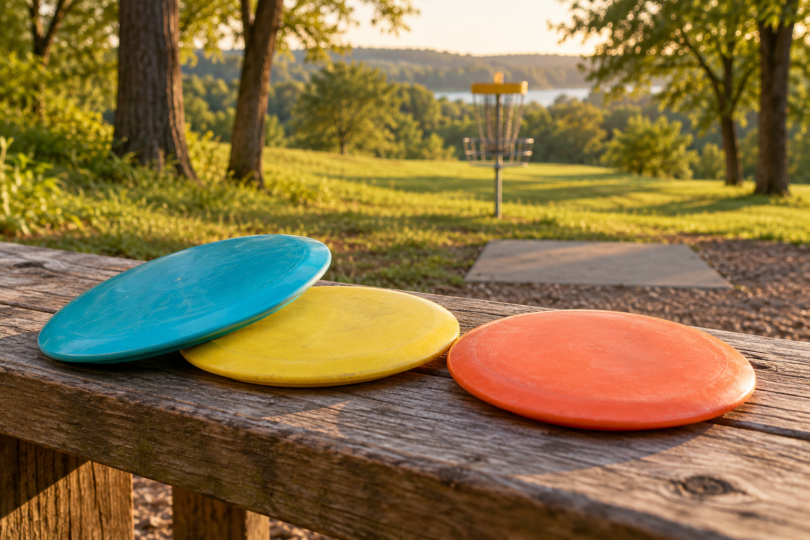

The Innova DX Leopard is our starting pick for a beginner’s first disc golf driver. Its speed-6 design is a manageable step up from a mid-range. The Latitude 64 Opto Diamond is a lightweight alternative for slower throws, the Opto River suits a developing player who wants a durable fairway driver, and the Innova DX Dragon adds a manufacturer-specified floating option.
These picks are based on manufacturer specifications, beginner guidance and identified buying configurations. They are not hands-on distance-test winners. Buy one driver that fits your throw and learn it alongside a putter and mid-range; you do not need all four to start.
Best beginner disc golf drivers at a glance
| Disc and selected plastic | Recommended buying configuration | Speed / glide / turn / fade | Best fit |
|---|---|---|---|
| Innova Leopard, DX | 145–150g, colors vary, one disc | 6 / 5 / -2 / 1 | A lightweight first fairway driver |
| Latitude 64 Diamond, Opto | 155–159g, turquoise, one disc | 8 / 6 / -3 / 1 | Slower throws needing an understable option |
| Latitude 64 River, Opto | 165–169g, turquoise, one disc | 7 / 7 / -1 / 1 | A durable option for developing control |
| Innova Dragon, DX | Manufacturer’s 150–160g range, one disc; choose color | 8 / 5 / -2 / 2 | A lightweight driver designed to float |
Numbers are each manufacturer’s flight ratings, not standardized cross-brand measurements or promised distances. A higher speed number does not make a disc travel farther for every thrower. Plastic, wear, release angle, throwing speed and wind can all change the result.
1. Innova DX Leopard: best first-driver starting point
The Leopard is a speed-6 fairway driver with a 1.6cm rim and ratings of 6 / 5 / -2 / 1. Innova recommends it for newcomers and includes it among its beginner-friendly molds. Our linked configuration is DX plastic, 145–150g, one disc, colors varying.
Why choose it: its lower speed requirement makes it a sensible first experiment with a driver, and DX is Innova’s entry-level plastic. The lightweight configuration is a useful starting point for a lower-power thrower. For a heavier alternative, the Innova Factory Store also lists separate weight bands, including 160–164g and 165–169g.
Tradeoff: DX changes flight as it wears more quickly than Innova’s premium plastics. Learn how your own disc behaves after impacts rather than expecting it to stay identical indefinitely. Also check the mold name: a Leopard3 is a different disc, and a Star or Champion Leopard is a different plastic configuration.

Innova DX Leopard Disc Golf Fairway Driver, 145–150g, One Disc, Colors Vary
As an Amazon Associate we earn from qualifying purchases.
2. Latitude 64 Opto Diamond: best lightweight understable option
Choose the Opto Diamond in 155–159g if you want a lightweight driver designed around developing players and slower arm speeds. Its manufacturer ratings are 8 / 6 / -3 / 1. Within Latitude 64’s range, the stronger negative turn rating distinguishes it from the less turn-prone River.
Why choose it: the Diamond pairs that understable design with Opto, Latitude 64’s durable translucent plastic. The selected maker link is for one turquoise disc in the 155–159g band. The stated band is not a promise of an exact 157g disc, and the manufacturer says shades and foil stamps can vary.
Tradeoff: understable does not mean impossible to fade or automatically straight. At too little speed it can still finish early; with more speed or a different release it can turn farther than expected. This is a deliberate lightweight choice, not a recommendation to replace it with a heavier Diamond or a different plastic merely because the mold name matches.
View the Opto Diamond, turquoise, 155–159g at Latitude 64.
3. Latitude 64 Opto River: best for a developing fairway game
The Opto River in 165–169g is the pick for a beginner whose controlled throws are already progressing. Latitude 64 rates this fairway driver 7 / 7 / -1 / 1. Its high glide rating describes its intended ability to stay aloft; it does not guarantee more distance than another disc.
Why choose it: Opto is intended to stand up to repeated course use, and the River offers another manageable fairway-speed option. The selected configuration is one turquoise disc in the 165–169g band. It is a more substantial-weight choice than the Diamond above.
Tradeoff: its milder turn and heavier selected weight can make it less accommodating for the slowest throws. Start with the Leopard or Diamond if you are struggling to get a driver to carry forward. This recommendation is specifically Opto River; the Retro Burst River uses a different, more readily worn-in plastic.
View the Opto River, turquoise, 165–169g at Latitude 64.
4. Innova DX Dragon: best when flotation matters
The DX Dragon is a lightweight fairway driver that Innova says floats in water. The current manufacturer specification gives a 150–160g range and ratings of 8 / 5 / -2 / 2. Choose this specific DX version if flotation is the reason for buying it.
Why choose it: it gives a developing player a driver designed for lighter-weight use, with flotation as a practical extra on courses with water. The linked full-production listing is for one DX Dragon; it lets you choose a color but does not offer an exact gram selection.
Tradeoff: the Dragon is faster and has more rated fade than the Leopard, so it is not our default first pick. A floating disc can still drift beyond reach. Follow course rules and retrieve it only when safe; flotation is not a guarantee you will recover it.
Check the weight description before ordering: some retailer listings still describe a 145–150g version. The manufacturer route below is the current 150–160g specification, rather than a promise that those listings are the same package.
View the full-production DX Dragon at the Innova Factory Store.
How to choose your first disc golf driver
Start with controllable speed
A distance driver with a high speed number may need more power than you can currently supply. The fairway drivers here sit at speeds 6–8. If your putter or mid-range goes just as far with better control, keep using it while you learn. Innova’s beginner guidance recommends learning a small number of lighter discs instead of trying many high-speed models.
Use flight numbers as guidance
The four numbers are speed, glide, turn and fade. Turn describes the early part of the intended flight; fade describes the finish as the disc slows. For a right-handed backhand throw, negative turn generally indicates a tendency to move right and fade a tendency to finish left. Those directions reverse for a left-handed backhand or right-handed forehand.
Innova’s flight-rating explanation cautions that ratings do not describe an exact flight and should not be treated as directly comparable between manufacturers. Use them to narrow your options, then learn the particular disc with your normal throw. No number guarantees a certain number of feet or metres.
Choose the weight and plastic deliberately
“Leopard” or “River” alone is not a complete buying specification. Check the plastic, gram range and whether the listing is one disc or a set. The lightweight Leopard and Diamond selections are starting options for lower-power throws; the selected River is heavier. There is no single correct weight for every beginner.
DX is a useful entry point, with wear changing its flight relatively quickly. Opto emphasizes durability. A premium plastic is not automatically easier to throw, and a replacement in a different plastic or weight may not fly like your old disc. Choose a visible color when the seller offers that option, and treat manufacturer product photographs as representative when colors or stamps vary.
Make the first practice sessions useful
Try the same disc repeatedly in a clear, open area in mild conditions before judging it. Compare comfortable, controlled throws instead of only your hardest effort. Understable discs are sensitive to speed and wind, so one difficult headwind session does not establish that you chose the wrong mold. Check that the landing area is clear before throwing.
Which beginner driver should you buy?
Start with the DX Leopard if you want a straightforward first fairway driver. Pick the Opto Diamond for a lightweight, more understable option, or the Opto River when you want the heavier durable-plastic configuration as your control develops. Make the DX Dragon a specific flotation choice. One suitable driver and regular practice are more useful than a large mixed pack with unclear molds and weights.
Frequently asked questions
What is the best disc golf driver for a complete beginner?
The Innova DX Leopard is our starting recommendation because it is a speed-6 fairway driver that Innova recommends for new players. The linked version is one 145–150g DX disc with colors varying. The Opto Diamond in 155–159g is another useful option for slower throws.
Will a higher-speed disc make me throw farther?
Not necessarily. A faster driver needs enough throwing speed to produce its intended flight. A controllable fairway driver, mid-range or even putter can work better while you develop technique. Flight numbers do not guarantee distance.
What weight should a beginner choose?
There is no universal weight. The selected Leopard is 145–150g and the Diamond is 155–159g for a lightweight starting point. The selected Opto River is 165–169g for a developing player. Choose a stated weight band that suits your comfortable throw rather than automatically buying the heaviest option.
Are flight numbers comparable across every brand?
No. Manufacturers use similar labels but do not provide a standardized cross-brand flight test. Treat speed, glide, turn and fade as guidance for intended flight. Your throwing speed, release, disc plastic, wear and conditions affect the actual result.
Does every Dragon disc float, and can I choose its exact weight?
The flotation recommendation here applies to the DX Dragon described by Innova, whose current listing gives a 150–160g range. The linked full-production page offers color selection but no exact gram selector. Do not extend the flotation claim to another plastic or assume a floating disc will be safely recoverable.