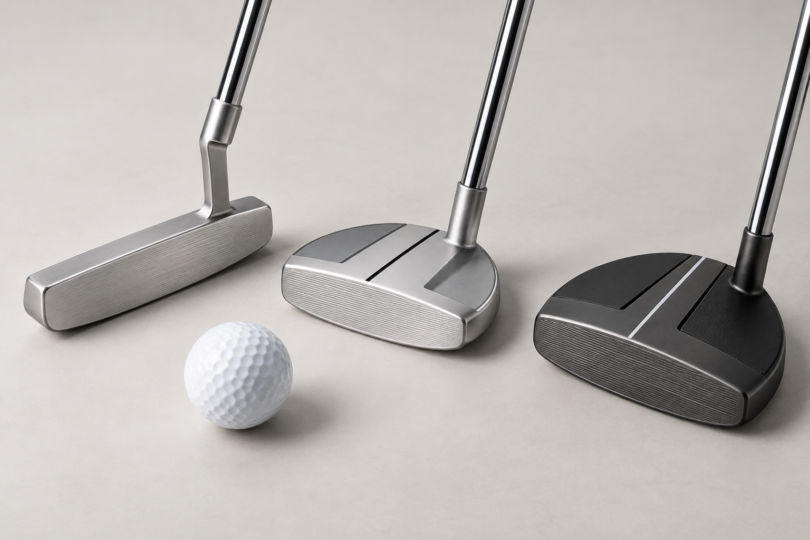

The best putter for a mid handicapper is the one that fits the player’s setup and stroke. Handicap alone does not tell you whether you need a blade, a mallet or a particular length. These four putters give you useful designs to compare: a traditional Cleveland blade, an Odyssey alignment-focused mallet, a TaylorMade Spider and a Wilson mallet with a milled face.
Use this shortlist to decide what to try and which exact version to buy. The comparisons below use documented specifications and design features, not a shared putting test or a promise to lower your score.
Best putters for mid handicappers at a glance
| Putter | Best reason to try it | Key specification | Check before buying |
|---|---|---|---|
| Cleveland HB SOFT 2 Model 1 | Traditional blade shape and a single alignment line | Plumber’s neck, moderate toe hang; 34 or 35 inches | Silver Model 1, correct hand and length; not HB SOFT 2 Black |
| Odyssey Microhinge Seven DB | Contrasting silver-and-black alignment with an insert face | Double bend, 0° toe hang; 33, 34 or 35 inches | DB rather than Seven S; manufacturer lists right hand only |
| TaylorMade Spider Tour Double Bend | A large, high-MOI mallet design with True Path alignment | Face-balanced double bend; 34 or 35 inches | Gunmetal Spider Tour DB, not small slant or counterbalance |
| Wilson Infinite Buckingham | A large mallet with a double-milled face and three alignment lines | Steel shaft, midsize grip; 34 or 35 inches | WG1P0347 family; choose hand and length |
1. Cleveland HB SOFT 2 Model 1: best traditional blade option
The silver Model 1 pairs a plumber’s neck with moderate toe hang and one alignment line. Cleveland positions it for a slight-arc stroke. Its 355-gram head has a variable groove-milling pattern, which the manufacturer designs to manage ball-speed differences across the face.
Choose it for: a compact, familiar blade view at address. Limit: it offers less visual framing than the mallets here, and its stroke recommendation is a starting point for fitting. The stock 35-inch build includes a 20-gram counterbalance weight; it is not simply the 34-inch build with extra shaft length.

Cleveland HB SOFT 2 Model 1 Putter, Silver, Right Hand, 34-inch
As an Amazon Associate we earn from qualifying purchases.
Choose the Cleveland HB SOFT 2 Model 1 hand and length. Stock specifications list right- and left-handed 34- and 35-inch options.
2. Odyssey Microhinge Seven DB: best for contrasting alignment
The Microhinge Seven DB combines a fang-style mallet shape with silver-and-black Versa alignment and a Microhinge insert. The manufacturer’s specification table lists a 360-gram head, 0° toe hang and a three-quarter-shaft offset. The standard lengths are 33, 34 and 35 inches, in right hand only.
Choose it for: trying a prominent alignment pattern and insert face in a face-balanced mallet. Limit: the contrast and shape are personal preferences, not guarantees of better aim. Seven S is a different hosel configuration, so do not substitute it for the DB just because both have “Seven” in the name.

Choose the Odyssey Microhinge Seven DB length. Verify the selected shaft and grip before ordering.
3. TaylorMade Spider Tour Double Bend: best large-mallet shortlist pick
The gunmetal Spider Tour Double Bend uses True Path alignment, a white Pure Roll insert and a damper behind the face. TaylorMade describes the structure as a high-MOI design intended to resist twisting on off-center contact. The double-bend model is face-balanced; the small-slant version has a different toe-hang specification.
Choose it for: a substantial mallet footprint and an alignment shape that frames the intended line. Limit: the larger head may look distracting if you prefer a blade. A forgiving head design still needs the right length, lie and delivery. This pick is the standard-length gunmetal model, not a counterbalanced or torched-finish variant.

Compare Spider Tour TP Double Bend options at Golf Galaxy. That listing offers right-hand 34- and 35-inch selections with the SuperStroke Pistol GT 1.0 grip.
4. Wilson Infinite Buckingham: best large mallet with a milled face
The Buckingham offers another way to compare a large mallet with the insert-faced Odyssey and TaylorMade. Wilson specifies a double-milled face, a two-tone PVD anti-glare finish, a midsize no-taper grip and three parallel alignment lines with a thicker center line.
Choose it for: trying a milled face and multi-line alignment in a large head. Limit: this is not the compact look of a blade, and a grip described as reducing wrist movement cannot guarantee that outcome for every player. Try the grip and head together before committing.

Choose the Wilson Infinite Buckingham hand and length. The right-hand 34-inch SKU is WG1P03470134; Wilson also lists right-hand 35-inch and left-hand 34- and 35-inch versions.
How to choose between these putters
Begin with length and lie, not the name on the head. Your normal address position should let you hold the club comfortably with the sole sitting appropriately on the ground. PGA professional Christopher Foley’s fitting guide explains why length, lie, loft and offset all matter. A fitting can assess these together instead of choosing a standard length solely from a height chart.
Next compare balance and appearance. The Cleveland is the toe-hang blade in this group; the Odyssey DB and Spider DB are explicitly face-balanced. Those specifications help you organize a trial, but they do not replace checking how you deliver the face. The PGA’s putter-selection guide also highlights stroke, head shape, length and grip as separate decisions.
When trying a putter, use the same ball and alternate short starting-line putts with longer pace-control putts. Notice whether you can aim comfortably, find the center and judge distance without changing your normal setup. Do not buy on the strength of one holed putt. If an existing putter fits well, compare it directly before paying for a replacement.
Finally, match the exact head, hosel, hand, length, grip and shaft on the order. A family name can cover materially different builds. Compare delivered prices only after those choices match, and check the seller’s return conditions before relying on an at-home trial.
Frequently asked questions
Does a mid handicapper need a mallet putter?
No. A mallet is worth trying for its head shape and alignment features, but handicap alone does not establish fit. A toe-hang blade such as the Cleveland Model 1 can also belong on the shortlist if its setup and stroke characteristics suit you.
Are face-balanced putters always better?
No. Face balance describes a design characteristic, not a universal performance ranking. Compare it with toe-hang options and assess your actual stroke. The Odyssey Seven DB and Spider Tour DB are face-balanced; their differently named slant-neck relatives should not be treated as identical.
Should I choose a 34- or 35-inch putter?
Choose the length that fits your address position and works with the correct lie angle. Both are common stock options, but neither is right for every golfer. A fitter can also check whether the head and grip weighting suit the selected length.
Is an insert face better than a milled face?
Not automatically. The Odyssey and TaylorMade use inserts, while the Cleveland and Wilson choices have milled face patterns. Compare feel and pace control with your usual ball. The construction label alone cannot establish which you will putt with best.
Will a new putter lower my handicap?
There is no guaranteed score improvement. A suitable putter can support a comfortable, repeatable setup, but green reading, pace judgment and practice still matter. Buy to address a fit or preference you can identify, rather than expecting the model name to solve every putting problem.