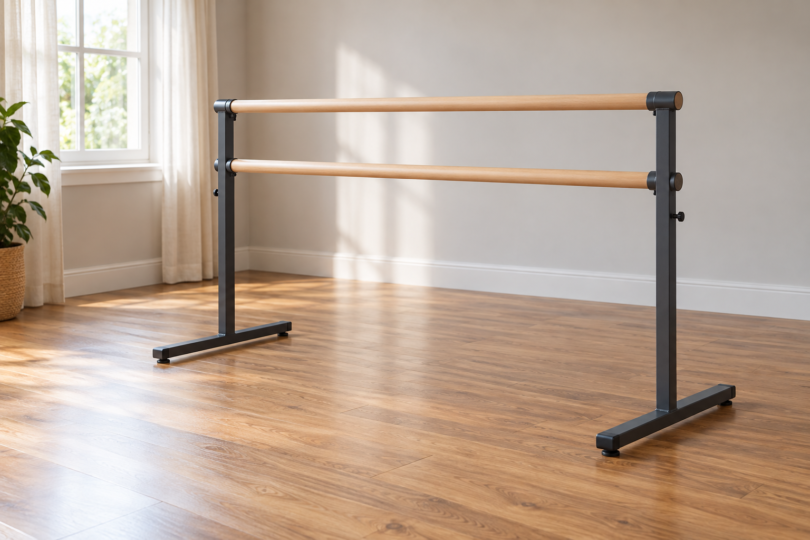

For a home ballet barre, start with the four-foot Vita Prodigy double barre if adjustable rail heights are the priority. Compare the Booty Kicker BK2000 if a fixed-height wooden rail and a frame that folds down better suit your routine. Both are freestanding; their permitted uses differ.
These picks are based on manufacturer specifications and assembly instructions. We have not performed stability or load tests. Choose for the movements you plan to practise, the height you need and the space you can clear, rather than treating every portable barre as interchangeable.
Compare the two home barres
| Selected barre | Dimensions and adjustment | Main tradeoff |
|---|---|---|
| Vita Prodigy Modern Aluminum Double, BD48, four-foot | Rails adjust from 6–46 inches; feet span 28 inches; listed weight 11 lb | Balance support; maker excludes full-body-weight loading and strenuous pushing/pulling |
| Booty Kicker BK2000, white, standard unassembled unit | About 37 inches high × 38 wide × 34 deep; fixed rail height | Folds down; separate dumbbells needed for weighted-rack setup |
1. Vita Prodigy double barre: for adjustable ballet practice
The BD48 version has two four-foot aluminum rails with 1.5-inch diameters. Both rail heights adjust between 6 and 46 inches, and the maker lists an 11-pound weight. That is useful when you want two different working heights without moving the same rail between exercises.
Allow for the 28-inch feet as well as the rail length and your movement space. The feet pivot sideways for storage; the structure does not hinge down like the Booty Kicker. Assembly uses hand-knob clamps without tools, and the optional carry bag is a separate choice.
The important limit is intended use. Vita says its freestanding ballet barres provide balance support and are not designed to bear full body weight or withstand strenuous pushing and pulling. Do not use the Prodigy as a crutch or assume it is a suspension or pull-up station. For those fitness movements, ask the maker about equipment specifically designed for the load.
The setup guide requires centered, vertical uprights and securely tightened clamps. Check every clamp before use and follow the instruction to have someone nearby. This four-foot size is generally intended for one person, according to Vita’s FAQ. See the four-foot Prodigy double barre.
2. Booty Kicker: for a folding frame and fixed wooden rail
The standard Booty Kicker has a steel frame, wooden barre and weight racks; dumbbells are not included. Its rail is approximately 38 inches wide and 1.75 inches in diameter, with the top 37 inches above the floor. Select white for the version compared here, and check that height before buying because this is not a height-adjustable rail.
The assembled unit is about 38 inches wide and 34 inches deep. Folded, the maker lists a height of five inches with the weight racks or three inches without them. The storage advantage comes with a setup obligation: remove weights before moving it, mind the hinge pinch points and secure the folded uprights and base legs with the two straps.
The maker’s FAQ gives a maximum of 250 pounds straight downward. That is not a rating for every direction or movement. Its manual warns that pushing or pulling can tip the unit and that rack weights affect stability; it prohibits gymnastic movements. Match your exercises and any ballast setup to the complete instructions rather than interpreting the downward figure as permission to hang from the barre.
Read the BK2000 use and assembly instructions before assembly. Work on a flat, level hard floor, follow the specified order and leave hardware loose until the prescribed final-tightening stage. The instructions require checking for loose hardware and damage before every session. See the standard Booty Kicker.
Choose by height, floor space and intended movement
Choose the Prodigy when adjustable heights are essential. Choose the Booty Kicker when its 37-inch height fits you and folding storage is more useful. Neither the four-foot rail length nor a compact folded size tells you how much clear floor space you need for your actual movements. Measure with the feet and base in their working positions.
Before following a workout, check whether it asks you to rest a hand for balance or to pull against the barre. The Prodigy’s stated purpose is balance support. The Booty Kicker accommodates specified pushing/pulling exercises, but its manual still warns about tipping and forbids gymnastics. Follow its rule to use the wooden rail, rather than the metal uprights or base legs, as the exercise contact surface.
Keep the assembly instructions with the equipment. Recheck clamps or hardware each time, including after storage or adjustment. Stop using the Booty Kicker if you find cracks or damage. These are buying and equipment-use checks; they do not establish that a barre will prevent falls or serve as rehabilitation equipment.
Frequently asked questions
Does a heavier load rating mean the barre is safe to hang from?
No. The direction of force and the permitted exercise matter. Booty Kicker’s 250-pound statement is for straight-down loading, while its manual prohibits gymnastics. Vita explicitly says its freestanding ballet barres are not designed to carry full body weight.
Which one stores flat?
Booty Kicker hinges down and must be secured with its straps after folding. Prodigy’s feet pivot parallel to its rails; it does not fold at a hinge. Compare those arrangements with the space where you plan to store the barre.
Can two people share the four-foot Prodigy?
Vita generally recommends a four-foot barre for one person. Its two adjustable rails offer different height choices; they do not automatically make the four-foot model a two-person station.