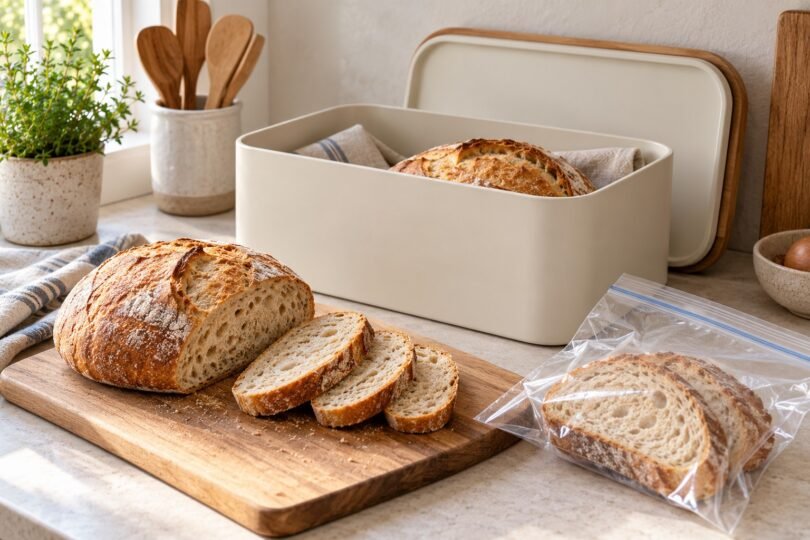

The right bread storage depends on the loaf and how quickly you will eat it. A bread box tidies the counter and protects bread from being crushed; a bag helps control moisture loss; freezer wrapping is the useful choice for bread you cannot finish soon. Buying a larger box does not, by itself, make bread last longer.
For a roomy countertop box, consider Brabantia’s 18-liter Fall Front model. For a storage bin with a cutting-board lid, look at Joseph Joseph’s white Bread Bin. For portioning and freezing, King Arthur’s All-Purpose Bread Bags offer a different kind of storage. These choices serve different routines, so start with your bread rather than a freshness promise.
Choose the storage method before the container
Packaged sandwich bread
Start with the instructions on the wrapper. Keep the original bag closed between uses, and do not assume every commercially packaged loaf has preservatives or the same storage life. A bread box can hold the wrapped loaf, but it does not replace the package’s directions.
For example, Dave’s Killer Bread recommends room-temperature storage away from heat, sunlight and high moisture. For longer storage, it recommends a second bag around the original bag, tightly sealed in the freezer, with slices thawed as needed. That is advice for its bread, not a guarantee for every brand.
Homemade and bakery bread
Let a freshly baked loaf cool completely before wrapping it. For a soft crumb, a well-closed food-storage bag or wrap helps retain moisture, although a crisp crust will soften. Leaving bread exposed or using a breathable cloth trades moisture retention for airflow; it is not automatically the better choice.
King Arthur’s bread-storage guide explains that wrapping, bread style and temperature all affect the result. A large crusty boule and a sliced sandwich loaf will not behave alike. With a homemade or preservative-free loaf, keep out only the amount you expect to use soon and freeze the rest while it is still in good condition.
Freezer or refrigerator?
For ordinary bread that does not require refrigeration, freezing is generally the better longer-term choice for eating quality. Refrigeration can slow mold in a hot, humid kitchen, but it also speeds the loss of a pleasant bread texture. Follow any refrigeration requirement on the product or recipe, especially for breads with perishable fillings.
The extension guide’s bread-storage section recommends cooling bread, wrapping it closely in suitable freezer packaging, sealing it and labeling the package. Divide a loaf into useful portions so you can remove what you need. Ordinary countertop cloth bags and decorative bread boxes are not substitutes for freezer wrapping.
Bread storage options worth comparing
Brabantia Fall Front Bread Box, White: for a roomy counter
The white Fall Front Bread Box, SKU 236785, is a steel box with a listed capacity of 18 liters. Its external measurements are 46.5 cm wide, 25 cm deep and 18.7 cm high, approximately 18.3 by 9.8 by 7.4 inches. Brabantia describes it as holding two loaves, but that depends on their shape and size.
The front drops open, leaving the flat top available for countertop organization. Its magnetic closure and textured bottom are distinct features: the maker describes the bottom as helping airflow. Neither feature establishes an airtight or mold-proof storage environment.
Choose it if: you want a broad, low box and can leave room in front for the door. Check first: the dimensions of your usual wrapped loaf and the supplied cleaning directions. The listed measurements describe the outside, not guaranteed usable interior space; do not infer dishwasher suitability from its steel construction.
Joseph Joseph Bread Bin with Bamboo Lid, White: for a shared storage and slicing space
The white Bread Bin, SKU 81097, measures 37 cm wide, 22 cm deep and 18 cm high. Its bamboo lid reverses into a cutting board with crumb-catching grooves, and the bin has a non-slip base.
The care requirements matter: wash and dry both parts by hand, do not soak the lid, let it dry fully before storage, and maintain the bamboo with food-safe mineral oil. The maker specifies dry-food use. Its current product page does not publish a liter capacity or adjustable ventilation setting, so avoid treating it as a humidity-controlled keeper.
Choose it if: using the lid as a bread board would simplify your routine. Check first: clearance to lift the lid and a clean place to set it while you reach inside. This is a less convenient choice if you want every part to go into the dishwasher.
King Arthur All-Purpose Bread Bags: for flexible portions
All-Purpose Bread Bags, item 201497, come as a set of 100 food-safe plastic bags. King Arthur identifies them for storing bread and other baked goods and for freezing. Clips and twist ties are not included.
They are a useful alternative when a rigid box would spend most of its time empty, or when you bake batches and divide them for the freezer. The product description says they can cover a 9-by-13-inch pan, but that is a use example, not an exact bag measurement or a promise that any loaf fits.
Choose them if: flexible packaging fits your baking routine. Check first: bag dimensions and how you will close them. The maker describes reuse but does not specify washing instructions on the product page; do not assume dishwasher, microwave or oven suitability. Use clean, intact packaging and replace it when damaged or soiled.
Measure the loaf, the opening and the workspace
Measure your bread in the wrapper you actually use. A tall bread-machine loaf may fail to fit a shallow bin despite its generous liter capacity; a wide round loaf may be awkward in a narrow rectangular box. Leave enough space to lift the bread without squeezing it.
Check the opening direction as carefully as the footprint. A lift-off lid needs overhead and landing space. A fall-front door needs clear counter space in front. If you want to keep a bread knife nearby, provide separate safe storage instead of letting it sit loose beside the loaf.
Ventilation is a design feature, not a freshness timer. Room conditions, the recipe, wrapping and handling all matter. Remove crumbs regularly, clean according to the exact model’s instructions and let the container dry before replacing food. Keep the box away from splash zones and cooking heat.
What to do if bread develops mold
Discard moldy bread rather than cutting away the visible spot. USDA guidance identifies bread and baked goods as porous foods that may be contaminated below the surface. Do not sniff a moldy loaf. Clean the storage location and check food it may have touched before putting a new loaf in the same space.
A practical setup is often simple: a closed bag for the bread you are using, a suitably sized box if you want counter organization, and freezer-ready portions for the remainder. Choose capacity and cleaning convenience over an unsupported promise of a fixed number of fresh days.