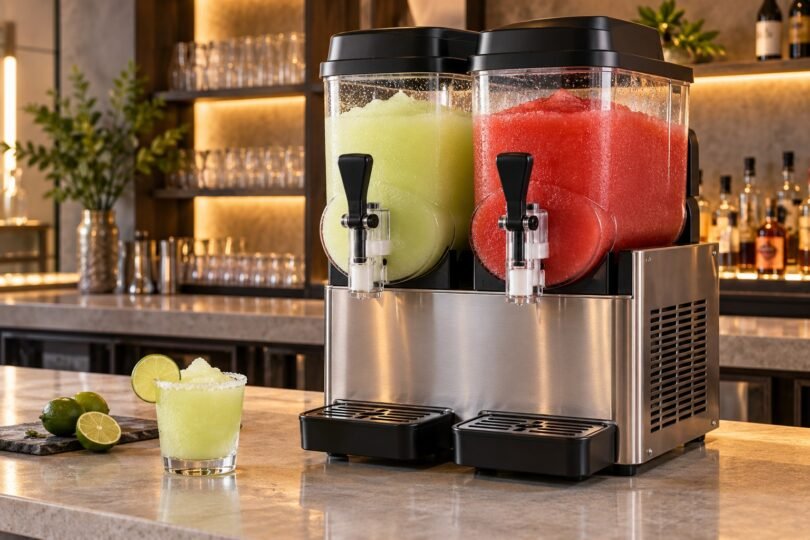

A commercial margarita machine should match your busiest service period, electrical supply, available counter space and cleaning routine. For a bar or restaurant, start with a documented commercial frozen-beverage dispenser and an approved recipe. A large home blender, an ice shaver and a refrigerated juice dispenser perform different jobs.
Two useful starting points are the BUNN Ultra NX 58000.0010 for two separately dispensed flavors and the Frosty Factory 127A for a single frozen-drink flavor from a freezing cylinder. Their capacities and performance specifications are expressed differently, so compare the actual service requirements below before choosing.
What type of machine do you need?
| Equipment type | Best matched to | What it does not establish |
|---|---|---|
| Refrigerated bowl-style frozen dispenser | A visible supply of premixed drinks, often with separate bowls for different flavors. | Bowl volume does not tell you how quickly a fresh refill will freeze. |
| Freezing-cylinder cocktail machine | Repeated dispensing of a planned frozen-drink recipe, with mix feeding a freezing cylinder. | Hopper capacity is not all immediately frozen, ready-to-serve product. |
| Commercial bar blender | Made-to-order drinks and frequent recipe changes. | A blender does not hold a batch frozen for dispensing; ice supply and staff time are part of the workflow. |
| Home frozen-drink maker or ice shaver | Household entertaining when the exact model permits that use. | “Professional,” a high wattage or a large pitcher does not prove commercial suitability. |
A chilled juice dispenser also should not be substituted for a slush freezer. Check the manufacturer’s stated function and operating range, not just whether a retailer calls it a drink machine. Margarita Girl, for example, separates its residential mini machines from its commercial range. Similar branding does not make the models equivalent.
Two commercial models to compare
The following specifications refer to the named U.S. configurations. Confirm the data plate, current manual and actual order before arranging electrical work or delivery.
| Specification | BUNN Ultra NX 58000.0010 | Frosty Factory 127A |
|---|---|---|
| Format | Black, manual-fill, two-bowl frozen beverage dispenser | Air-cooled, single-flavor freezing-cylinder machine |
| Capacity | Two 3-gallon hoppers | 16-quart hopper and 7-quart freezing cylinder |
| Published output | No cups-per-hour figure in the reviewed current specification sheet | Manufacturer states up to 160 ten-ounce servings per hour |
| Electrical configuration | 120 V, 12 A, single phase, 60 Hz | Standard 115 V, 12 A, single phase, 60 Hz; other configurations exist |
| Plug and circuit | NEMA 5-15P; installation manual specifies an individual grounded 15 A branch circuit and NEMA 5-15R receptacle | Current Model 127 sheet lists NEMA 5-15 for 115 V and a 20 A circuit breaker; verify the exact unit with the installer |
| Listed dimensions, H × W × D | 32.4 × 16.6 × 26.4 inches | 28 × 12 × 26 inches |
| Sanitation information | BUNN lists NSF 18 and NSF 6 (Dairy) | The linked Model 127 sheet displays NSF and UL marks; confirm the exact ordered configuration and local acceptance |
See the BUNN model page, its current specification sheet, and the Frosty Factory 127A page for model details. The BUNN sanitation claims above are manufacturer-published information, not a determination that a particular installation will be approved locally.
BUNN Ultra NX: a two-flavor starting point
The 58000.0010 is worth investigating when two separate drink flavors and visible bowls suit your service. Its six gallons of combined hopper capacity should not be described as six gallons per hour. The current specification sheet leaves the output field blank, so ask the equipment supplier to demonstrate the required recovery rate with your recipe and serving pattern.
Confirm the exact suffix when ordering. Other Ultra NX versions have different lids, finishes, handles or autofill arrangements. An autofill model can introduce additional water, concentrate and sanitation requirements. BUNN also states that using its commercial equipment for residential or noncommercial use voids the warranty.
Frosty Factory 127A: a single-flavor production option
The 127A gives buyers an explicit manufacturer output claim to evaluate: up to 160 ten-ounce drinks per hour. Treat that as a rated maximum, not a promise for every recipe, room temperature or rush. Ask the supplier how it applies to your actual drink size and refill temperature.
Its hopper holds incoming mix, while the cylinder is where the drink freezes. Adding those volumes together does not describe a ready-to-pour batch. The manufacturer’s 127A manual describes approximately 20 minutes for initial freezing under stated ideal conditions, including precooled mix at 40°F and an 80°F room. That initial freeze time is a different measure from hourly dispensing capacity.
Size the machine for the rush
Write down your busiest realistic 15-minute demand, drink size and flavor split. For example, 30 ten-ounce drinks in 15 minutes require 300 fluid ounces of drink during that interval. That is an average service rate equivalent to 120 ten-ounce drinks per hour, but an order surge at the start of the interval can be harder to serve than evenly spaced orders.
Give the supplier that scenario and ask three separate questions: how much product is ready at the start, how much can be dispensed before quality deteriorates, and how long a refill takes to recover. Specify the intended recipe, starting mix temperature and likely ambient conditions. Do not compare one brand’s bowl capacity with another brand’s maximum hourly output as if they were the same measurement.
Also account for flavor imbalance. A two-bowl machine can have plenty of product in one bowl while the popular flavor is waiting to refreeze. If you need several recipes only occasionally, compare the staffing and ice requirements of a properly specified commercial blender with the cleaning burden of more dispenser bowls.
Check the circuit and the installation footprint
Have an electrician confirm the receptacle, branch circuit, grounding and nameplate requirements before delivery. Rated operating amperage and required breaker size are different specifications. Do not infer that two machines can share a circuit because each has a familiar-looking plug, or adapt a plug to a mismatched outlet.
The BUNN installation guide calls for a sturdy support capable of at least 180 pounds, indoor use, at least six inches behind the dispenser and approximately six inches between its sides and a wall or another appliance. It also specifies an individual circuit and discourages extension cords. Reserve room to remove components and move the dispenser for cleaning.
Resolve Frosty Factory’s clearance figures before planning cabinetry. The 127A web page lists 12 inches at the sides and six inches behind. The linked manual recommends 24 inches at both sides, 12 inches above and eight inches behind. Its current Model 127 specification sheet presents clearance information differently again. Send your proposed layout and unit identification to the manufacturer or authorized installer and obtain the applicable requirements in writing. Do not design around the smallest number.
The Model 127 specification sheet lists a 115 V NEMA 5-15 configuration and an optional 230 V NEMA 6-20 configuration. These are different ordering and electrical arrangements. The actual machine’s data plate and approved installation instructions must settle which one you are buying.
Recipe compatibility comes before performance promises
Use a recipe approved for the exact machine. Sugar concentration, alcohol and starting temperature affect freezing; adding more spirit to a recipe is not just a flavor adjustment. A temperature setting alone cannot make every mixture behave correctly.
BUNN’s manual advises thoroughly mixing ingredients before filling and gives model-specific guidance on apparent Brix. Frosty Factory provides different mix guidance in its own manual. Do not transfer a number from one manufacturer to another, confuse a recipe’s spirit proportion with final alcohol by volume, or assume a reading intended for a simple sugar solution establishes everything about an alcoholic mixture.
Before service, agree with the supplier on how the recipe will be checked and demonstrated. Include any fruit pulp, dairy or other ingredients you plan to use. Keep preparation, storage and allergen procedures appropriate to those ingredients. Use potable water for drink preparation and the cleaning processes that require it.
Cleaning access and food-contact suitability matter
Ask for the current cleaning instructions before purchasing. Staff should be able to identify every food-contact component that needs removal, washing, sanitizing, inspection and reassembly. A rinse or an “automatic clean” mode does not establish that seals, valves, shafts and hidden surfaces have received the required treatment.
BUNN’s Ultra NX care guide shows disassembly of the faucets, hoppers, augers, seals and bushings. It says not to put the hoppers or their lids in a dishwasher. Treat that card as a quick reference alongside the current operating manual, particularly where revisions differ.
Before ordering, confirm the machine’s food-contact and sanitation documentation with the supplier and the local authority responsible for your premises. A stainless exterior, “food-grade” marketing or an electrical safety mark alone should not be treated as complete evidence of foodservice acceptance. Certification applies to an identified model and scope.
Plan for suitable sinks, approved chemicals and test methods, drying space, replacement seals and staff training. Follow the current manufacturer procedure and applicable local requirements. A standby or night mode does not by itself authorize indefinite storage or skipping cleaning; the recipe, equipment and operating rules still govern.
What to ask for in a complete quotation
- Exact model, electrical version, fill method, flavor count and included accessories.
- Written confirmation of recipe suitability and demonstrated service/recovery expectations.
- Required ventilation, loaded support weight, electrical supply and any water or drain connections.
- Current manuals, model-specific listing information and local installation acceptance.
- Cleaning tools, approved consumables and availability of wear parts.
- Delivery access, installation/startup service, warranty conditions and the nearest qualified repair support.
Choose the machine that meets that complete specification. For the two examples above, BUNN offers a documented two-bowl configuration; the Frosty 127A provides a single-flavor cylinder format with a published maximum output. The better purchase is the one whose supplier can support your actual menu and busiest service period.