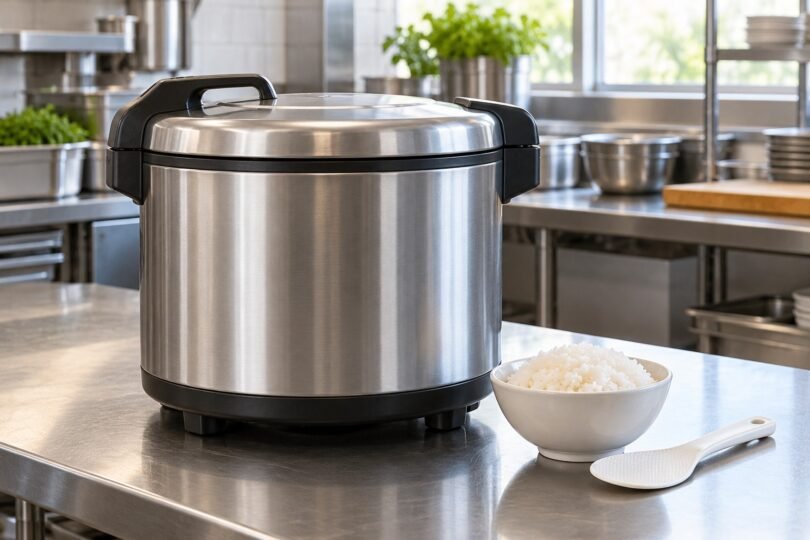

A rice warmer for a restaurant should fit the way your kitchen cooks, transfers and serves rice. If a separate cooker already makes the batches, start with a dedicated holding appliance. If you need to cook raw rice as well, choose a commercial cooker with a warming function and plan how service will continue while the next batch cooks.
The most useful comparison is the amount of cooked rice you need during a service period, the available electrical supply and how easily staff can clean and monitor the unit. A large cup count or an illuminated “Warm” light cannot establish food safety by itself.
Three commercial options to compare
These are specification-based choices for different workflows. Confirm the exact regional model, supplied parts and written commercial warranty before purchasing.
| Model | Job and capacity | Electrical rating | Best reason to consider it |
|---|---|---|---|
| Zojirushi THA-603SA | Holding-only electric warmer; 6.0-liter capacity | 120 V / 77 W | A separate serving station supplied by an existing cooker |
| Zojirushi THA-803SA | Holding-only electric warmer; 8.0-liter capacity | 120 V / 77 W | More holding volume with the same listed width and depth as the 6-liter version |
| Aroma ARC-1033E | Commercial cooker with automatic Warm; up to 60 rice-measure cups of cooked white rice | 120 V / 60 Hz / 1,650 W | Cooking large batches where a holding-only unit would leave a production gap |
Specifications come from Zojirushi’s THA product page and Aroma’s ARC-1033E page. The capacity labels use different units and should not be compared as though a liter, a rice-measure cup and a restaurant portion were interchangeable.
Zojirushi THA-603SA and THA-803SA: for holding cooked rice
Both models have a removable nonstick pan, detachable washable inner lid and included rice spatula. Zojirushi lists cETLus and ETL Sanitation recognition. The manufacturer gives dimensions of 18⅛ × 15 × 12⅝ inches for the 6-liter version and 18⅛ × 15 × 15⅜ inches for the 8-liter version, in width × depth × height order.
The practical choice is batch turnover: buy the larger version when the extra volume will actually be served during your planned holding period. Otherwise, a smaller batch may be easier to rotate. Allow extra room above the stated closed height to open the lid and lift out the pan.
These warmers do not replace a cooker. Zojirushi’s THA-603/803-series instructions describe preheating and loading already-hot cooked rice, prohibit using the warmer to reheat cold rice, and advise against holding longer than 12 hours. That older manual names THA-603/603S and THA-803/803S; obtain the instructions applicable to the complete SA suffix on the unit you buy rather than assuming every historical detail is identical. A maximum manufacturer duration never overrides measured temperatures or your food-safety plan.
Aroma ARC-1033E: for cooking and then holding
This is a different workflow. The same vessel cooks the batch and switches to Warm. That can suit a kitchen whose cooking and service periods line up, but it ties up the cooker while rice is being served. A separate warmer becomes useful when you need to start another batch without interrupting service.
The linked 2025 ARC-1033E manual sets a minimum of 15 rice-measure cups of raw rice. Its maximum is 30 cups of raw white rice, producing about 60 cooked cups; brown rice is limited to 20 raw cups, producing about 40 cooked cups. Each small rice measure is 180 mL. The included 900 mL tumbler equals five of those measures. This makes it a poor match for a kitchen that usually needs only a few portions. The manual also limits Warm mode to no more than 12 hours; treat that as an upper appliance limit, not a promise that any batch is safe for 12 hours.
Check the warranty before placing a restaurant order. Aroma’s product page and the manual’s safety section specify commercial use, but the same linked manual’s warranty section says coverage is void for use other than single-family household use. Those statements conflict. Ask Aroma or the authorized seller for written clarification of coverage for your restaurant; do not assume that the advertised one-year term covers it.
Warmer, cooker or insulated carrier?
- Electric holding-only warmer: receives cooked, hot rice and keeps it ready for service. You still need a way to cook and, where appropriate, reheat the food.
- Commercial cooker with Warm: turns raw rice and water into a batch, then changes to holding mode. Its useful output depends on minimum batch size and production timing.
- Unpowered insulated container: slows heat loss but adds no heat. Its suitability depends on a validated transport or service plan with time and temperature checks.
Small household rice cookers, multicookers, grocery bags and serving bowls are not equivalent alternatives to commercial holding equipment. “Keeps warm” in a product description does not answer questions about restaurant duty, sanitation acceptance, batch size or temperature monitoring.
Size it from portions and batch turnover
Start with your actual cooked portion, then multiply by the number of orders expected before the next fresh batch arrives. For example, 40 portions at 150 mL each require 6 liters of cooked rice before allowing for service losses. That arithmetic is a planning example, not a claim that a nominal 6-liter warmer should be filled above its marked working limit.
Use the same unit throughout the calculation. Rice-cooker cups commonly differ from U.S. measuring cups, and raw rice expands during cooking. A “60-cup cooker” may mean a cooked yield from a much smaller raw quantity. Ask for the raw limit, cooked capacity, cup volume and minimum batch size in writing when the listing is unclear.
Also map the busiest hour: who replenishes the serving station, where the next batch waits and where the empty pan is cleaned. Two manageable batches may fit the operation better than a single oversized batch that remains in service too long. Avoid topping a new batch over an older one; keep batch identification and holding time clear.
Hot holding: measure the rice
The 2026 FDA Food Code is a model for adoption, not automatically the enforceable rule in every restaurant. Confirm the edition and any amendments used by your state or local regulatory authority.
Under the model code’s section 3-501.16, ordinary hot-held time/temperature-control-for-safety food must be maintained at 135°F (57°C) or above. Follow a stricter applicable local requirement. Measure the food with a suitable, calibrated probe and use the checks and records in your establishment’s food-safety procedures. A dial setting, indicator lamp or manufacturer’s general temperature range is not a measurement of the rice at the coldest point during service.
Load food only as the appliance instructions permit, keep the lid closed between serving and account for power interruptions. If a batch misses a required limit, follow the operation’s corrective-action procedure with the person in charge. Do not guess how long it was cool or blend it into a fresh batch.
Rice deserves careful handling because Bacillus cereus can produce a heat-resistant toxin in improperly stored food. FDA’s explanation of cereulide is one reason reheating is not a reliable rescue for temperature-abused rice. Smell and appearance cannot establish that a batch is safe.
Cooling and reheating after service
Switching a warmer off and leaving a full pot overnight is not a cooling method. For cooked food, FDA model section 3-501.14 specifies cooling from 135°F to 70°F within two hours, then to 41°F or below within six hours total. Use an approved process that can meet those limits, such as suitable shallow portions and effective refrigeration, and verify it with measurements.
For previously cooked and cooled rice that will be reheated for hot holding, the model’s usual requirement is 165°F for 15 seconds, reached within two hours. Use equipment intended for reheating, then transfer as appropriate to the holding appliance. Specialized alternatives require the applicable approved procedure; a warmer’s slow heating or an informal “four-hour rule” is not a substitute.
For staff taking leftovers home, USDA consumer guidance calls for prompt refrigeration in shallow containers within two hours, or one hour above 90°F. That household advice serves a different context from a restaurant’s monitored cooling process. Never use it to postpone the start of commercial cooling.
Power, cleaning and the purchase checklist
The 77-watt holding appliances and the 1,650-watt cooker place very different loads on a circuit. Match the regional voltage, plug and appliance label to the installation; do not assume an imported version has the same electrical specification. The ARC-1033E manual requires grounding and a separate circuit from other operating appliances. Have the facility’s electrician resolve outlet or circuit questions.
Before cleaning, turn off and unplug the appliance as instructed and let it cool. Remove the food-contact parts the manual identifies, wash them with the appropriate nonabrasive method, and dry the pan exterior before reassembly. Do not immerse the electrical body, cord or plug. Confirm dishwasher suitability for each part rather than treating “removable” as “dishwasher-safe.” Sanitize food-contact surfaces under your establishment’s approved procedure.
Before ordering, check these details with the seller:
- Exact model and regional voltage, with a readable rating-label photo
- Cooked holding volume or raw cooking limits, with the unit of measure
- Inner pan, inner lid, cord, spatula and any measuring accessories included in that offer
- Electrical and sanitation listings accepted by your local authority
- Commercial-use warranty, return terms and access to replacement pans and lids
- Space to open, serve from and clean the unit without obstructing other work
For a kitchen that already cooks sufficient rice, the THA holding-only models are the more direct category to evaluate. For a production shortfall, evaluate the ARC-1033E’s batch limits and resolve its warranty wording first. In either case, base the final choice on your measured service demand and food-safety process.