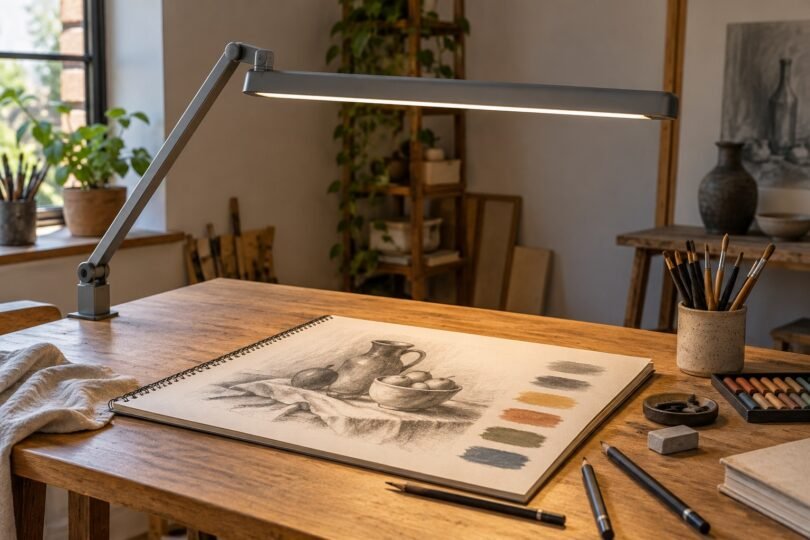

The best desk lamps for artists put useful light across the whole drawing area, let you position the head without losing desk space, and publish enough information to judge color rendering. For a fixed art desk, start with an adjustable clamp lamp. For a table you move between rooms, a freestanding base may be more practical.
Our first comparison would be the Daylight Slimline 4 for a conventional drawing desk and the Daylight Luminos when extra reach matters. The Verilux SmartLight is a different option for a small shared desk, though its conflicting published light-output specifications deserve attention before color-critical work. These are specification-based choices, not results from hands-on testing.
Desk lamps for artists: three options to compare
The figures below are manufacturer specifications. Lux describes light arriving at the work surface; lumens describes total light output. A lamp with more lumens does not automatically light your particular sheet of paper more evenly.
| Lamp | Published light output | Color and dimming | Mounting consideration |
|---|---|---|---|
| Daylight Slimline 4, brushed steel U35109 | 1,000 lumens; up to 3,200 lux at 30 cm / 12 inches | 6,000K; CRI 95+; four brightness levels | Clamp opens to 55 mm; optional table base |
| Daylight Luminos, U35600 | 1,960 lumens; up to 4,500 lux at 30 cm / 12 inches | 6,000K; CRI 95+; three brightness levels | 112 cm / 44-inch reach; clamp opens to 75 mm |
| Verilux SmartLight desk lamp, white VD46WW3U | Product page: 250–500 lumens; linked manual: 600 maximum. No comparable lux-at-distance figure found. | Three color modes; eight brightness levels. Published CRI differs between page and manual. | Freestanding base with flexible gooseneck |
Daylight Slimline 4: for a desk where space around the paper matters
The Slimline 4 has a slim horizontal shade and a two-in-one clamp/screwable tabletop mount. Its maximum 55 mm clamp opening is worth checking against both the desktop and any underside lip. The separate table base is an accessory, so do not assume a freestanding base comes with the clamp version.
Its four settings are specified at 3,200, 2,000, 1,500 and 750 lux at 30 cm. Published consumption is 13.6W, and the 5V/2A USB-C port is for charging a device. The US fact sheet identifies brushed steel as U35109. Older U35108 listings refer to the preceding Slimline generation.
Choose it if: you want a dedicated drawing position and can secure the mount properly. Check first: whether the head reaches the far corner of your usual paper without the arm obstructing your hand. Its fixed 6,000K light does not provide warmer color modes.
Daylight Luminos: for a larger workbench or deeper drawing table
The Luminos is the larger option here: the maker lists a 112 cm reach, 75 mm maximum clamp opening, 3.2 kg lamp weight and 22W consumption. It has a multi-position head and three brightness levels. Its maximum 4,500-lux figure is measured at 30 cm, not across an entire large desk.
Choose it if: you regularly move between a sketchbook, palette and larger board and need the arm to reach each area. Check first: the mounting surface, space behind the desk and the arc through which the arm will move. A long arm is useful only if it can occupy its working position without colliding with a shelf or monitor.
A smaller setup may be easier to arrange around a compact lamp. Do not choose this one solely because its maximum output is higher; compare coverage and positioning at your actual working height.
Verilux SmartLight: for a small desk that also serves other tasks
The white VD46WW3U SmartLight offers a tabletop base, flexible gooseneck, eight brightness settings and nominal 3,000K, 4,000K and 5,000K modes. The manufacturer lists 18W consumption and a 1A USB charging port. It suits a desk where attaching a clamp is inconvenient.
Important specification difference: the product page lists CRI above 80 and 250–500 lumens, while its linked VD46 manual lists CRI above 90 and 600 lumens maximum. Confirm the revision before buying for paint or pigment matching. Neither figure establishes CRI 95+ performance.
The manual lists the lamp, adapter and user manual in the carton and says there are no user-serviceable parts. Use the supplied adapter; the USB output is for a device, not a substitute lamp power connection.
Choose it if: portability around the home and adjustable light color matter more than a large drawing-area specification. Check first: how much of your paper remains evenly lit when the head is high enough to leave room for your hand.
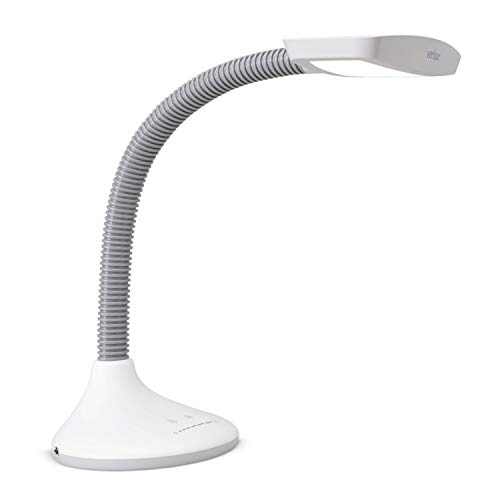
Verilux SmartLight VD46WW3U, White, 1 desk lamp with power adapter
As an Amazon Associate we earn from qualifying purchases.
How to compare light quality without getting lost in the numbers
Use lux with its measurement distance
A lux claim needs a distance and a measurement position. Daylight explains in its lighting glossary that its task-lamp readings are taken at 30 cm and report the brightest point below the center of the shade. The outer edge of your paper may receive less light.
For a useful comparison, ask whether the quoted reading was taken at the height you expect to use. Do not compare a close-up magnifier reading with a desk lamp measured farther away. If your artwork is large, a coverage diagram is more informative than a single impressive center reading. Wattage, meanwhile, tells you about power consumption rather than the amount of light landing on the page.
Keep color temperature and color rendering separate
Color temperature describes whether the light looks warmer or cooler. Color rendering describes how objects appear under that light compared with a reference. The US Department of Energy’s bulb guide treats these as separate specifications. A cool-white lamp can still have modest color rendering.
For choosing paints, pencils or fabrics, prioritize a clearly documented CRI and a consistent working setup. We would favor the documented 95+ CRI options over a lamp that only promises “natural” light. That is a buying preference, not a guarantee that every pigment will look identical in another room.
Before finishing a color-sensitive piece, look at it under the lighting where it will be displayed. For a shared desk, adjustable color temperature can be convenient; for repeatable color decisions, remember which mode you used rather than changing it halfway through a session.
Check reflections as well as brightness
Glossy paint, coated paper and a nearby screen can reflect the lamp. Sit in your normal working position and move the head until its reflection is out of the area you need to inspect. Try moving the light to the side opposite your drawing hand, then adjust for the shadows your particular technique creates.
Dimming helps you balance the task lamp with the room. It is not a reason to assume a product prevents eye strain, has zero flicker or improves eye health. Those claims require separate evidence; they are not established by CRI, wattage or the word “LED.”
Make sure the lamp fits the desk
- Measure the mounting edge. Check thickness, underside clearance and whether an apron prevents the clamp jaws from seating. Follow the lamp and furniture instructions for suitable mounting surfaces.
- Map the useful reach. Place your largest normal sheet, palette and reference material on the desk. Measure from the proposed mounting position to the area that needs light.
- Check the whole movement. Allow clearance above the head and behind the arm. A lamp that reaches over a monitor may still be awkward over an angled drawing board.
- Budget for the complete setup. Confirm the lamp count, regional power adapter, clamp or base, and any separately sold magnifier. A master-carton quantity on a trade sheet is not a consumer multipack.
- Ask about serviceability. For integrated LED lamps, check the maker’s repair options and replacement-adapter details. Do not assume the LED module can be replaced like a screw-in bulb.
If a replaceable bulb is a priority, choose a fixture explicitly designed for one, then check its socket, permitted bulb dimensions and maximum actual wattage. Evaluate the bulb’s CRI and color temperature separately. A fixture’s included bulb may not be the bulb you would select for artwork.
Questions to settle before buying
How many lumens does an artist need?
There is no single lumen figure that guarantees a good drawing setup. Paper size, lamp distance, beam spread and room lighting all affect the result. Compare lux at a stated distance, then check coverage and dimming at your working position.
Is a clamp lamp better than a lamp with a base?
A clamp saves usable tabletop space when the edge can support it correctly. A base is easier to move and avoids relying on the table edge. Choose according to the furniture and the space your artwork needs.
Does daylight-colored light guarantee accurate colors?
No. Color temperature and color rendering are separate characteristics. Look for a documented CRI, keep the working mode consistent and assess the finished piece in its intended display lighting.