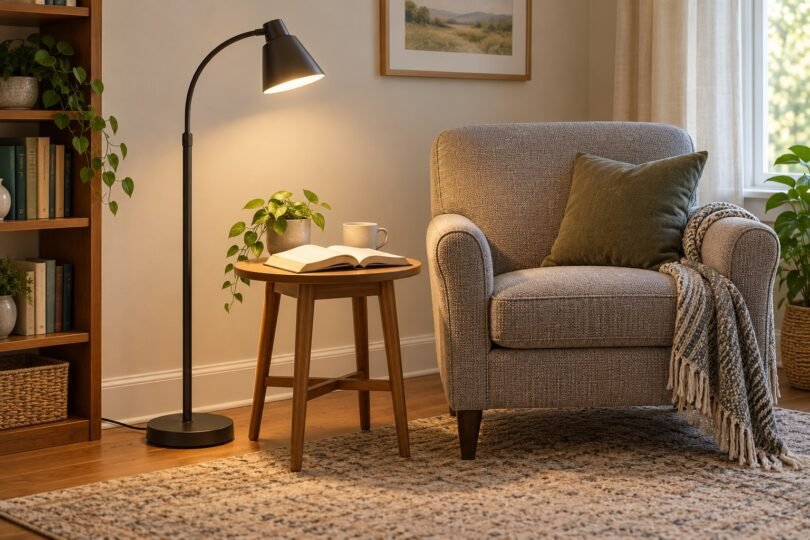

The most useful reading lamps for older adults combine adjustable brightness, a head that reaches the page, manageable glare and controls that are comfortable to use. Start with the reader’s usual chair, book and preferred light level. Age alone does not tell you which lamp, color temperature or brightness setting will work best.
A lamp that looks impressive in a listing can still be awkward if its switch sits behind the chair or its beam covers only half a newspaper. The comparisons below use manufacturer specifications and practical accessibility considerations. They focus on three identifiable task lamps rather than decorative lights, alarm clocks or magnifiers that do a different job.
Reading lamps worth comparing
- For a reading chair and adjustable light color: Verilux SmartLight VF09WW3 in White.
- For spreading light over a book or craft area: Daylight DuoPro UN1560 with two independently adjustable heads.
- For a desk with books and a screen: BenQ e-Reading AR15_D Silver, with a broad curved head and a dimming knob.
These are different starting points, not a universal ranking. Before buying for someone else, let them try the controls and choose the light they find comfortable. A good return policy is especially valuable when the lamp cannot be tried in person.
Five checks that matter more than an “eye-care” label
1. Can the light reach the actual reading position?
Measure from the proposed base location to the middle of the open book while sitting normally. A tall floor lamp may still have too little sideways reach. A desk lamp may need more tabletop space than expected. Check whether the head stays where it is placed and whether repositioning it takes more force than the reader finds comfortable.
2. Is the light source shielded from view?
Look for a shade or diffuser, then check the lamp from the seated position. An exposed bright emitter can be uncomfortable even when the page is well lit. Glossy magazines and tablet screens also reflect light, so a small change in angle may help more than increasing brightness. RNIB’s guide to making the most of your sight recommends adjustable task lighting with the shade below eye level and general room lighting alongside it.
3. Can the reader find and operate the controls?
Try switching on, dimming and changing modes without leaning out of the chair. A touch panel requires little pressure but may be harder to locate by feel. A knob offers a distinct physical control but still needs comfortable grip and reach. Check how many taps or button presses a routine adjustment requires, and whether the lamp remembers the preferred setting.
4. Does the beam cover enough of the page?
Check both pages of an open book, including the corners. A concentrated bright spot is less useful if the reader must keep sliding the book into it. A wider head or two adjustable heads can suit newspapers and larger work areas. Moving a lamp farther away may widen coverage while reducing illumination at the page.
5. Does it fit safely around the furniture?
Allow space for the base, feet and any mobility aid. Keep the cord out of the walking route and away from moving recliner parts. A weighted base is useful, but it does not make a lamp a support rail. Consider whether the reader needs help with assembly or moving a heavier model.
1. Verilux SmartLight VF09WW3: adjustable color for a reading chair
The white Verilux SmartLight offers five brightness levels and three nominal color settings: 3,000K, 4,000K and 5,000K. Its flexible neck lets you redirect the head, while touch controls and setting memory reduce the need to repeat adjustments each time it is switched on.
Verilux lists 14 watts, an 11-pound weight and a 6-foot cord. The manufacturer gives dimensions of 48 inches high by 10.5 inches wide by 9 inches deep, with a fully extended height of 64 inches. Treat those as planning measurements: the usable height and reach change with the neck position.
Why consider it: it offers warmer and cooler light choices in a floor-standing format without occupying a side table. What to check: the touch panel must remain reachable, and the 11-pound lamp may be inconvenient to move regularly. The manufacturer’s page and linked manual give different lumen and color-rendering figures, so those numbers are not used here to rank it. Its manual specifies indoor use and the supplied power adapter.

Verilux SmartLight VF09WW3 LED Floor Lamp, White, One Lamp
As an Amazon Associate we earn from qualifying purchases.
2. Daylight DuoPro UN1560: two heads for a wider task area
The DuoPro floor lamp has two pivoting heads, a flexible upper arm and four brightness levels for each shade. Independent adjustment is useful when one side of a spread needs a different direction or intensity. Its fixed 6,000K light is a cooler-looking choice; choose another model if adjustable color is important.
The US UN1560 fact sheet lists 14 watts, a 5.06-pound weight and a 59-inch cord. The base measures approximately 7 by 9.5 inches. Its dimension drawing separates a 35-inch pole, 15-inch flexible section and 11-inch head section; these are component measurements, not a promise of a fixed overall height in every position.
Why consider it: the split heads provide more positioning options for a broad reading or hobby area. What to check: both touch dimmers must be easy to reach, and the fixed cool light must suit the reader. The manufacturer’s 23-by-9-by-3-inch figures describe the packaging, not the assembled lamp. This link goes to the manufacturer so the exact UN1560 model and supplied regional adapter can be checked.
3. BenQ e-Reading AR15_D Silver: a broad desk-lighting option
The BenQ e-Reading desk lamp combines an articulated arm and curved light head with a touch-sensitive on/off ring and a knob for brightness or color adjustment. It offers a 2,700K–5,700K color range and automatic screen and paper modes, giving a desk user several ways to set the light.
BenQ’s specifications list maximum consumption of 18 watts, dimensions of 59 by 22 by 62.5 centimeters, and a 4.8-kilogram net weight, approximately 10.6 pounds. The listed light coverage is 90 centimeters wide at 500 lux under the manufacturer’s conditions. That is a coverage specification, not a recommended reading-light level for everyone.
Why consider it: the wide head suits a desk holding an open book, notes and a monitor. What to check: it is a substantial desk lamp, and the controls are on the head. Confirm that they remain within reach. The silver desk-lamp listing below includes a pedestal base; do not assume an optional desk clamp or floor stand comes with it.

How bright should a reading lamp be?
There is no single setting that fits every older reader. RNIB notes that additional lighting can help many people with sight loss, while some find light uncomfortable or experience worse vision in particular lighting conditions. Its low-vision guidance emphasizes even general lighting and additional task light where needed. Adjust for the person, material and room rather than choosing the highest number available.
Watts measure electrical power, while lumens describe total light output, as explained by the US Department of Energy. Lux describes light reaching a surface. A lux claim needs a measurement distance and position to be meaningful. Do not directly compare a center reading at 12 inches with a reading taken at 45 centimeters, or confuse either with even coverage across a whole book.
Color temperature describes the light’s warmer or cooler appearance. It is separate from brightness. Try the available settings on the actual page instead of assuming “daylight” is automatically more comfortable. A high color-rendering specification may matter for crafts, but it does not prove that a lamp treats an eye condition.
A simple at-home placement check
- Sit in the normal reading position with the usual glasses and reading material.
- Keep some room lighting on, then direct the task light onto the page while keeping the emitter out of the direct line of sight.
- Adjust the angle to remove hand shadows and shiny reflections. If writing, try the lamp on the side opposite the writing hand.
- Change one setting at a time. Check both pages and look away briefly to assess the surrounding room.
- Confirm that the switch remains reachable and that standing up does not bring a foot into the cord or base.
Frequently asked questions
Is a floor lamp better than a desk or clip-on lamp?
A floor lamp preserves table space; a desk lamp can put controls closer to hand. Clip-on book lights are portable but may add weight to a paperback and cover a smaller area. Choose around the reading position and control access.
Can a reading lamp replace glasses or a low-vision assessment?
No. Lighting changes the reading environment; it does not correct every reason for difficulty seeing print. If reading remains difficult, seek advice from an eye-care professional. RNIB recommends choosing magnification with a low-vision practitioner rather than guessing at a magnifier’s advertised strength.
Does reading in dim light damage the eyes?
The American Academy of Ophthalmology says it does not, although better lighting can make reading easier and reduce how quickly the eyes tire. The goal is comfortable, usable light, not buying the brightest lamp out of fear.