

Good disposable food prep gloves should be labeled for food contact, fit your hands, and suit the job you are doing. Powder-free nitrile is a practical starting point for close-fitting prep work; vinyl can suit brief, light-duty tasks; loose polyethylene gloves are useful when frequent changes matter more than a snug fit. None replaces handwashing or clean utensils.
The two product examples below have traceable manufacturer information and exact size-and-count listings. They illustrate different materials rather than claiming one glove is best for every kitchen. We have not performed laboratory barrier testing or hands-on durability tests.
Two disposable food prep gloves to compare
AMMEX X3 blue nitrile, medium, box of 100
The X344100-BX is a box of 100 medium blue nitrile gloves. AMMEX’s X3 technical sheet describes a single-use, powder-free, latex-free, textured glove for light-duty work, including food service. It identifies X344100 as the medium model and lists 100 gloves per box.
The maker specifies approximately 3-mil palm and 4-mil finger thickness. A mil is one-thousandth of an inch, not a millimeter; retail tables sometimes confuse those units. The model is industrial grade and non-sterile. Its suitability here comes from documented food-contact use, not from a claim that it is a medical examination glove.
Good fit: cooks who prefer a closer-fitting disposable glove for handling ingredients and utensils. Trade-off: this is still a lightweight glove. It is not a substitute for cut-resistant equipment, oven mitts, or chemical protection selected for a particular cleaner. Medium is a verified example, not a recommendation that everyone buy that size.

AMMEX X3 X344100-BX Nitrile Gloves, Blue, Medium, Box of 100
As an Amazon Associate we earn from qualifying purchases.
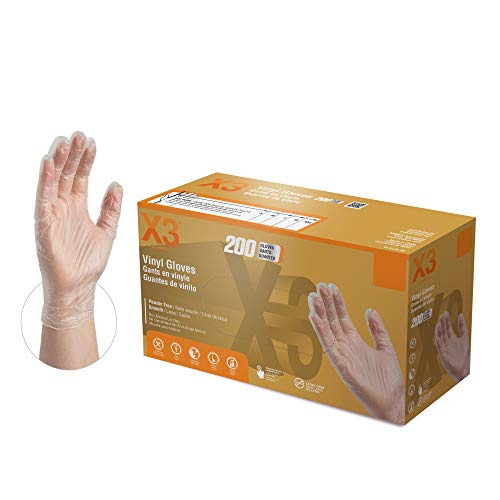
AMMEX X3 clear vinyl, medium, box of 200
The GPX3D44100-BX is the medium, clear, 200-count vinyl box. AMMEX’s manufacturer flyer identifies the corresponding GPX3D44100 model as clear, powder-free, smooth, polymer-coated, and latex-free. The exact retail listing confirms the box quantity and the full retail model suffix.
AMMEX includes its X3 clear vinyl family among its food-service glove options. Consider this material for short tasks such as assembling sandwiches or portioning ready-to-eat ingredients when a looser feel works for you.
Good fit: light-duty stations with frequent glove changes. Trade-off: the smooth vinyl surface and fit may feel different from textured nitrile. Test a box before buying a case for a team. Check the model carefully: GPX3 and GPX3D listings can have different box counts, and 200 gloves means individual gloves, not 200 pairs.
Match the material to the task
Nitrile: consider food-contact-labeled nitrile when you want a fitted glove and a textured surface. Thickness, formulation, and sizing vary, so “nitrile” alone does not guarantee a particular level of durability. A thin nitrile glove can still split or be punctured.
Vinyl: a reasonable option for brief, relatively undemanding handling. Before committing to a large supply, check whether it stays comfortable when you bend your fingers and whether the fingertips interfere with your grip. A low unit price is less useful if workers discard extra gloves because the fit is wrong.
Polyethylene: loose food-service poly gloves can be convenient at stations where staff repeatedly put gloves on and take them off. Their roomy shape may be less convenient for precise work. Choose a product explicitly intended for food handling and a size that stays on during the task.
Latex: natural-rubber latex requires extra care around allergies. For a shared kitchen, a latex-free option avoids introducing that particular material. Latex-free does not mean that no wearer can experience irritation from the glove, moisture, or other ingredients.
Check food-contact labeling and the exact box
Look for a manufacturer, model number, material, size, single-use designation, and food-contact information on the packaging or technical sheet. Color alone establishes none of these. Blue, black, and clear gloves can all be sold for different applications.
“FDA approved” is often used too loosely in retail descriptions. A manufacturer may instead document that the glove’s materials comply with applicable food-contact requirements. AMMEX’s X3 nitrile sheet lists a food-contact regulation; that is more specific evidence than an unqualified approval slogan. Medical use and food handling are separate intended uses, so do not assume that one label automatically establishes the other.
Confirm whether the offer is one box, several boxes, or a case. Compare the delivered cost per individual glove for the exact size. A 100-count box contains enough for 50 two-handed changes before allowing for damaged gloves or tasks that need only one glove. A bigger box reduces restocking frequency, but it does not extend the safe life of a glove once worn.
Fit matters more than a familiar size label
Try a small supply before ordering in bulk. The glove should allow natural hand movement without pulling hard across the palm, pinching the fingers, or leaving excessive material at the fingertips. Ask each regular user to check their own fit; one shared size can create avoidable waste.
Dry hands thoroughly before putting gloves on. If gloves repeatedly tear during donning, review the size, technique, product condition, and storage rather than simply assuming a thicker glove will solve everything. Check the manufacturer’s storage instructions and any expiration information. Keep unused gloves in a clean, dry dispenser away from splash, heat, and cleaning chemicals.
Use a fresh pair at the right time
The FDA’s Employee Health and Personal Hygiene Handbook emphasizes washing hands before donning gloves, changing between raw and ready-to-eat foods, discarding damaged gloves, and never washing or reusing disposable gloves. A clean glove can become contaminated just as a clean hand can.
- Prepare the clean work area, utensils, and ingredients before putting on gloves.
- Replace gloves after handling raw meat before touching a salad, cooked food, or another ready-to-eat item.
- Change gloves after touching a phone, bin, face, or other contaminating surface, and wash hands as needed.
- Discard a torn or contaminated glove immediately instead of continuing until a convenient break.
- Keep food-prep gloves separate from gloves used for cleaning.
For a business, follow the rules adopted by your local authority and the establishment’s food-safety procedures. The FDA Food Code is a model used by regulators; it is not a substitute for checking your local requirements.
Remember when utensils are the simpler choice
Tongs, scoops, deli tissue, and other suitable utensils can reduce direct hand contact with ready-to-eat food. Plan the station so these tools are easy to reach and keep clean. If a task does not need hands inside a glove, there is little value in wearing one simply for appearance.
Bottom line: start with a correctly sized, powder-free, food-contact-labeled glove. The AMMEX X3 blue nitrile example suits a closer-fitting approach, while the clear vinyl example suits brief, light-duty handling. Correct changes, clean hands, and a well-organized prep area do more for food safety than buying the largest box or the thickest-looking glove.
Image note: Existing category illustration retained from original article.