

A Kiddush wine fountain is a serving set that distributes a pour into several small cups. The most useful features are the number of receiving cups, the way unused outlets are managed, the actual materials and how easily the set can be cleaned and stored. For a colorful eight-cup option with documented stopper plugs, start with Yair Emanuel’s FNH-1. For a smaller household, compare a six-cup set rather than automatically choosing a larger display.
This guide is based on named products and their published specifications. We have not tested flow balance, finishes or cleaning performance. It is a buyer’s guide to the serving equipment; questions about the order of Kiddush, quantities or your household’s practice should go to your rabbi or other appropriate religious authority.
Kiddush fountain options to compare
| Option | Receiving cups | Stated construction | Why consider it |
|---|---|---|---|
| Yair Emanuel FNH-1 | Eight, plus one large cup | Hammered nickel with colorful anodized aluminum rings | Colorful design with included stopper plugs |
| Legacy Judaica 911 | Six | Silver-plated Jerusalem design | A six-cup format for a smaller gathering |
| Legacy Judaica 4705-ST | Eight | Hammered stainless steel | Stainless steel construction with published overall dimensions |
Yair Emanuel FNH-1: colorful rings and adjustable serving
The FNH-1 manufacturer page identifies eight small cups and one large Kiddush cup, with hammered nickel and colorful anodized aluminum rings. It also specifies stopper plugs that block the flow when fewer cups are needed, and says the set is hand-wash only.
That documented stopper arrangement is worth considering if your regular table is smaller than your holiday gathering. Before first use, identify which pieces block unused outlets and follow the supplied instructions. Removing a cup alone does not close its outlet.
Choose the FNH-1 hammered version deliberately. Emanuel also makes differently shaped fountains and anodized aluminum versions. A similar color scheme does not establish the same material, height or cup shape. The matched retail listing uses manufacturer part number AR-YE-FNH-1, which helps distinguish this specific set.
The design suits a table where colored accents are welcome. If the recipient prefers a single metal finish, compare the actual photographs with their existing pieces rather than treating multicolor rings as a neutral choice.

Yair Emanuel Kiddush Fountain set Hammered 8 Cups for Sharing 1 Main Cup Colorful Anodized Aluminum Rings Judaica Gift
As an Amazon Associate we earn from qualifying purchases.
Legacy Judaica 911: a six-cup Jerusalem design
Legacy’s manufacturer listing for model 911 describes a silver-plated six-person fountain with a Jerusalem design. The smaller cup count is the meaningful distinction for a buyer who usually serves a modest group and does not want eight receiving cups on the table every time.
Silver-plated describes a surface finish; it should not be read as solid sterling silver. Ask the seller for the care instructions, the overall footprint and the complete contents of the exact package. The material description alone does not establish the composition of every component or the kind of cleaner it can tolerate.
Choose six cups because it matches the usual gathering. If you regularly need more servings, compare a larger set or plan how additional cups will be served. Buying a smaller fountain and improvising cups under unsupported positions is less practical than choosing the correct format at the outset.
Legacy Judaica 4705-ST: hammered stainless steel
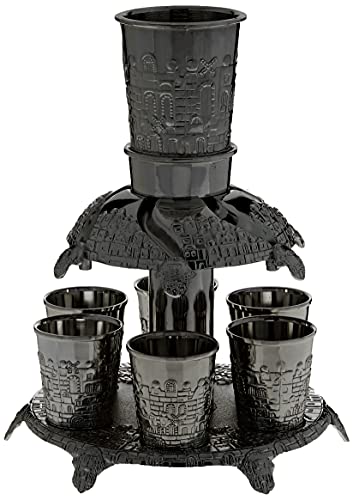
Legacy lists 4705-ST as a hammered stainless steel fountain with eight cups, an eight-inch diameter and a 9.5-inch height. Those overall dimensions are useful when deciding whether the assembled set fits between place settings and inside a cabinet.
Consider this version when stainless steel is the construction you want. Its material and dimensions distinguish it from Legacy’s similarly numbered crystal, colored and other metal sets. Include the “ST” suffix when asking a shop to confirm the item, and check that the product photograph matches the hammered-metal design.
The reviewed manufacturer entry does not establish that it is dishwasher safe or that unused outlets can be plugged. Ask for those details if they matter to your routine.
Count the cups the way you will use them
Look for a clear distinction between the large Kiddush cup and the small receiving cups. A listing described as a nine-cup set may mean one large cup plus eight small ones. Piece counts can also include a tray, stand or other parts, so a large number in the title does not necessarily mean more guests can be served.
Write down your usual group size and the largest group you realistically expect. If the difference is substantial, an eight-cup model with documented outlet stoppers may be easier to adapt than one with a fixed, unchangeable arrangement. Confirm whether stoppers are supplied, how they are fitted and whether replacements can be purchased.
Do not infer serving capacity from cup count. Overall cup height does not establish liquid volume, and the amount a receiving cup holds is not necessarily the amount it will receive from one pour. If capacity is important, request the usable volume of the large and small cups for that exact model.
Check the assembled footprint and storage space
A fountain needs room beyond its central cup. Measure the full tray or outer edge, then allow practical space to lift out receiving cups without brushing plates or other tableware. A paper circle cut to the stated diameter is a simple way to check the footprint on your own table before buying.
Height matters too. Tall stemmed cups and raised arms can look impressive, but consider sightlines across the table and the height of your storage shelf. Ask whether the unit comes apart for storage and which pieces are intended to be removed. Do not assume decorative joints are meant to unscrew.
For a gift, an attractive box is useful only if the recipient has somewhere to keep the set afterward. Check whether they already have a preferred Kiddush cup, whether they want a coordinated new set, and whether the fountain accommodates the way they normally host.
Materials and cleaning deserve a careful look
Read the full material description rather than relying on “silver” in a color selector. Silver-plated, nickel, stainless steel and anodized aluminum are separate descriptions. For any mixed-material design, ask about the interior surfaces that contact the drink as well as the decorative exterior.
Use the care directions supplied for the exact model. FNH-1 is expressly hand-wash only. Do not extend that instruction into an invented universal cleaning recipe, or assume another fountain can go in the dishwasher because its main body is metal.
Before ordering, ask how to reach the distribution channels, whether removable parts have seals, and how the maker recommends drying them. A fountain that looks easy to wipe on the outside may still have narrow passages that need attention. If a product arrives with rough rims, peeling coating or damaged channels, ask the seller to resolve the defect before using it for drinks.
A used or inherited fountain needs the same clarity. If you cannot identify its material or original intended use, obtain appropriate advice before serving from it or attempting to restore the interior with a household polish.
Make the first use straightforward
Read the assembly instructions and check the contents before the occasion. Identify the receiving positions, the pouring point and any supplied outlet stoppers. Arrange the cups as intended and place the set on a stable surface. Keep the packaging until you have checked that no part is missing or damaged.
If the manufacturer allows a practice run with water, do it beforehand and follow the cleaning and drying instructions afterward. This can help you learn the pouring position without making claims about perfect flow balance. Stop and ask the supplier if the channels do not behave as the instructions describe.
For the gathering itself, plan how the fountain will reach the table and where the small cups will go after serving. Avoid moving a filled, loosely assembled set simply because it has a tray-shaped base; confirm how the manufacturer intends it to be carried.
Frequently asked questions
Can I use fewer cups than the fountain includes?
Only if its design supports that arrangement. FNH-1 lists stopper plugs for unused outlets. For other models, obtain a clear answer before buying. Leaving a space empty is not the same as stopping the liquid flowing toward it.
Is a fountain necessary for Kiddush?
This article compares a serving accessory and does not prescribe a religious practice. Choose equipment that suits your household and ask your rabbi about ritual questions, including quantities and the order of serving.
Will any small cup work as a replacement?
Do not assume so. The cup’s diameter, height and position beneath the outlet can matter. Ask for a replacement made for the exact fountain, and confirm whether it matches the original material and finish.
Which one should you choose?
FNH-1 is the clearest starting point for eight colorful receiving cups and documented outlet stoppers. Legacy 911 is worth comparing when six receiving cups suit your table. Legacy 4705-ST provides a hammered stainless steel alternative with a stated footprint. Before ordering, confirm cup capacities, complete contents, cleaning directions and the recipient’s preferred style.
Image note: Existing category illustration retained from the original article.