
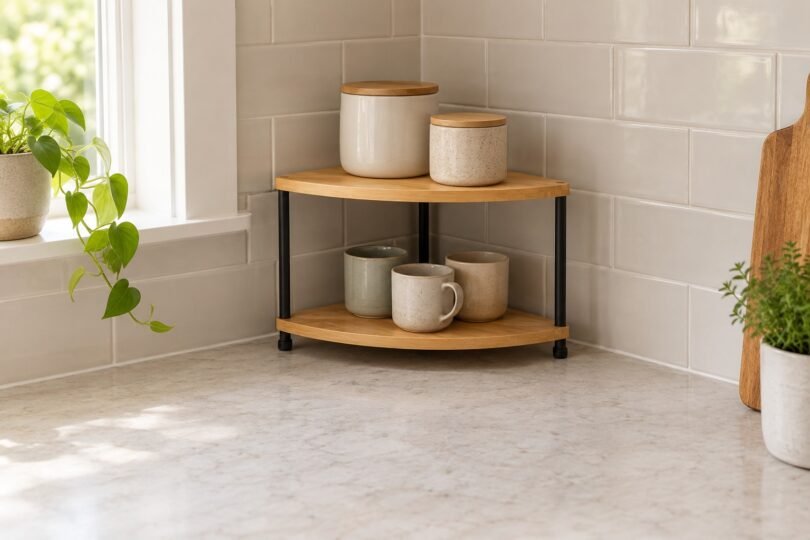

A kitchen counter corner shelf works best when it gives everyday dishes or jars a clear place without taking over your preparation space. For a compact bamboo organizer, start with the Bambüsi BAM-CSO; for a metal alternative with a published load limit, compare the Yamazaki Tower Kitchen Corner Rack. The smaller Lakeside bamboo rack is another option when counter space is tight.
Choose by footprint, usable shelf space and the height of what you plan to store. A product called a “corner shelf” is not guaranteed to match your backsplash angle, fit beneath your cabinets or leave enough room to lift out a bowl.
Three counter corner shelves to compare
These are freestanding organizers that sit on the counter. The measurements below are the sellers’ overall dimensions, not measurements of your kitchen or guaranteed usable shelf openings.
| Shelf | Overall size | Construction and setup | Main check before buying |
|---|---|---|---|
| Bambüsi BAM-CSO, natural bamboo, one organizer | 10 in. wide × 10 in. deep × 9.5 in. high | Three slatted platforms; bamboo; assembly required | Check the clear gap for your dishes; no numerical load limit found in the checked specifications |
| Yamazaki Tower Kitchen Corner Rack, 7453 or 7454 | 34 cm wide × 22.5 cm deep × 29 cm high | Two shelves; powder-coated steel and silicone cushions; no assembly | Match the exact model; maker states 2.5 kg per shelf |
| Lakeside Bamboo Kitchen Counter Corner Shelf, item 2148468 | 9 in. square × 9.85 in. high | Three slatted platforms; bamboo; assembly required | Confirm tier clearance and load capacity for your intended contents |
Bambüsi BAM-CSO: a compact bamboo option for separating dishes
The BAM-CSO is worth considering for small stacks of plates, bowls or cups that currently sit on top of one another. Its current product photos show three physical slatted platforms, including a low base. The selected Amazon listing is the natural bamboo one-pack; the two-pack is a different option.
Bambüsi’s specifications give the 10 × 10 × 9.5-inch overall size and say assembly hardware and instructions are included. The selected BAM-CSO package also lists a screwdriver. Dishes in the photographs are styling props, not an included dinnerware set.
Watch the openings: the overall height does not tell you how tall a bowl stack can be between platforms. Check that measurement before buying for tall mugs. The slats also deserve attention if you want to store small bottles with narrow bases.
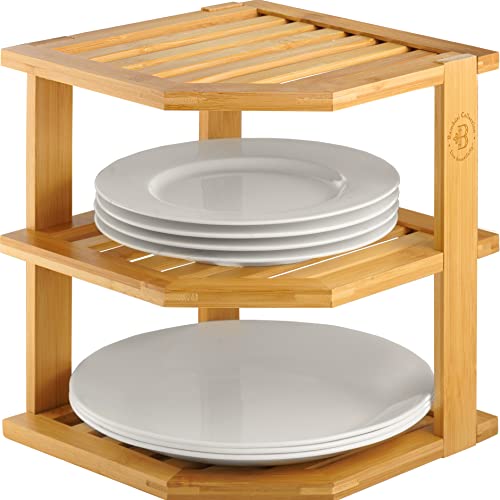
Bambusi BAM-CSO bamboo corner shelf, natural bamboo, 1 organizer
As an Amazon Associate we earn from qualifying purchases.
Yamazaki Tower 7453/7454: a metal option with a stated load limit
The Tower Kitchen Corner Rack has two open shelves in a powder-coated steel frame with silicone cushions. Yamazaki identifies white as 7453 and black as 7454, specifies 2.5 kg per shelf and says no assembly is required.
Its 34 × 22.5 × 29 cm dimensions are approximately 13.4 × 8.9 × 11.4 inches. Those width and depth figures describe the overall shape; do not assume they are equal wall-facing sides. Check the footprint drawing or make a paper template before deciding it fits.
Watch the model name: Yamazaki sells other corner risers with different heights and capacities. These figures apply to 7453/7454 only. The linked specification page is an international maker listing, so verify the exact model and delivery destination with your seller. The checked page does not provide an internal tier-clearance measurement.
Lakeside item 2148468: a smaller bamboo footprint
The Lakeside Bamboo Kitchen Counter Corner Shelf is listed at 9 inches square and 9.85 inches high. Its product photo shows three slatted platforms and an open front, giving you separate places for compact dish stacks.
The seller lists bamboo construction and assembly with included hardware. It is one shelf unit; the listing’s multiple-item promotion does not turn it into a two-pack. Cups and dishes pictured on it are not listed as included components.
Watch plate diameter: a nominal 9-inch footprint is not a promise that a 9-inch plate fits between the supports. Ask for the usable shelf dimensions, tier gap and numerical load limit if those determine whether the rack will work for you. Those details were not given in the checked product specifications.
Measure the counter before choosing a shelf
Clear the corner and measure the space you can actually use, with nearby cabinet doors open and your usual appliances in place. A diagonal counter edge, rounded backsplash joint, raised trim or projecting outlet cover can prevent an otherwise small rack from sitting flat.
- Check the corner angle. Many corner-shaped organizers are intended for a right-angle layout. Compare the actual backsplash angle and any rounded joint with the maker’s shape. Do not force a rack into a tighter corner.
- Mark the full footprint. Use paper or removable tape to outline the specified overall size and shape, including feet and projecting shelves. Check how much usable counter remains in front of it.
- Measure overhead space. Measure from the counter to the lowest obstruction, which may be a light fixture or cabinet trim. Add the height of items on the top shelf and room to lift them out.
- Check each opening. Compare the actual clear distance between platforms with your tallest mug, jar or dish stack. Include handles and lids. Do not divide the total height by the number of tiers and assume the result is usable clearance.
- Try the reach. Place your intended items inside the outline. If getting a jar from the back requires moving several things in front, a shallower organizer or a different location may work better.
A shelf can fit inside a measured rectangle and still be awkward to use. The front supports reduce the entry opening, and a curved or clipped front reduces the surface available to a large round plate. Confirm both the outside dimensions and the usable platform area.
Freestanding counter shelves and wall-mounted shelves are different purchases
A freestanding shelf carries its weight through its feet onto the counter. It can usually be repositioned after you remove its contents, but it still occupies counter space. Assembly screws that connect its panels are not wall-mounting hardware.
A wall-mounted corner shelf needs a compatible wall surface, the specified brackets or anchors and installation according to its instructions. An adhesive shower caddy is another category again: its mounting method and permitted surfaces matter. A countertop rack should not be hung on a wall unless its maker specifically supports that installation.
For a rental kitchen, a freestanding rack can be a practical starting point because it avoids a wall installation. Check the condition of its feet and your counter finish, and lift the emptied rack rather than dragging it across the surface.
Choose materials and shelf surfaces for the items you use
Bamboo: look at the actual finish, joints and slats. A warm wood appearance does not establish waterproofing or dishwasher suitability. Wipe spills promptly and follow the product’s care instructions. Bambüsi advises avoiding prolonged direct water contact; keep any bamboo organizer out of standing water.
Coated metal: inspect the finish and any protective feet. “Steel” and “powder-coated” do not by themselves establish rustproof performance. Check for damaged coating, sharp edges or missing cushions before putting the rack on the counter.
Slatted versus solid platforms: slats leave gaps beneath your items, so check whether a small bottle or narrow cup base sits level. Solid shelves support small bases more continuously but still need wiping. Do not add a liner that interferes with the rack’s assembly or makes items unstable.
Store food in suitable containers or dishes. A shelf photographed with bread or fruit on it is not, by itself, evidence of a food-contact rating.
Load, assembly and accessories: what to verify
Look for a numerical capacity and whether it applies to each shelf or the entire unit. A claim that a rack holds “multiple plates” is not a weight rating. If your plan depends on a heavy ceramic stack or filled canisters, obtain the maker’s limit before buying.
Assemble the rack using the supplied instructions and specified hardware, then check it on the intended counter before loading it. All supporting feet should sit securely. Spread items across the supported surface and avoid heavy overhanging objects that can tip or twist the unit.
Count organizers separately from tiers: one three-tier rack is one product, while a two-pack contains two organizers. Also check whether hooks, utensil holders or shelf liners are included, optional or simply used in the photograph. None of the three selections above is presented here as a hook or utensil-holder bundle.
Do not assume an organizer can safely surround a toaster, kettle or other appliance because a seller’s lifestyle photo places it nearby. Use the appliance maker’s required ventilation and heat clearances as well as the shelf maker’s placement instructions. There is no single clearance figure that works for every appliance and shelf combination.
Frequently asked questions
Will a kitchen counter corner shelf fit any corner?
No. Compare the rack’s footprint and shape with your counter, backsplash angle, trim and overhead space. Also check the room needed to reach and remove its contents.
Does a three-tier shelf mean three organizers?
No. Tiers describe storage levels within an organizer; pack quantity describes how many organizers you receive. Check both the selected option and the product photo.
Can I put a countertop corner shelf on the wall?
Only if the maker specifically provides a wall-mounting method for that model. A freestanding counter rack and a wall-mounted shelf have different support and installation requirements.
Can I choose a shelf using only its overall height?
No. You also need the clear gap between platforms and space above the top shelf. Measure your items with their handles or lids and leave room to lift them out.


