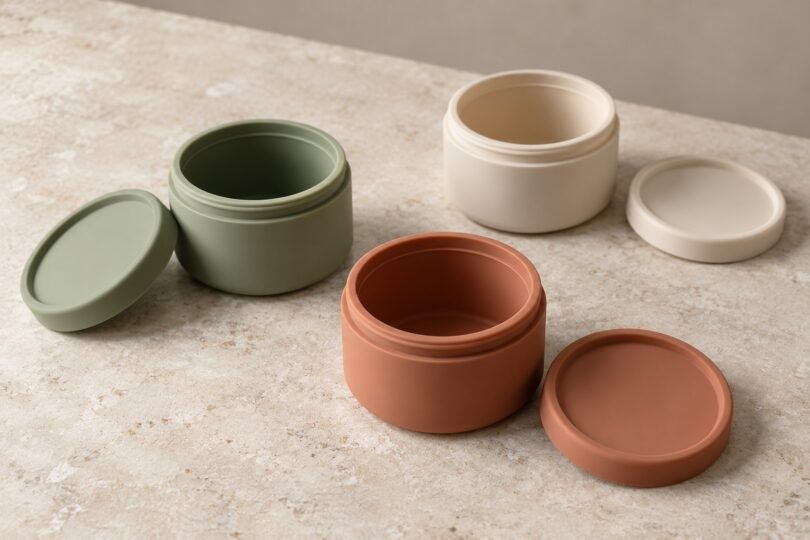

A silicone concentrate jar is usually a small container sold for wax, resin and cannabis concentrates. The important buying question is which parts actually touch the contents: the entire body may be silicone, or the jar may be glass with only a silicone lid. This guide focuses on the empty containers and the specifications that help you choose between them.
For a compact all-silicone jar, start with a clearly specified capacity and a matching lid. For a glass contact surface, choose a glass jar with a documented closure. Neither the word “silicone” nor a tight-feeling lid establishes chemical compatibility, a safe heating temperature or long-term storage performance.
Silicone concentrate jars: three designs to compare
These manufacturer examples illustrate different sizes and constructions. Check the selected size, color and quantity before ordering; a product-family photograph may show several versions.
| Container | Published size | Body and closure | What to check |
|---|---|---|---|
| Pulsar Silicone Concentrate Container | Small: 3 mL, 32 mm diameter; medium: 6 mL, 35 mm; large: 7 mL, 38 mm | Silicone body; top and bottom snap together | Select the size deliberately. The linked variant is Small / Rasta. |
| Pulsar RIP Series Block Silicone Container | 9 mL | Platinum-cured silicone; one base and one lid; stackable block shape | The linked variant is Rasta. Stacking is an organization feature, not proof of leak resistance. |
| Oil Slick 6 mL Glass No-Neck Jar with Silicone Lid | 6 mL; packs of 200, 400 or 1,000 | Glass body with silicone lid; non-child-resistant | A bulk-pack alternative with glass walls. Confirm the supplied closure before ordering. |
Choose the body material first
An all-silicone container puts its contents against silicone walls and base. A glass jar with a silicone lid gives you a glass body, but the contents may still contact the lid. A silicone sleeve around a glass insert is another construction again; inspect the parts list rather than judging by the exterior color.
Pulsar describes its round container as silicone with a snap-together top and bottom. Its Block model adds a stackable shape and a larger listed capacity. Those are useful physical differences, but the product descriptions do not supply a general solvent-compatibility chart or a numerical heating limit. See the round-container specifications and the Block specifications.
For compatibility, ask about the exact contents, their concentration, contact time and temperature. Thermo Fisher’s sample-handling technical guide explains that these conditions affect material resistance. That laboratory guidance is a reason to seek product-specific confirmation; it does not certify the consumer jars above. A container advertised for wax is not automatically suitable for every oil, resin mixture or cleaning solvent.
Match capacity to the space you need
Milliliters measure volume; grams measure mass. Do not read “7 mL” as “7 grams.” The amount that fits depends on the material, and a listed capacity does not tell you how much clearance the lid needs.
- Check capacity and exterior dimensions separately. Diameter matters when fitting a jar into an organizer; volume describes its internal space.
- Allow room for the closure. Avoid filling material into the rim or lid engagement area.
- Check the package contents. One jar, a base-and-lid pair and a bulk pack are different purchases.
- Choose a shape you can inspect and clean. Look at the interior corners and the underside of the lid, not only the decorative exterior.
Check the lid independently
Use the lid intended for that exact jar. Similar capacity or diameter does not establish interchangeability. Before filling, check that the rim is undamaged and the closure seats evenly. A loose, torn or distorted lid is a reason to replace the affected part.
Treat “airtight,” “leakproof” and “child-resistant” as separate claims. A snap lid does not demonstrate all three. Oil Slick explicitly identifies its 6 mL example as non-child-resistant. Its current page calls the lid twist-off, while an older indexed version calls it snap-on; ask the supplier to confirm the closure supplied with your order. Check the current product details.
For extended storage or transport, request evidence for the complete jar-and-lid combination under the intended conditions. A storage duration cannot be inferred from the material name, and a lid that feels secure is not a measured shelf-life claim. Follow the contents supplier’s packaging instructions when they specify a particular container.
Cleaning and temperature: follow the exact product
Oil Slick’s current instructions for the 6 mL glass jar and silicone lid specify warm water and mild soap, gentle cleaning and complete drying. They say to avoid abrasive cleaners, harsh chemicals, extreme temperature changes and the dishwasher. Those instructions apply to that product. Read Oil Slick’s care guidance.
For other jars, obtain the maker’s care instructions before using alcohol, another solvent, boiling water or a dishwasher. Instructions for one silicone accessory do not automatically apply to another formulation or closure. Remove the lid for cleaning when the product allows it, inspect the mating surfaces and ensure the parts are dry before reassembly.
Do not select an oven, microwave or freezer temperature from a generic silicone claim. Ask for limits for the complete product, including its lid and any insert. A storage container should not be treated as heating equipment without explicit manufacturer instructions for that use.
Does “food-grade silicone” settle suitability?
No. If food contact is your intended use, ask for documentation for the exact finished container and the relevant food type, contact time and temperature. The FDA’s food-contact reference tables distinguish food types and conditions such as room-temperature storage, refrigeration and reheating. A broad material label does not establish approval for every condition, and food-contact wording does not establish suitability for inhalation-related use.
Before you buy
Confirm five things: the material touching the contents, capacity, matching lid, care instructions and compatibility for your intended storage conditions. Choose the smallest pack that meets your needs. If a listing conflicts on size or closure, get that detail resolved before committing to a larger order.