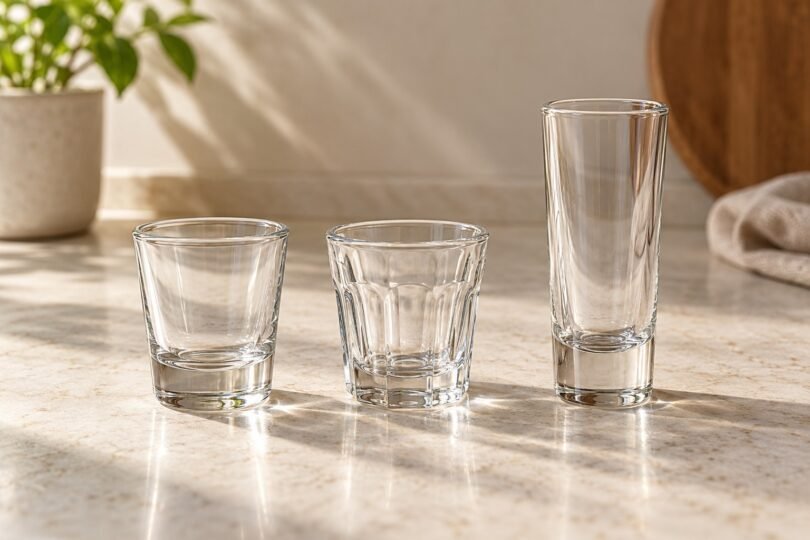

The best Libbey shot glass depends on what you need to pour, how you plan to serve it, and how many glasses you actually want to store. A fluted two-ounce glass, a smaller plain whiskey glass, and a tall shooter can all be sensible choices, but they solve different problems. Start with the exact model number and usable serving space rather than a long list of look-alike listings.
For a versatile unmarked option, start with the Libbey 5126. Consider the 5120 for a shorter, simpler shape or the 5109 when a taller presentation matters. If you need a visible one-ounce reference, look specifically for 5126/A0007. These recommendations compare manufacturer specifications and practical buying considerations; they are not based on hands-on testing.
Libbey shot glasses at a glance
| Model | Listed capacity | Manufacturer case pack | Why consider it |
|---|---|---|---|
| 5126 Fluted Whiskey | 2 oz | 48 pieces | Unmarked fluted glass with room for a smaller measured pour |
| 5127 Fluted Whiskey | 1.5 oz | 48 pieces | Smaller capacity in a similar-looking fluted format |
| 5120 Whiskey | 1.5 oz | 72 pieces | Short plain glass for compact service |
| 5109 Shooter | 2 oz | 24 pieces | Taller format for presentation |
These are Libbey’s foodservice case quantities, not a promise about the quantity in every retailer’s listing. A seller may offer a split case, a repackaged set, or a bundle. The linked model pages below provide the manufacturer specifications; confirm the selling quantity separately before checkout.
1. Libbey 5126: the versatile fluted option
The Libbey 5126 Fluted Whiskey is listed at two ounces, 2.88 inches tall and 2.25 inches in diameter. Its pressed-glass, fluted shape suits a straightforward bar-glass look. Libbey specifies a 48-piece case.
Choose this model when you want an unmarked serving glass and will measure the drink elsewhere. Its nominal capacity leaves more room around a smaller pour than a glass whose capacity equals that pour. That makes it a more practical starting point for someone who values carrying space above the liquid.
The limitation is measurement: the plain 5126 does not become a one-ounce measure just because a related version has a line. Keep the full model code on your shopping checklist. If your existing glasses are lined, replacing them with this unmarked version may change your serving routine.
2. Libbey 5127: check capacity despite the similar shape
The Libbey 5127 Fluted Whiskey has a listed capacity of 1.5 ounces and a 48-piece case pack. Libbey lists its height as 2.88 inches and diameter as 2.25 inches, the same exterior measurements shown for the 5126.
That is a useful warning against choosing by the photograph alone. Similar outside dimensions do not establish equal internal capacity. Buy the 5127 if you specifically want this smaller-capacity model, perhaps to match glasses already in your cupboard. Avoid treating its name or appearance as proof that it holds the same quantity as another fluted glass.
For a full 1.5-ounce serving that needs comfortable headroom, evaluate a larger-capacity glass instead. The smaller model can still be useful for smaller tastes, but the amount served should be a deliberate choice rather than whatever reaches the rim.
3. Libbey 5120: a short, plain whiskey glass
The Libbey 5120 Whiskey is a clear, pressed-glass model with a 1.5-ounce listed capacity. Its specifications show a 2.38-inch height, a two-inch diameter, and a 72-piece manufacturer case.
This is the practical candidate when a low-profile, uncomplicated glass fits your table better than fluting or a taller shooter. Before buying a case for a small household, consider whether the extra quantity is genuinely helpful. A smaller retailer pack may suit you better even if the price per glass is higher.
The shorter height is also worth checking against your storage and washing setup. A glass can fit comfortably on a shelf yet be awkward in a particular dishwasher basket. Measure the space you intend to use rather than assuming all small glasses behave alike.
4. Libbey 5109: a taller shooter
The Libbey 5109 Shooter is currently listed by Libbey at two ounces, 3.5 inches tall and two inches in diameter, with a 24-piece case. Its taller shape offers a different presentation from the short whiskey glasses.
Consider it when the look of a layered drink or small serving is part of the occasion. The taller profile deserves a storage check, especially if you use shallow drawers or low shelves. It is a presentation choice, not evidence of a larger pour than another glass with the same listed capacity.
Some older catalogs describe this model differently. Use the exact model and the specifications attached to the item you are ordering, and ask the seller to resolve any conflicting capacity description. Do not mix specifications from different listings simply because the photographs appear similar.
Listed capacity is not a comfortable serving size
Libbey explains that its capacity measurements go to overflow: liquid is above the rim immediately before spilling. The company also describes using an average from a production run, with individual pieces able to vary slightly.
A two-ounce capacity therefore does not mean two ounces will sit below the rim with room to carry the glass. Decide your intended pour first, then allow space above it. For example, if your recipe needs 1.5 ounces, a nominal two-ounce glass is a more sensible candidate to assess than one rated at exactly 1.5 ounces. The precise headroom still depends on the glass.
A simple check at home is to measure your intended serving with a separate kitchen or bar measure, transfer it into the glass, and see whether the remaining space suits your use. This checks your setup without pretending to certify the vessel.
When a marked shot glass makes sense
Libbey’s Shots & Shooters lineup distinguishes 5126/A0007, a two-ounce fluted glass with a one-ounce line, from 5126/S0711, a two-ounce model with a seven-eighths-ounce line. It also lists 5127/S0710 with a three-quarter-ounce line and 5127/S0711 with a seven-eighths-ounce line.
The suffix is part of the product identity. A listing that merely says “lined Libbey shot glass” is not enough when your recipe depends on the line position. Check the capacity, marked quantity, exact code and pack count together.
A visible measuring reference should not be treated as a certified calibration claim. The cited lineup identifies the lines but does not establish a measurement tolerance or legal certification for your intended use. If controlled accuracy or trade measurement matters, choose an appropriately specified measure and verify its documentation.
Dishwasher claims and everyday care
Do not infer that every Libbey glass, decorated version or reseller-customized set has identical washing instructions. The foodservice specification pages above establish model details; they do not, by themselves, establish a dishwasher claim for every possible version. Check the care instructions supplied with your exact purchase.
Libbey’s handling guidance warns against abrupt temperature changes and recommends letting glassware reach room temperature before washing. It also advises removing damaged glassware from use. Avoid knocking the rims against hard objects or carrying several glasses by their rims.
A plain shot glass is not automatically suitable for hot espresso, an oven or a microwave. If heat exposure is part of your plan, look for explicit approval for that use rather than relying on thickness or a heavy base. Inspect new arrivals before use and contact the seller about chips, cracks or shipping damage.
A final buying checklist
- Match the code: copy the entire model number, including any line-mark suffix.
- Count actual glasses: distinguish one piece, a retailer set and a manufacturer case.
- Plan the pour: allow room above the intended serving instead of filling to capacity.
- Check storage: compare height and diameter with your shelf, tray and washing arrangement.
- Check the seller: review breakage reporting, returns and whether replacements can match the set.
For most buyers, narrowing the choice to a few verified models is more useful than chasing the largest multipack. Pick the shape you will use, confirm the correct capacity and line, and buy a quantity that makes sense for your home or service setup.