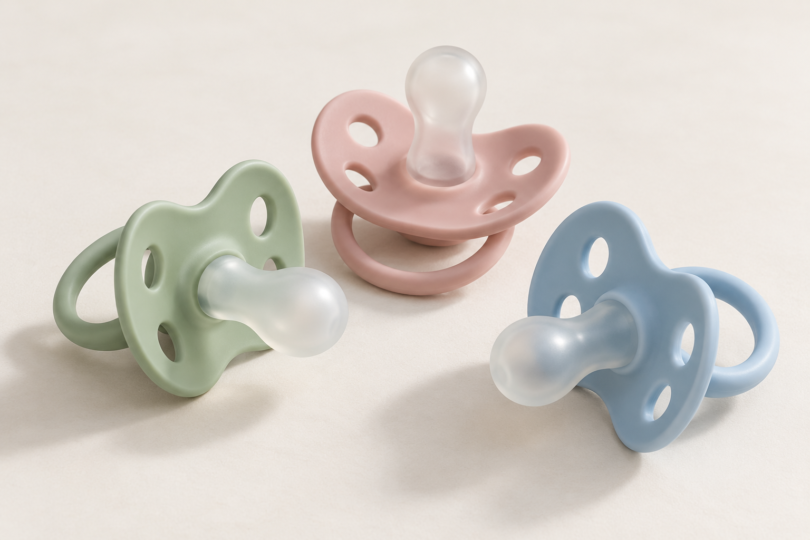

The best pacifier for a breastfed baby is one that fits their age, is used according to its instructions and suits their preference. Start by comparing the Philips Avent Soothie for a simple newborn option, Dr. Brown’s HappyPaci for its open-back design, and NUK First Choice Comfy for a different shield and nipple design. All three are one-piece silicone pacifiers; none comes with a promise that your baby will accept it.
For breastfed babies, timing matters more than a “breast-like” label. The American Academy of Pediatrics’ guidance is to wait until breastfeeding is established: a good milk supply, comfortable and consistent feeding, an effective latch and appropriate weight gain. That timing varies. If feeding is painful or weight gain is uncertain, ask your pediatrician or lactation professional before adding a pacifier.
Compare the three pacifiers
| Pacifier selection | Labeled age and pack | Why compare it | Main buying limit |
|---|---|---|---|
| Philips Avent Soothie, SCF190/41, Green | 0–3 months; 4 pacifiers | Simple one-piece silicone construction | Shorter labeled age range than the other two |
| Dr. Brown’s HappyPaci, Light Pink/Pink/White | 0–6 months; 3 pacifiers | Open-back bulb and butterfly-shaped shield | Bottle-nipple shape does not guarantee acceptance |
| NUK First Choice Comfy, Earth Tones, model 2190570 | 0–6 months; 5 pacifiers | Heart-shaped shield and NUK nipple design | Five-pack is a larger first purchase if the shape is new to your baby |
1. Philips Avent Soothie: a simple newborn option
The Soothie SCF190/41 is the first option we would compare for a baby within its 0–3 month label. Its one-piece silicone construction keeps the design straightforward, and this green four-pack provides spares. The advantage is simplicity; the limitation is its shorter age window. Check the package when moving to another Soothie size instead of assuming every version is interchangeable.
Philips’ support page for this model links its care instructions, which say to inspect and pull the nipple before use, discard it at the first damage or weakness, and replace it after four weeks of use. A four-pack is useful only if you track wear and replacement for each pacifier.

Philips Avent Soothie SCF190/41, 0–3 months, Green, 4-pack
As an Amazon Associate we earn from qualifying purchases.
2. Dr. Brown’s HappyPaci: an open-back design
The HappyPaci is a good alternative to compare if you want a 0–6 month silicone pacifier with a butterfly-shaped shield and an open-backed bulb. The open back gives access for cleaning, and the shield curves away from the nose and cheeks. The selected pack contains light pink, pink and white pacifiers.
Its nipple shape follows Dr. Brown’s bottle nipple, but that is a design feature, not proof of a better fit for breastfeeding. Buy the three-pack because you want to try that shape, not because of an acceptance promise. The manufacturer identifies the pink/white version as PS13005; the selected retailer lists its three-pack as PS13005-P4.
Dr. Brown’s pacifier instructions allow top-rack dishwasher cleaning and suitable sterilization methods for HappyPaci. They also say it is not a teether, require inspection before every use, and specify replacement after one to two months of use or sooner at signs of damage.

3. NUK First Choice Comfy: another shape to try
The NUK First Choice Comfy, model 2190570 is worth comparing if your baby does not take to the first nipple shape you try. This selection is the Earth Tones five-pack for 0–6 months. It combines a heart-shaped shield with a one-piece silicone body. NUK calls its nipple “orthodontic”; treat that as the product’s design description, not a guarantee about future teeth or jaw development.
The five-pack provides several spares, but it is a bigger commitment to an untried shape. Match the age, Earth Tones color selection, five-pack count and model 2190570 on the maker’s page. Comfy packs and age stages can differ, so the family name alone is not enough.
NUK’s care guidance specifies a five-minute boil before first use, daily washing with hot water and mild detergent, and top-rack dishwasher compatibility. It says to replace pacifiers after two months of use and to discard a damaged nipple immediately.
How to choose without buying too many
- Start with the age label. These specific selections are for 0–3 or 0–6 months. For an older baby, compare a correctly labeled stage rather than extending the use of these sizes.
- Try a shape before stocking up. Babies have different preferences. Start with one pack; buying several brands at once is optional.
- Plan cleaning and replacement. Follow the instructions supplied with the exact pack, including cooling after sterilization. Inspect before every use, pull the nipple as directed, and replace at any sign of damage or weakness rather than waiting for the scheduled interval.
- Keep feeding first. The AAP’s pacifier advice says not to use one to postpone a meal or to make a baby accept it. Offer it only when the baby is not hungry; stop if they refuse.
Pacifiers and sleep: keep the rules separate from the shopping choice
The AAP recommends offering a pacifier at naps and bedtime once breastfeeding is established. If the baby refuses it, do not force it; if it falls out after they fall asleep, you do not need to replace it. Pacifiers do not guarantee prevention of SIDS. Continue placing your baby on their back in a crib, bassinet, portable crib or play yard that meets safety standards with a firm, flat mattress and fitted sheet.
Keep strings and cords away from the baby’s neck, and do not attach a pacifier to sleep clothing. Keep plush holders, toys, blankets and other attachments out of the sleep space. Bottle nipples, food feeders and teething tubes are not substitutes for an age-appropriate pacifier.
Follow the particular product’s supervision warnings as well as its age and care directions. Philips specifies adult supervision; Dr. Brown’s and NUK warn against leaving a child unattended with a pacifier. General sleep guidance does not override those instructions. Ask your child’s clinician if you need help reconciling the label with a sleep routine.
Frequently asked questions
Which pacifier is most like breastfeeding?
No nipple-shape description can tell you which pacifier your baby will prefer. Compare age-appropriate designs, keep feeding needs first and skip a pacifier your baby does not want.
When can a breastfed baby start using a pacifier?
When breastfeeding is established, rather than on a universal calendar deadline. If latch, comfort, milk supply or weight gain is a concern, get individual feeding advice first.
Does an orthodontic pacifier guarantee straight teeth?
No. Do not read the label as a promise about your child’s teeth. The AAP says prolonged sucking habits can affect the mouth and tooth alignment; discuss ongoing use and weaning with your child’s clinician or dentist.
Which one should I compare first?
Compare Soothie for a straightforward 0–3 month option, HappyPaci for its accessible open-back design at 0–6 months, or NUK Comfy if you want another nipple and shield design to try. Your baby’s age, preference and the product instructions should settle the choice.