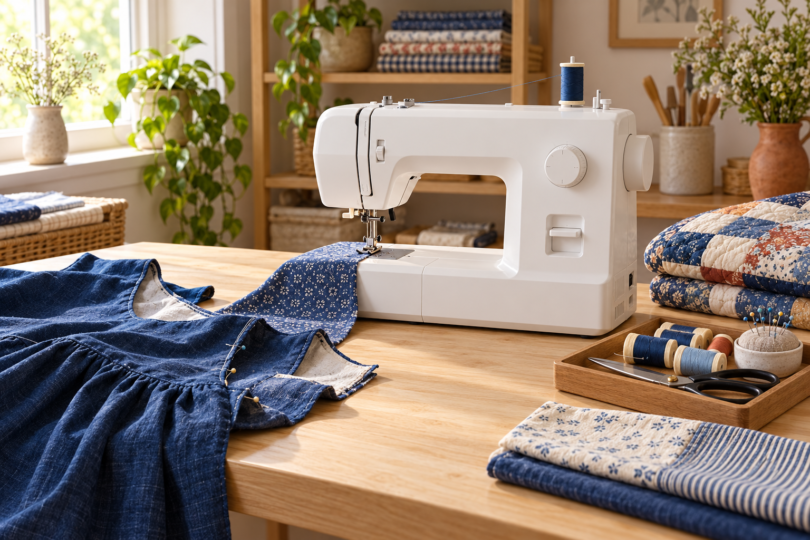

The best sewing machine for an advanced sewer depends on the work you want to improve. Start with the JUKI HZL-F600 for computerized utility and decorative sewing, the JUKI TL-2000Qi for a dedicated straight-stitch workstation, or the Janome HD-3000 for mechanical controls. This shortlist compares documented features and tradeoffs; it does not claim hands-on testing or an overall performance winner.
Three machines for different sewing priorities
| Machine | Machine type | Reason to shortlist it | Main limitation |
|---|---|---|---|
| JUKI HZL-F600 | Computerized household machine | 225 stitch patterns, 16 buttonhole styles and programmable thread trimming | Choose its controls for your workflow; stitch count alone is not a quality measure |
| JUKI TL-2000Qi | Portable straight-stitch machine in JUKI’s mechanical/semi-professional range | Adjustable presser-foot pressure, drop feed and foot-controlled trimming | Straight stitch only; no built-in zigzag or buttonhole program |
| Janome HD-3000 | Mechanical household machine | Dial stitch selection, manual tension and adjustable foot pressure | No needle-up/down control listed |
1. JUKI HZL-F600: for a varied home-sewing workload
The HZL-F600 is the most natural starting point here if you want utility stitches, decorative patterns and buttonholes in one computerized household machine. JUKI specifies 225 stitches, 16 buttonhole styles and four lettering fonts. It also lists needle positioning, pattern-sequence memory and programmable thread trimming.
Consider it when you often switch between garment construction and decorative work. The included wide table and knee-lift lever also merit a place on your demonstration checklist. JUKI’s box-feed design is a feature to try on your own fabrics, not evidence that every difficult seam will feed perfectly.

JUKI HZL-F600 Computerized Sewing and Quilting Machine
As an Amazon Associate we earn from qualifying purchases.
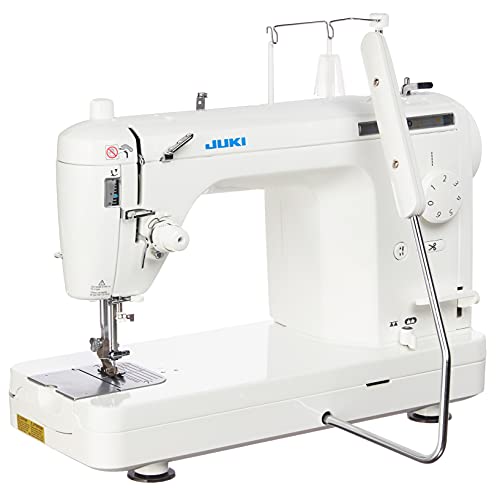
2. JUKI TL-2000Qi: for focused straight-stitch work
The TL-2000Qi is a different proposition: a portable straight-stitch machine with adjustable foot pressure, a thread-tension dial, needle-up/down control and a feed-dog drop for free-motion work. JUKI rates its maximum speed at 1,500 stitches per minute. That is a manufacturer specification, not a speed achieved in our testing.
It is worth considering as a dedicated piecing, quilting or straight-seam machine when you already have a way to sew zigzags and buttonholes. It cannot replace those built-in stitch programs. The model here is TL-2000Qi; do not assume the similarly named TL-2010Q has the same controls or accessories.
3. Janome HD-3000: for sewists who prefer mechanical controls
The HD-3000 offers dial stitch selection, manual thread tension, adjustable presser-foot pressure and 18 stitches. Its free arm and drop feed add useful flexibility. It belongs on the list if you prefer setting a machine directly and have little interest in a large decorative-stitch library.
This is a simpler workflow choice, not an automatic upgrade for every experienced sewer. Janome lists no needle-up/down control. Its product page also disagrees with itself about some buttonhole and stitch-width details, so confirm those functions on the actual machine before buying. The “heavy duty” name is not a promise of unlimited material thickness.

What to check in a dealer demonstration
- Bring the fabric, thread and seam stack you actually sew, including a bulky intersection. The HD-3000 manual specifically recommends trying the thread and needle on a sample of the project fabric. Extend that practical habit to every machine you compare.
- Test slow starts, stopping position, reverse stitching and foot-pressure adjustment. Decide whether a knee lift, automatic trim or needle-position button saves enough effort to justify the machine you are considering.
- Check the actual space around the needle and the table footprint. An extension table supports fabric outside the machine; its width is not the same thing as throat space inside the arm.
- For leather, dense canvas or repeated bulky work, ask the dealer to demonstrate your exact materials and explain the machine’s limits. None of these recommendations establishes a maximum stack thickness or suitability for continuous industrial production.
- Verify the exact model, voltage label, included feet, table, case, service arrangements and return terms before paying. A model-family description does not establish the contents or support terms of every seller’s bundle.
Frequently asked questions
Which is the best all-round starting point?
For this shortlist, start with the HZL-F600 if you need varied stitches and computerized conveniences. Choose the TL-2000Qi around straight-stitch work, or the HD-3000 around a preference for mechanical adjustment. Those are workflow recommendations, not measured rankings.
Is a mechanical machine better for an advanced sewer?
Not automatically. The HD-3000 uses dial stitch selection and manual tension; the F600 adds computerized stitch and pattern controls. Even the TL-2000Qi’s mechanical/semi-professional classification includes electronic controls. Compare the functions you will use rather than treating either label as a quality guarantee.
Can these machines sew leather?
There is no blanket yes for every leather or seam stack. Janome provides a specific HD-3000 leather-sewing guide, which recommends leather thinner than 4 mm, or thinner than 2 mm when sewing more than four layers. Those material recommendations do not guarantee every seam stack will work. Request a demonstration of your material and intended layers before choosing any machine for that work.
Will the TL-2000Qi sew buttonholes?
Should I buy the machine with the most stitches?
Only if you expect to use them. Make a list of your essential stitch types and controls, then compare those features on a sample project. The F600’s larger pattern selection and the TL’s single-stitch focus solve different problems.