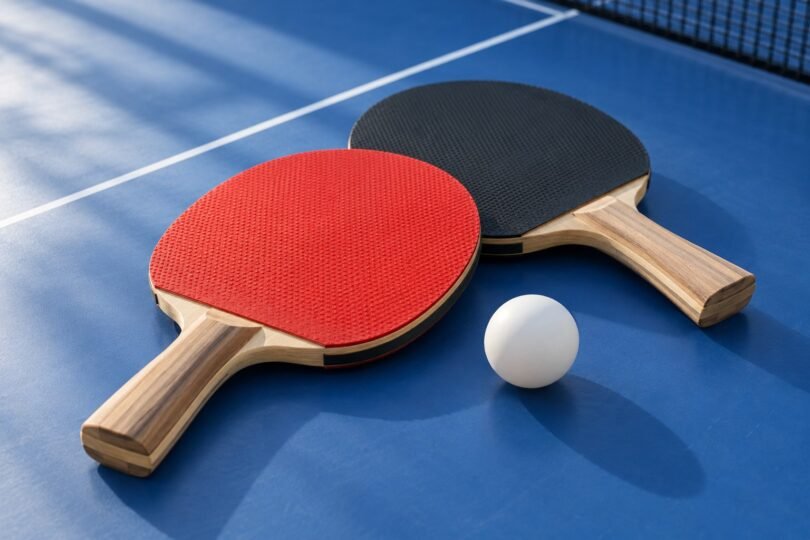

A good STIGA table tennis racket should help you repeat your strokes, place returns and develop spin without making every rally feel rushed. For an improving recreational player, the Evolution is a sensible first comparison. For an established attacker who specifically wants a carbon construction, compare the Red Pro Carbon and Raptor. The Titan offers another five-ply option, although its current manufacturer page leaves some specifications unstated.
This guide compares published manufacturer details and buying trade-offs. It does not claim hands-on testing, measured ball speeds or a universal winner. The recommendations also separate ready-made paddles from custom blade-and-rubber combinations: a familiar brand name alone does not make two setups equivalent.
Quick comparison of four STIGA rackets
| Racket and current listed SKU | Blade | Sponge | Manufacturer speed / spin / control |
|---|---|---|---|
| Evolution, T1281-1 | 6-ply wood | 2 mm | 96 / 94 / 90 |
| Red Pro Carbon, T1290RD | 5 wood layers plus 2 carbon layers | 2 mm | 99 / 100 / 80 |
| Raptor, T1291-1 | 5 wood layers plus 2 carbon layers | 2 mm | 99 / 100 / 80 |
| Titan, T1260 | 5-ply balsa blade | Not stated on cited current page | 80 / 77 / 81 |
These numbers are STIGA’s published ratings, not independent measurements, percentages or guaranteed results. A control score of 90 does not mean 90 percent of your shots will land. Use the figures as limited clues about the manufacturer’s positioning, then consider grip comfort, technique and the full construction.
Evolution: start here for a balanced shortlist
The STIGA Evolution uses a six-ply blade made with Ayous, Awan and Kiri woods, a two-millimeter sponge and a flared handle. STIGA also identifies Shock Dispersion Tube technology in the handle. The current U.S. product page lists SKU T1281-1.
It is our starting point for someone choosing among these performance-oriented premades who values placement alongside attacking potential. That recommendation is an interpretation of the published setup and positioning, not proof that it will feel more controlled in every player’s hand.
Do not buy it only for the technology names. If you can try a racket before purchasing, pay attention to whether you can keep a relaxed grip and make comfortable backhand-to-forehand transitions. For a new player, a manageable feel matters more than a marginal difference in a printed score.

STIGA Evolution table tennis racket, 1 Racket variant
As an Amazon Associate we earn from qualifying purchases.
Red Pro Carbon: for a deliberate move toward attack
The Red Pro Carbon, SKU T1290RD on the current U.S. page, combines five lightweight wood layers with two integrated carbon layers and a two-millimeter sponge. STIGA identifies smooth inverted S5 rubber and a flared handle.
Consider it if you already know you want this carbon construction and are comfortable making active attacking strokes. Do not treat “carbon” as an automatic upgrade for a beginner. A more ambitious setup is only useful when you can manage the short game and return opponents’ spin consistently.
The red version also needs to be distinguished from the Blue Pro Carbon, Cybershape versions and bundles. Check the selected variant, rather than relying on a search result that combines several names. The Amazon link below is for the Red, One Size variation; compare the seller’s current model details with STIGA’s specification before ordering.

Raptor: compare the details instead of assuming a higher tier
The STIGA Raptor is listed as T1291-1. It also has a seven-layer construction combining five wood layers with two carbon layers, a two-millimeter sponge and smooth inverted S5 rubber. STIGA lists the same speed, spin and control ratings as the Red Pro Carbon.
Those shared specifications do not demonstrate identical feel, but they also do not justify calling the Raptor a clear performance upgrade. Put the actual selling price, grip comfort, supplied accessories and return terms ahead of an assumed ranking.
For buyers comparing the two, our recommendation is to avoid paying extra solely for the name. A clubmate’s racket or an in-store handling opportunity can help answer the comfort question more directly than another marketing description. Keep any such trial specific to the same version you intend to buy.
Titan: a five-ply alternative with a specification caveat
Escalade Sports’ Titan page lists model T1260 with a five-ply lightweight balsa blade, a Concave Pro handle and smooth inverted rubber. Its manufacturer ratings are lower for speed and spin than the other three rackets in this comparison.
That makes it worth considering when you want a less aggressively positioned option, but the ratings alone cannot establish that it is easier to use. Its control figure also illustrates why a simplistic “slower equals higher control score” ranking is unreliable.
The cited current page does not specify sponge thickness. We have left that field unstated rather than borrowing a number from an older review or a look-alike listing. If thickness is important to your choice, ask the seller to verify the exact packaged version before you buy.
How to choose by the shots you actually play
STIGA’s paddle selection guide recommends that beginners prioritize control and comfort, with more experienced players choosing around their style. We would turn that into a practical question: which recurring problem are you trying to solve?
- Your returns regularly go long: first assess stroke length, racket angle and timing. Buying the most attacking option may not address the cause.
- You rally reliably but struggle to pressure opponents: compare the attacking models, ideally with advice from a coach who has seen you play.
- Your hand feels cramped or tense: prioritize handle comfort instead of choosing by speed rating.
- You mainly play occasional family games: decide whether you need one personal racket or a recreational set before paying for a performance premade.
For a trial session, use your usual ball and partner if possible. Try short serves, return of serve, controlled drives, blocks and a few deliberate attacks. Note which shots become easier to repeat. This is a suggested buying test, not a test we have conducted on these products.
Blade layers, rubber and sponge are different specifications
The blade is the structural body of the racket. Rubber is the ball-contacting surface, and sponge sits underneath the rubber in a sandwich covering. A “seven-ply blade” and a “two-millimeter sponge” describe different parts; neither figure is the total thickness of the finished racket.
STIGA’s rubber selection guide discusses thickness alongside hardness and playing style. The buying lesson is to avoid judging the whole setup from one number. Two rackets with two-millimeter sponges can still use different blades, rubber compounds or constructions.
Similarly, do not assume you can replace the rubber on every ready-made paddle as easily as on a purpose-built custom setup. Before purchasing with future modifications in mind, verify replaceability with the manufacturer or seller. If choosing your own rubber is already a priority, ask a specialist about a separate blade-and-rubber combination.
What “ITTF approved” does and does not establish
The manufacturers describe approved rubber on these product pages. That is not a guarantee that every racket carrying the model name will pass every event’s equipment check indefinitely. The exact covering, its condition, any alterations and the competition’s requirements still matter.
The ITTF’s racket-control explanation identifies checks for flatness, covering thickness, volatile organic compounds and conformity with the authorized-coverings list. For organized competition, verify the current list and event requirements with the organizer. A printed sponge specification is not a measurement of the entire covering assembly.
We have not independently certified these individual retail units or matched every shipped rubber to a current authorization entry. Treat a manufacturer’s tournament-play description as a starting point for checking, rather than a substitute for the rules that apply to your event.
Care and purchase checks
STIGA’s cleaning guide recommends gentle surface cleaning with a soft cloth or damp sponge and air drying. Follow the instructions for your exact racket, avoid soaking the blade, and allow it to dry before putting it away. STIGA also recommends a protective case and avoiding excessive heat and moisture in its performance-racket guidance.
Before checkout, verify that the listing is a complete racket, identify the selected model and color, and check whether a case or balls are actually included. Compare final delivered cost and returns rather than a headline discount. Start with the Evolution if you want a balanced shortlist; move toward the carbon options because they suit a clear playing goal, not because their names sound more advanced.