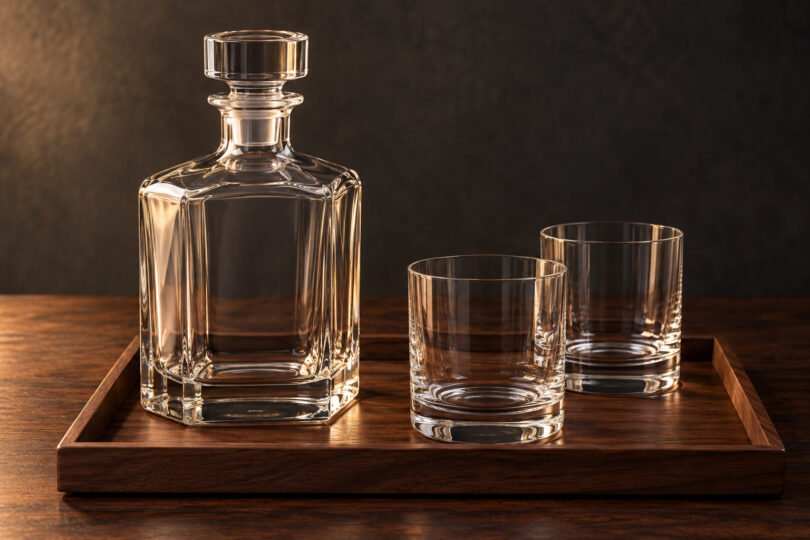

Royal Decanters was the name used for decorative whiskey-decanter sets, including an etched globe and a skull-shaped design. The challenge today is identifying the exact set behind a listing. A similar silhouette or a title containing “royal” does not prove that two products have the same maker, capacity or accessories.
The clearest surviving specifications below come from the retailer that offered these sets. They are historical listing details, not results from hands-on testing or a current manufacturer catalogue. The original retailer pages are not reliable current shopping destinations. Use them to identify an existing set and ask better buying questions, rather than assuming an old listing guarantees current availability.
First, confirm the Royal Decanters brand
A brand-promotional press release names Royal Decanters and links its skull-shaped product to the former royaldecanters.com website. It also discusses globe and ship-themed designs. This helps establish the historical brand identity, but promotional language is not independent evidence of durability, safety or superior taste.
A current manufacturer catalogue and model-specific care manual could not be verified for this guide. Royal Doulton, for example, has its own official decanter collection; it should not be substituted for Royal Decanters simply because both names contain “Royal.” Likewise, a listing labelled Royal Reserve or Crown Royal needs its own identification. Compare the full brand, model, photographs and package contents.
Two historically documented Royal Decanters sets
Etched Globe Whiskey Decanter Set
A historical Touch of Modern listing for the Royal Decanters etched-globe set specifies an 850 mL decanter, a wooden base and four matching glasses. Its FAQ gives the glasses’ size as 10 ounces each. The retailer describes hand-blown glass and lists the materials as wood and glass.
The same page gives dimensions of 12 inches long, 10 inches wide and 17 inches high, but does not clearly distinguish the assembled footprint from packaging measurements. Confirm usable display dimensions with the seller before planning a shelf around those numbers. The record marks the sale as ended. Its old price and warranty line should not be treated as a current offer or enforceable promise from a new seller.
Skull Whiskey Decanter Set
A separate historical Touch of Modern listing for the Royal Decanters skull set specifies a 750 mL decanter, a wooden base and four glasses. It also describes hand-blown glass and lists wood and glass as the materials. Its stated dimensions are 12.20 by 11.26 by 7.64 inches.
That page does not establish the individual glasses’ capacity. Do not borrow the globe set’s 10-ounce figure for the skull set. Nor should a two-glass skull-shaped product elsewhere automatically be described as this four-glass package. Similar-looking designs can have different dimensions and bundles.
Choose capacity around the bottle you actually use
Compare millilitres with millilitres whenever possible. An 850 mL advertised capacity is nominally larger than a 750 mL bottle, while a 750 mL vessel is nominally the same size. However, a quoted maximum capacity does not tell you the comfortable working fill level beneath the stopper. Ask whether the measurement is a practical fill volume or a brimful measurement, especially if transferring an entire bottle matters.
Think about the pouring routine as well. Will you lift the vessel out of a stand for every serving? Can you hold the body securely without gripping delicate decoration? Is there room above the display to remove the stopper? Measure your intended shelf and leave handling space rather than treating the advertised height as the only clearance required.
Glass, crystal and lead: what the evidence supports
The surviving retailer descriptions establish wood and glass, but they are not laboratory reports. Although the historical press release uses a lead-free claim, no model-specific composition certificate was verified here. This guide therefore does not certify either set as lead-free. Ask the current seller for documentation tied to the actual product if the material composition is central to your purchase.
For lead crystal, Health Canada advises against extended beverage storage. Lead can migrate from the crystal into a drink, with the amount affected by the material, liquid and contact time. The agency recommends using such decanters for serving rather than prolonged storage. This is general guidance about leaded crystal, not a finding that a particular Royal Decanters set contains lead.
Do not infer composition from weight, sparkle, a ringing sound or the word “crystal” in a marketplace title. For an unidentified second-hand vessel, keeping it decorative until you can establish what it is avoids making a food-contact assumption from appearance alone.
A stopper is not proof of airtight storage
No verified seal test or preservation study was found for these exact sets. A product photograph showing a stopper cannot establish how well the assembled vessel seals, and a seller’s “airtight” adjective is not a measured storage result.
If your main aim is keeping an expensive bottle for occasional use, retaining its original bottle and closure is the simpler practical choice. Use a decorative decanter for presentation only when its food-contact suitability is established. Avoid buying one on a promise that it will age whiskey, improve every pour or preserve flavour for a stated number of months without supporting evidence.
Care when the original instructions are missing
No Royal Decanters-specific dishwasher or cleaning instructions were verified. Do not transfer the care label from another brand’s similar-looking globe or skull set. Ask for the original instructions and keep them with the product.
For general glass handling, the Canadian Conservation Institute recommends inspecting an object for damage before cleaning, supporting it with both hands and avoiding extreme or rapid environmental changes. It also warns that repaired glass objects should not be used for food or beverages. These are useful conservative principles for an older decorative set.
- Inspect the rim, neck, stopper and any interior decoration for chips, cracks or repairs before use.
- Avoid forcing a stiff stopper or pushing a brush against delicate internal glasswork.
- Keep the wooden support separate from glass-cleaning decisions; the absence of instructions is not permission to soak the entire assembly.
- Do not assume dishwasher, freezer or hot-water compatibility without model-specific guidance.
Questions to ask before buying a used or remaining-stock set
- What identifies the maker? Request photographs of the box, labels and any model information, as well as the actual vessel.
- What is included? Count the glasses and confirm that the matching stopper and base are present. Ask about funnels or other accessories rather than assuming they were standard.
- What condition is it in? Request close-ups of the opening, stopper seat, base contact points and any internal ornament. Ask explicitly about repairs.
- What documentation comes with it? Seek care directions, material information and any current warranty terms supplied by this seller.
- What happens if it arrives damaged? Check packing arrangements, reporting deadlines and return costs before paying.
Common questions
Are all Royal Decanters sets the same size?
No. The documented globe and skull listings state different vessel capacities. Identify the model rather than treating the brand name as a single specification.
Do the listed sets include whiskey?
The cited package descriptions list glassware and a base, not a bottle of whiskey. A staged photograph containing a drink should never be read as an included-item list.
Which set is the better buy?
There is no substantiated performance winner here. Choose by the verified model, completeness, condition, documented suitability and practical fit for your space. If the seller cannot establish those basics, an attractive shape is not enough reason to commit.