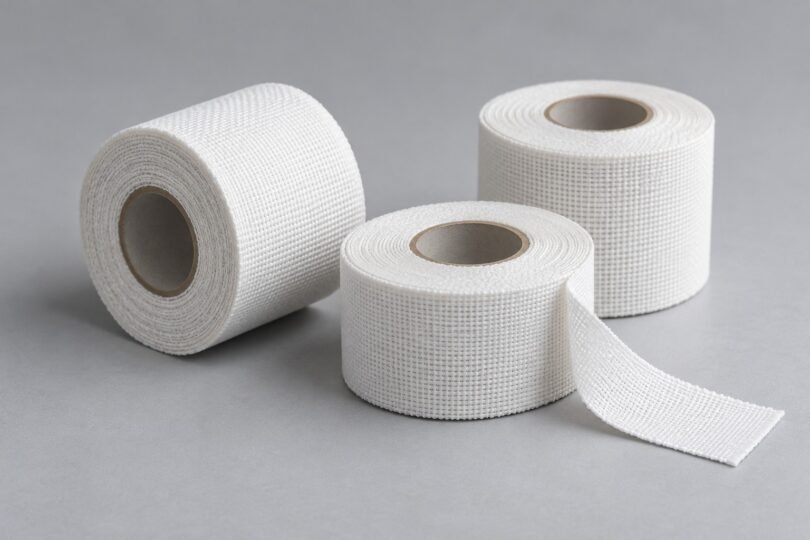

If you need Zonas 1-inch tape, look for the full specification: 1 inch wide by 10 yards long per roll. A familiar white roll or the Zonas name alone is not enough. The range also includes a wider 1.5-inch tape, and the available records use more than one product identifier.
The other important check is latex. Current manufacturer and device information does not support treating Zonas as universally latex-free. Before buying, match the width, length, pack count and material warnings to the exact package being sold.
The one-inch product to identify
The FDA/NLM AccessGUDID record for ZONAS by Actimove identifies BSN Medical, Inc. as the company and lists model and catalog number 65001-04. Its description specifies one-inch by ten-yard athletic tape with a device count of 12. The record’s metric dimensions are 2.54 centimeters wide and 914.4 centimeters long, equivalent to the stated inch and yard measurements.
Use those details as a reference when checking an offer. A seller may list one roll taken from a box, a complete box or a larger case. The product’s registered configuration does not prove that every retail listing contains the same number of rolls.
- Brand: ZONAS by Actimove
- Record identifier: model 65001-04; primary device identifier 04042809649277
- Target size: 1 inch × 10 yards per roll
- Registered device count: 12
- Retail quantity: verify the seller’s exact selected offer
Why you may also see reference 5104
The Essity Sports Medicine catalog, page 11, lists one-inch Zonas under reference 5104. That row specifies white tape, 1 inch × 10 yards, with 12 rolls per box and 12 boxes per case, or 144 rolls in the full case. The same page describes Zonas as rigid, porous cloth strapping tape with a 100% cotton backing, and warns that the product contains dry natural rubber.
Older Johnson & Johnson listings also use 5104. For example, a Rhode Island purchasing document from 2004 specifies that number for the same nominal width and roll length. That older document helps explain the identifier, but cannot establish the composition, condition or availability of a package offered today.
The manufacturer catalog and device record are useful cross-checks, not permission to assume every listing is identical. When an offer mixes old branding with a newer reference, ask for a photograph of the actual package and its label. A stock image reused across several widths cannot settle the question.
Latex and material claims need a careful check
For model 65001-04, AccessGUDID says a natural-rubber-latex or dry-natural-rubber labeling statement is required. It does not identify that product as “not made with natural rubber latex.” Together with the manufacturer’s dry-natural-rubber warning, this is a clear reason not to rely on a generic “latex-free” description.
If you have a known latex allergy, do not choose this product on the strength of an old listing or a retailer’s short summary. Ask your clinician or pharmacist for an appropriate alternative with an explicit, current material statement. Do not use a skin trial to check a known allergy.
Cotton backing and adhesive composition are separate things. “100% cotton” describes the backing; it does not make the whole adhesive product latex-free. Likewise, “porous,” “breathable” and “gentle” do not rule out irritation or allergy. Check every relevant part of the label rather than allowing one appealing material description to answer all your safety questions.
One-inch and 1.5-inch Zonas are different purchases
The Essity catalog also lists Zonas reference 5190 at 1.5 inches × 15 yards in a 32-roll Speed Pack. That is wider, longer and differently packed than the one-inch option. A broad marketplace search can return both, so compare the selected size and quantity immediately before checkout.
A 1.5-inch roll is 50% wider than a one-inch roll. That simple difference matters when a clinician, trainer or supply list has specified a width. A longer roll does not cancel out the width mismatch, and a larger case does not make an unsuitable specification a bargain.
Check the product title, variant selector and package label together. If one says “1 inch” and another says “1.5 inches,” pause rather than choosing whichever field seems convenient. Do not assume that splitting a wider roll produces an equivalent substitute for a specified product.
What kind of tape is Zonas?
Actimove’s sports-medicine information places Zonas in its athletic-tape range and describes a high-tensile strapping tape for support, with a porous backing and hand-tearable construction. Those are product characteristics, not a guarantee that a particular injury will improve or that any taping technique is safe.
Rigid athletic tape is different from stretchy kinesiology tape, a cohesive wrap that sticks to itself, and a wound dressing with a pad. These categories can appear together in search results because all are sold as medical or sports supplies. Choose by the intended task and instructions, not simply by color or the word “tape.”
The one-inch device record states that the product is not packaged sterile and is single-use. Do not treat a roll as a sterile wound-contact dressing or a substitute for wound closure. If the purpose is covering a cut, securing a medical device or managing an injury, ask which product and method are appropriate for that specific job.
Skin and circulation precautions
Strong adhesive and restrictive wrapping need care. NHS guidance on therapeutic taping identifies fragile skin, reduced sensation, circulation problems and some skin conditions as reasons to discuss suitability with a clinician. It also advises removing tape if it causes irritation, itching, discomfort or pins and needles. Those cautions are useful here; a technique written for a different tape or condition should not be copied as Zonas instructions.
Do not wrap tightly to force a painful joint into position, or keep adding layers to an application that feels wrong. Stop using the tape if it causes a rash, new pain, tingling or numbness. NHS hand-therapy safety advice also flags increasing pain, swelling, altered sensation and blue fingers under a strap. Color changes, increasing swelling or persistent symptoms need prompt medical assessment. Obtain professional guidance before taping if you have poor circulation, reduced sensation or easily damaged skin.
Follow the package and your clinician’s advice for wear time and removal. There is no universal overnight or multi-day schedule for every body area and purpose. Remove adhesive carefully rather than pulling it sharply across fragile skin, and do not keep applying tape over an irritated patch.
A practical buying checklist
- Confirm the task. Is rigid athletic strapping actually what was specified? If you need a dressing or a latex-avoiding option, resolve that first.
- Match the measurements. Read both width and roll length. Look for one inch and ten yards, not merely “small” or an unlabeled photograph.
- Confirm what one order contains. A roll, a 12-roll box and a case are different purchase units. Get a written quantity if the listing is unclear.
- Inspect the current label. Check the product reference, manufacturer identity, material warning and any expiry or lot information supplied.
- Compare equivalent offers. Divide the delivered total by the number of correctly specified rolls. Only compare price per yard when width and product type also match.
- Check the source. Start with the manufacturer’s sports-medicine distributor information, then confirm the exact one-inch item with the selected supplier.
Bottom line
For a one-inch Zonas purchase, dimensions and package identity matter more than a long list of vaguely similar tapes. Use the current device record and manufacturer catalog to check the offer, take the natural-rubber warning seriously, and ask for clarification when a listing’s size, count or label conflicts. If the exact product cannot be confirmed, wait for a clear specification instead of accepting an undisclosed substitute.