
A 2006 Ford F-150 4-inch lift kit needs to match the truck’s drivetrain, chassis and existing suspension. Start with a complete system explicitly listed for your configuration, then have the installer approve the wheels, tires and supporting parts. A pair of leveling spacers, replacement control arms or rear blocks alone does not establish a complete 4-inch suspension system.
For a standard six-lug 2006 F-150, the manufacturer-listed systems below are useful starting points. The final choice depends on whether your truck is 2WD or 4WD, the wheel package you want to keep, and the work needed to bring a twenty-year-old suspension into good condition.
Which 4-inch systems are listed for a 2006 F-150?
| System | Manufacturer application | What to resolve before ordering |
|---|---|---|
| Rough Country 54720 | 2004–2008 F-150 4WD | Excludes seven-lug Heavy Duty Payload models. Requires cutting and drilling. Confirm the current 4-inch parts list and wheel package. |
| Rough Country 52330 | 2004–2008 F-150 2WD | A separate 2WD system with the same seven-lug exclusion and cutting/drilling note. Do not substitute the 4WD kit. |
| BDS 576H / 576FS | 2004–2008 F-150 4WD | 576H selects NX2 rear shocks; 576FS selects FOX 2.0 rear shocks. Excludes seven-lug HD models. Factory 17-inch wheels cannot be reused. |
These are manufacturer-listed candidates, not a claim that every 2006 F-150 accepts the same kit. Rough Country also excludes the older 2004 Heritage body style from these applications. A listing that combines “F-150,” “4 inch” and a broad year range is not enough to establish fit.
Identify the truck before comparing packages
Give the suspension manufacturer and installer the VIN, cab and bed configuration, 2WD/4WD designation, lug count, current tire size and wheel specifications. Include photos of any existing spacers, aftermarket control arms or altered crossmembers. An unknown previous lift needs to be identified before more parts are added.
- Seven-lug truck: none of the systems above is an approved shortcut for the Heavy Duty Payload chassis.
- 2WD truck: use the specifically listed 2WD application. The absence of a front differential does not make a 4WD kit interchangeable.
- AWD or unusual configuration: request explicit confirmation. BDS flags front-driveshaft modification for AWD applications; Rough Country’s 4WD page separately lists a 2008 AWD application. Neither is a blanket approval for every AWD truck.
- Existing modifications: disclose them before purchase. The kit manufacturers warn against combining lifting devices or adding height beyond the intended system.
Check what the complete kit actually includes
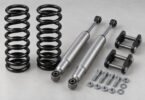
The Rough Country 4WD installation document lists replacement knuckles, front and rear crossmembers, strut spacers, differential relocation parts, rack-related brackets, a skid plate, brake components, rear blocks, U-bolts, hardware and rear shocks. It covers multiple lift heights and packages, so its inventory must be matched to the actual 54720 shipment.
The 52330 2WD document has its own spindles, crossmembers, strut spacers, sway-bar and brake provisions, alignment hardware, rear blocks, U-bolts and rear shocks. Its shared 4-/6-inch parts lists also require the installer to identify the correct package. Replacement front struts are not automatically included just because a related kit offers them.
BDS describes a system built around crossmembers, replacement steering knuckles, strut spacers, differential relocation and protection, sway-bar and brake provisions, alignment hardware and rear lift components. Its current product page offers the two rear-shock packages above. Get a written bill of materials for the selected SKU, including any cab/bed-dependent rear-spring parts and possible driveshaft accessory. A photograph of a kit laid out on the floor cannot confirm every box or optional part in your order.
When comparing quotes, ask the shop to separate the suspension kit, replacement wear parts, wheels and tires, installation, alignment and follow-up inspection. A low parts price is hard to compare with a quote that also covers worn ball joints, tie rods or other work found during inspection.
Wheel and tire clearance needs an exact combination
Write down wheel diameter, width, offset or backspacing, and the full tire size. The shop also needs to check the wheel’s clearance to the replacement knuckle and brakes. Tire clearance must be checked through steering travel and suspension movement, including contact with bodywork, hoses and wiring.
BDS lists a 35 × 12.5 tire with a 17 × 9 wheel and 4.625-inch backspacing, with possible trimming. It says factory 18- and 20-inch wheels can be retained with stock tires; that statement does not approve larger tires on those wheels. Its linked manual also contains a separate 4.5-inch backspacing note for 17-inch wheels. Have BDS resolve that difference for your actual wheel before buying.
Rough Country’s pages provide wheel/tire combinations and tell buyers to test-fit them. Its shared 4WD manual includes a tire example described for a 6-inch lift, while the 2WD manual describes an 18 × 9 development wheel and then gives a separate maximum-width recommendation of 8 inches. Those passages should not be turned into a universal 4-inch tire rule. Ask Rough Country to confirm the correct specification for your SKU and tire model.
Do not order tires on a promise that “all 33s” or “all 35s” will fit. Diameter alone leaves out width, wheel position and the tire’s actual inflated dimensions. Resolve any disagreement between the current application page, instructions and seller listing before installation.
Installation and checks to include in the quote
These systems involve more than bolting a spacer onto a strut. Rough Country recommends a certified technician, and BDS recommends professional installation. Review the exact manual with the installer before authorizing cutting, drilling or any spring/strut work.
Ask for a documented completion check covering:
- Fastener torque, correct hardware and secure routing of brake hoses, ABS wiring and related lines
- Steering sweep, tire clearance and brake-hose slack throughout the required suspension travel
- Brake operation, front axle/CV clearance on 4WD trucks and any driveline vibration
- Professional alignment, headlight adjustment and a controlled road check
- The kit-specific follow-up torque inspections, including U-bolts
The Rough Country 4WD manual warns about front-driveshaft vibration and recommends against operating in 4WD above 40 mph. Discuss that restriction and any required driveline work with the installer. A vibration after installation needs diagnosis before continued use.
What a 4-inch lift does not change
A lift does not grant a higher payload or tow rating. Ford’s 2006 F-150 owner’s guide explains that added aftermarket equipment weight must be deducted from the payload on the vehicle’s tire label. Keep the vehicle’s axle, tire and gross-weight limits in the loading calculation.
Also distinguish the job you want done. Leveling changes front-to-rear stance; a body lift raises the body relative to the frame; a suspension lift changes suspension geometry and ride height. Rear block thickness is not automatically the amount of extra rear lift, because the original configuration and the kit’s installation method matter.
Before paying, confirm the installed height will suit your garage, trailer setup and normal use. Ask about the requirements where the truck will be registered and driven; a parts listing is not proof of local road approval.
Before you place the order
Get a quote that names the exact kit SKU and shock option, confirms your six-lug 2006 drivetrain and cab/bed configuration, lists included and additional parts, and approves the precise wheel/tire combination. For a 2WD truck, start with the dedicated 52330 application. For a 4WD truck, compare 54720 with the BDS 576H/576FS packages on confirmed fit, installation requirements and the complete installed cost.