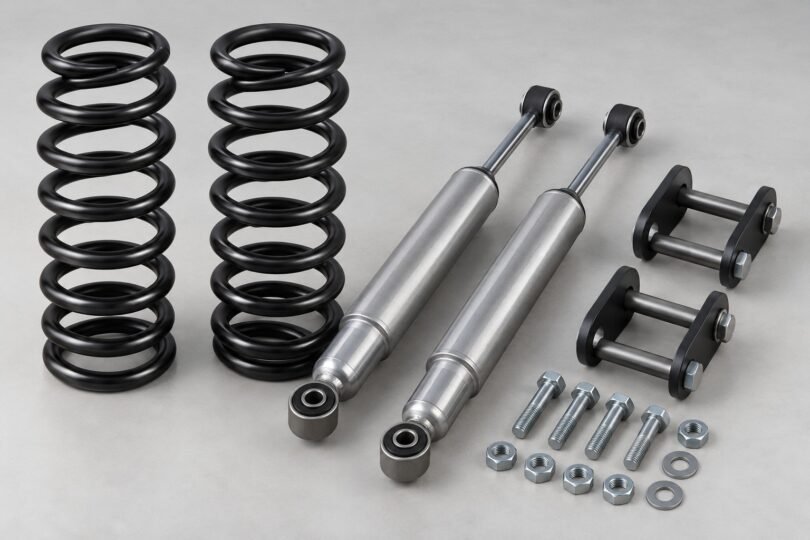

A 2002 Toyota Tacoma lift kit must match the truck’s chassis before it matches a desired lift height. The low-riding 2WD five-lug Tacoma uses different suspension hardware from the six-lug PreRunner and 4WD models. A kit advertised as “1995–2004 Tacoma 2WD/4WD” can still exclude the five-lug truck.
For a five-lug 2WD truck, Fabtech’s K7014 spindle system is a documented option to investigate. For a six-lug PreRunner or 4WD truck, compare a modest spacer-and-shackle system with a matched spring-and-shock package. The useful choice depends on existing wear, permanent accessory weight, tire dimensions and how the truck is used, rather than which box promises the most inches.
First check: five lugs or six?
- 2WD five-lug: Buy only a kit that explicitly names this configuration. Do not substitute a six-lug coilover or spacer kit because its year range includes 2002.
- 2WD PreRunner six-lug: This is a separate application from the five-lug 2WD. Some systems share fitment with the 4WD truck, but four-wheel-drive-only components are not automatically required.
- 4WD six-lug: In addition to steering and suspension clearance, the installer must consider the front differential, CV axles and boots.
Count the actual wheel lugs, confirm the drivetrain and record the VIN, engine, cab configuration and existing suspension parts. A used truck may already have spacers, altered springs or nonstandard wheels. Have the installer establish the starting configuration before ordering another lift.
Three manufacturer-documented options
Five-lug 2WD: Fabtech K7014 spindle system
Fabtech K7014 combines FTS4130-7 three-inch front lift spindles, an FTS200 rear add-a-leaf kit, two FTS7078 front shocks and two FTS7163 rear shocks. Its application is the 1995.5–2004 five-lug 2WD Tacoma. Do not mistake the three-inch system name for a promise of an identical measured increase at all four corners.
Fabtech’s product description contains inconsistent “2WD/4WD” wording, but its application category, drive field and linked spindle instructions identify 2WD. Use the explicit five-lug 2WD application, not that stray wording, when discussing fitment with the manufacturer.
The manufacturer also warns that larger tires cannot be installed on the original wheels with this system. It supplies a specific wheel-and-tire example, not a universal clearance guarantee. Budget for a confirmed wheel specification and any prescribed trimming rather than assuming your existing wheels will work.
Six-lug PreRunner/4WD: Rough Country 740 configurable system
Rough Country’s 740-config 2.5-inch Tacoma system explicitly excludes five-lug models. It offers different shock and strut selections, so the configuration in the cart matters as much as the product-family name.
The manufacturer’s 92740200 instructions describe the spacer-and-shackle arrangement: front strut extensions, rear shackle plates and rear shocks, with nominal lift of 2.5 inches at the front and 1.5 inches at the rear. The instructions require exhaust modification for rear spring clearance. Confirm which current SKU supplies that layout and which instructions apply if selecting replacement loaded struts instead.
This approach is worth comparing when the retained front springs and dampers are healthy. If those parts are already worn, include their replacement in the quote before deciding that a spacer package is the economical choice.
Six-lug, configurable spring-and-shock package: Toytec ULTAC04-955
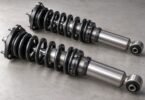
Toytec ULTAC04-955 is listed for 1998–2004 Tacomas and excludes five-lug trucks. Its package uses adjustable TT-AFCS front coilovers with Bilstein shocks, rear Bilstein 5100 shocks, longer U-bolts and a brake-proportioning-valve extension bracket.
It is a buildable package rather than one fixed combination. The selector offers 500, 600 and 650 lb/in front springs and rear choices including TAC-AL add-a-leaves, TT-MINIL14-P progressive add-a-leaf packs or P10046 complete leaf springs. These are alternatives; they are not all included together. Have Toytec match the spring selection to the engine, cab and actual permanent load.
Toytec recommends its RM83010 differential-drop option for 4WD models and offers upper-control-arm options. Ask for an itemized configuration showing the chosen front assemblies, rear lift method, shocks, U-bolts and supporting parts. Do not assume an accessory shown in a package photograph is selected or included.
Suspension lift versus body lift
A suspension lift changes the relationship between the chassis and wheels. Depending on its design, it changes spring position, control-arm angles, spindle geometry or axle mounting. A body lift spaces the cab and bed upward from the frame. It does not add suspension travel or directly raise the frame and axles away from the ground.
A body-lift quote must address the exact cab and transmission configuration, body mounts, steering-shaft connections, bumpers, radiator/fan clearance, hoses and other connections between body and frame. It is not interchangeable with a suspension kit of the same advertised height.
Be careful with older buying guides: 4Crawler’s Tacoma body-lift documentation now says production of its body-lift kits ceased on January 1, 2025. Its technical information may help identify an existing installation, but a historical configuration page is not proof that a complete kit remains available. Confirm current manufacturer support before considering old stock.
What the installer needs to inspect
A lift also changes driving risk. Fabtech warns that suspension lifts raise the center of gravity, alter handling and can increase rollover risk on and off road. Rough Country likewise warns about rollover risk and reduced braking performance with larger, heavier tires and wheels. Discuss these changes with the installer, use seat belts and follow the kit and vehicle safety instructions.
Alignment, control arms and ball joints
Inspect the frame and suspension mounting areas, ball joints, tie-rod ends, bushings, wheel bearings and alignment adjusters before adding height. Repair existing defects first. Check the VIN through Toyota’s recall and service-campaign lookup, and ask a dealer about unresolved campaign history.
Have a qualified shop document caster, camber and toe after installation. There is no reliable blanket rule that every two-inch lift needs new upper control arms, or that every three-inch lift can keep the originals. The selected system, attainable alignment and joint clearance through suspension movement determine the answer. JBA’s first-generation Tacoma application guidance distinguishes spring/leveling lifts from cradle-drop combinations, illustrating why the lift design matters.
CV axles on the 4WD truck
Front lift can change CV operating angles. Toytec’s RM83010 differential-drop documentation describes reducing those angles on the applicable 1995.5–2004 4×4 Tacoma and includes skid-plate accommodation. That does not make a differential drop a universal cure for binding, boot contact or an excessive lift. The installer still needs to inspect the complete operating range and follow the chosen system’s requirements.
Brake hoses, ABS wiring and rear brake proportioning
Brake hoses and, where fitted, ABS wiring need clearance without stretching, pinching or rubbing at steering lock and through suspension movement. Fabtech’s FT4130-7 instructions include ABS-specific routing provisions and brake-line clearance checks. A generic “bolt-on” description does not remove those responsibilities.
If the truck uses a load-sensing brake-proportioning linkage affected by rear ride height, the installer must address it using the applicable instructions. A bracket supplied for that purpose is not a substitute for correctly sized brake hoses, and neither part replaces the final brake-system inspection.
Why lift height does not guarantee tire fit
Tire clearance depends on actual inflated size, wheel width, offset/backspacing, alignment, bumper and fender shape, and suspension movement. A tire that clears while parked can still rub during a turn or compression. Rough Country’s product page specifically advises test-fitting combinations; treat customer-gallery examples as examples rather than approval for your truck.
Choose wheels and tires with the installer before ordering the lift. Ask for a written specification and confirmation of full-steering and suspension clearance. Avoid buying wheel spacers or stacking additional lift spacers as a last-minute workaround. Heavier, larger tires can also affect braking and driving behavior.
Compare the complete installed cost
Request a quote covering the exact kit SKU and selected options, wear repairs, installation, alignment, any required exhaust work, wheel-and-tire changes, brake/ABS accommodations and follow-up inspection. Compare like-for-like configurations. A parts-only price is incomplete when another package replaces springs and dampers that the cheaper option retains.
Use a competent suspension shop with the current kit instructions and Toyota service information. This guide is for choosing parts, not a procedure for compressing springs, supporting a truck or altering brake components. Keep the vehicle within the manufacturer’s intended configuration and follow its inspection schedule. For example, the referenced Rough Country instructions specify a fastener recheck after 500 miles, while Fabtech’s spindle instructions specify 50 miles; the correct interval belongs to the actual system installed.
The best starting point is modest, verified fitment: a five-lug-specific system for the low 2WD truck, or a correctly configured six-lug package for the PreRunner/4WD. Get the alignment, load support, brakes and tire clearance right before chasing a larger advertised lift.