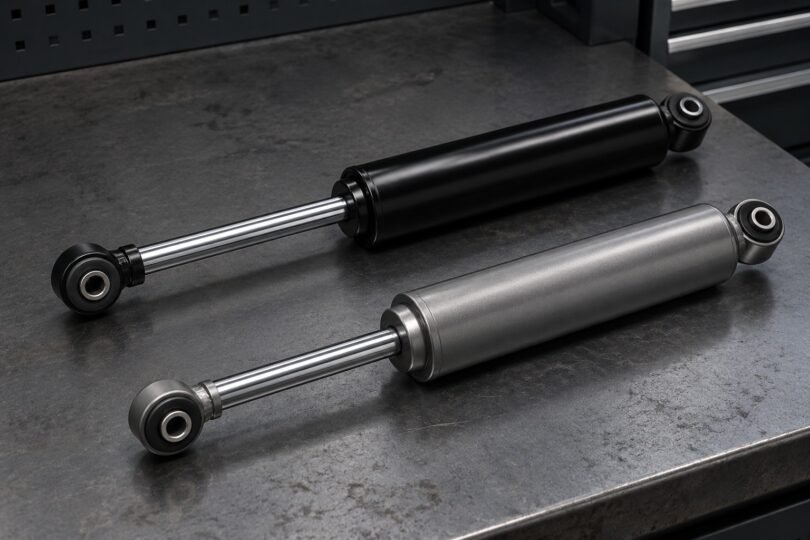

The best shocks for a Silverado 1500 2WD are the ones matched to its exact suspension, ride height and workload. A stock-height daily driver, an older truck with front coil springs and a leveled truck can need very different parts. Start with the vehicle application and suspension codes, then choose how much change in ride feel you want.
For a stock-height truck, an application-correct original-equipment replacement or Bilstein B6 4600 is a sensible starting point. For a leveled or lifted truck, use a shock approved for that specific lift arrangement. There is no single four-shock kit that fits every rear-wheel-drive Silverado 1500.
Quick picks by the job you need the shocks to do
- Restore the original everyday ride: compare OE replacements and the appropriate KYB restoration option for your exact truck.
- Keep factory ride height with a monotube replacement: check the Bilstein B6 4600 application. The series is intended for stock-height vehicles.
- Level a compatible front coilover suspension: investigate an application-specific Bilstein B8 5100 Ride Height Adjustable unit, including its installation requirements.
- Replace shocks on an already modified truck: start with the lift manufacturer’s specified shock lengths and mounting arrangement, rather than a generic Silverado search.
These are shopping routes, not interchangeable part numbers. Bilstein’s 4600-versus-5100 guidance distinguishes factory-height replacements from lifted and leveling applications.
Identify your Silverado before comparing prices
Write down the VIN, model year, exact model, trim, cab configuration, drivetrain and suspension option codes. Make sure the catalog says Silverado 1500, not 1500HD, 2500HD or a related SUV. A familiar body shape or the words “half-ton Chevy” are not enough to establish fitment.
Transition-year labels deserve special attention. A 2007 Silverado 1500 Classic uses a different application from a 2007 new-body Silverado 1500. Similarly, select the complete model designation when a catalog offers Silverado 1500 LD or LTD. Never discard those extra letters because the listing otherwise looks close.
Use the following as a lookup checklist, rather than a guarantee that parts interchange within each group:
- 1999–2006 and 2007 Classic: check the actual front suspension. A 2WD description alone does not prove that the truck has the front coil-spring configuration specified by a particular shock.
- 2007 new-body through 2013: choose the new-body application, with its own suspension and electronic-control exclusions.
- 2014–2018 and later trucks: run a fresh year-specific search. Do not extend an older part’s fitment range yourself.
- Any modified truck: record the front and rear modifications separately, including spacers, replacement springs, spindles, blocks and shock-relocation brackets.
If you cannot identify the hardware, ask a suspension shop to inspect it before ordering. The VIN describes the original build; it does not reveal everything a previous owner changed.
A specific older-truck example: Bilstein 24-029025 and 24-029032
For a 2004 Silverado 1500 LS, rear-wheel drive, with front coil springs, without Quadrasteer and without ZX3 electronic suspension, Bilstein’s application guide lists 24-029025 at the front and 24-029032 at the rear. This is a useful, tightly defined example for someone maintaining an older stock-height truck, not permission to fit the pair to any Silverado.
The manufacturer’s application guide separates coil-spring RWD applications from 4WD and SS entries and distinguishes the Classic body style. It is an older catalog, so reconfirm the application in the current catalog or with Bilstein before purchase.
Those manufacturer pages identify two different products. A full-vehicle replacement requires two appropriate front units and two appropriate rear units, subject to the seller’s package contents. Buying two items labeled “shock absorber” does not necessarily buy a complete set.
Which shock family is worth comparing?
Bilstein B6 4600: a factory-height shortlist
The B6 4600 makes sense to investigate when the truck remains at factory height and you want a vehicle-specific monotube replacement. Bilstein describes its truck product range by application, which is more useful than assuming a higher series number must be better. Check both axle listings and all exclusions before deciding.
There is no supported promise here that the same shock will feel soft on an empty regular cab and on a heavily equipped crew cab. Tire construction, pressure, wheel weight, springs and existing wear all affect the result.
KYB: choose restoration or a firmer response deliberately
KYB distinguishes products intended to restore original ride control from options intended to produce a firmer response. Its ride-comfort guidance also notes that Gas-a-Just can be a restoration choice where the vehicle originally used monotube shocks. That makes “Excel-G versus Gas-a-Just” an application question, not a simple good-versus-better ranking.
Use the KYB vehicle catalog to see which products actually apply. Do not select a product family first and then try to make its nearest part number work.
OE replacement: useful when preserving the original configuration
An OE parts lookup is particularly valuable if the truck has unusual suspension equipment, uncertain previous repairs or a configuration that aftermarket catalogs exclude. Give the supplier the VIN and suspension codes, and ask it to confirm the current replacement number for each axle. Request clarification if the part number has been superseded.
Bilstein B8 5100: check the type, not just the name
A ride-height-adjustable front unit and a conventional rear 5100 are different products. Front spring-seat adjustment is application-specific; a rear replacement damper is not automatically a lifting device. Confirm the permitted height range at each axle and whether original springs and mounts are reused. A listing for a lifted 4WD truck is not evidence of compatibility with your 2WD truck.
Read suspension codes and exclusions literally
GM’s Regular Production Option codes identify equipment that a trim badge may not explain. Monroe’s GM suspension guidance explains why these codes matter and notes that their location varies by vehicle. Photograph the label or obtain the build information through an appropriate vehicle lookup.
When a catalog says “without electronic suspension,” “with front coil springs,” or “excluding Quadrasteer,” treat each phrase as a requirement. Conversely, do not assume that every GM truck has the same systems mentioned in a general truck-and-SUV guide. Verify what your particular Silverado actually carries. A badge such as Z71 should not replace a complete application check.
Front, rear, single unit or complete assembly?
Compare the contents of each offer before comparing totals. “Set,” “pair,” “front and rear,” and “complete assembly” describe different purchases. A bare front damper may reuse the existing spring and other components; a loaded assembly may include those parts. Confirm exactly what is supplied rather than relying on a representative photograph.
Monroe recommends replacing shocks or struts in axle pairs. For a rear-only job, that means two suitable rear shocks. For all four corners, budget for both front units, both rear units and any separately required hardware or worn mounts. Do not mix unmatched left and right damping specifications merely because their mounts look similar.
Towing, sag and rough ride need different questions
Describe the actual problem to the installer: repeated bouncing, a harsh empty-bed ride, rear sag when loaded, or instability while towing. These symptoms should not all lead automatically to a “heavy-duty” shock purchase. KYB’s wear guidance lists bouncing, sway, wandering and uneven tire wear as reasons to investigate the suspension.
A shock change does not authorize exceeding the truck’s payload, axle, tire or towing limits. Check the vehicle labels and the applicable Chevrolet owner’s manual. If the truck sags, have the load distribution, springs and other supporting components assessed. Choose damping for the real operating conditions after confirming the vehicle is correctly loaded.
Before installation and the first drive
Have the installer compare the received part numbers with the confirmed application before disassembly. Ask for an inspection of mounts, bushings, springs, tires and other worn suspension components so the new shocks are not expected to cure an unrelated fault.
Installation procedures and fastener specifications vary by truck and shock. Spring-loaded assemblies require appropriate equipment and training. Use the vehicle service information and the supplied shock instructions, and arrange an alignment whenever the work or ride-height change requires one. Keep the part numbers and invoice with the truck’s service records.
Bottom line: establish the exact Silverado application, decide whether you want original-style control or a deliberate change, and compare complete installed costs. The right fitment notes are more valuable than a long list of supposedly universal 2WD shocks.