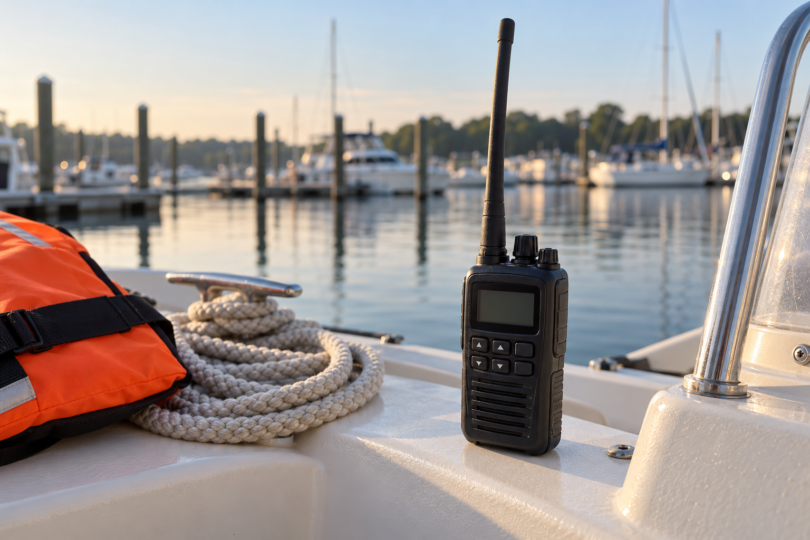

For U.S. recreational boating, start with the Icom IC-M25EVO if USB-C charging and a compact voice radio are your priorities. Choose the Standard Horizon HX890BK when you want built-in GPS and Digital Selective Calling (DSC). The Cobra MR HH350 FLT remains an older, dock-charged alternative to compare, with an important model-replacement caveat.
This shortlist covers marine VHF handhelds. Aviation radios, amateur radios, FRS/GMRS walkie-talkies and receive-only scanners serve different purposes; do not treat them as interchangeable marine transmitters. Select the correct regional channel group and follow the rules for the waters where you operate.
Three marine handhelds worth comparing
| Exact linked model | Transmit settings | Useful features | Main buying check |
|---|---|---|---|
| Icom M25EVO, Blue | Approx. 5 / 2.5 / 1 W | USB-C charging; floating light and alarm; IPX7 | USB Power Delivery unsupported; confirm supplied charging accessories |
| Standard Horizon HX890BK, Black | 6 / 2 / 1 W | Class H DSC; built-in GPS; floats; IPX8 | Correct MMSI setup and complete charging kit |
| Cobra MR HH350 FLT, Grey | 6 / 3 / 1 W | NOAA weather; Tri-Watch; floats; IPX7 | Superseded model; dock charging |
Transmit wattage is not a distance rating. Marine VHF communication is largely line of sight, and antenna height and obstructions matter. None of these handhelds comes with a guaranteed communication radius or guaranteed Coast Guard reception.
1. Icom IC-M25EVO: best for USB-C charging
The IC-M25EVO is our practical first choice for a compact voice-radio setup. Icom specifies 228 grams with the antenna and MB-133 belt clip. Its Float’n Flash system combines flotation, a flashing light and an alarm; weather alerts and Dual/Tri-watch are also included.
The USB-C port is convenient for a compatible portable power source, but Icom explicitly says USB Power Delivery is unsupported. Check the charging instructions and source compatibility before a trip. Its IPX7 specification is for one meter of water for 30 minutes, not unrestricted underwater use.
Read Icom’s wet-radio guidance before relying on the set: the maker says a power-saving setting can prevent transmission when the radio is drenched. Understand the Float’n Flash and power-save settings in the manual.
The linked offer is one Blue M25EVO, manufacturer part ICM25EVOL. Its accessory field lists an antenna, battery and belt clip. Icom’s standard supplied-accessory list also names a USB-C cable and hand strap, with a version-dependent footnote. Confirm those items with the seller; do not assume a wall adapter is included.

Icom M25EVO Marine VHF Radio, Blue
As an Amazon Associate we earn from qualifying purchases.
2. Standard Horizon HX890BK: best for built-in GPS and DSC
The HX890 is the feature-rich choice here. Its Class H DSC functions and integrated 66-channel WAAS GPS receiver can send identity and position information in a properly configured distress alert. It also provides NOAA weather channels, a water-activated strobe and selectable transmit power.
Budget time for setup. The HX890 manual requires an MMSI before DSC functions can operate and warns that correcting a stored number requires a reset. Obtain the right registration for your intended use, enter it carefully and verify the displayed GPS position before heading out. GPS hardware alone does not establish a valid current position.
The Micro-USB connection is a data port for programming. Charging uses the designated cradle and power supply. Standard Horizon describes a standard kit with a rechargeable battery, alkaline tray, AC and 12V charging equipment, programming cable and belt clip with lanyard.
The exact linked offer is one black HX890BK. Its retail accessory list is incomplete compared with the manufacturer’s kit description, so confirm the battery, cradle, power adapters and tray before purchasing. The manual’s IPX8 submersion specification is 1.5 meters for 30 minutes and depends on properly sealed microphone/data jacks and battery cover.

3. Cobra MR HH350 FLT: an older voice-radio alternative
The MR HH350 FLT offers selectable 1-, 3- and 6-watt transmission, NOAA weather channels, Tri-Watch and a floating IPX7-rated body. It is worth comparing if you want those core features and are comfortable with a charging dock.
Cobra says the BlueBound 350 has replaced this model. Treat the HH350 as an older-model purchase and check battery condition, warranty eligibility and access to the correct charger. There is no USB charging port: it charges on its dock using the appropriate AC or 12V supply.
The linked Grey MR HH350 FLT listing specifies one marine radio, dock charger, 12V adapter, AC adapter, belt clip and removable antenna. Check that exact package when comparing sellers. A similarly named Cobra walkie-talkie or CB radio is a different purchase.

What to check before taking it aboard
Choose charging arrangements you can support aboard, then practice channel selection, volume, squelch and the appropriate radio-check procedure before departure. Keep seals clean and closed as the manual requires. Flotation and water ratings can help with an accidental drop; they do not make a radio impossible to lose or establish that it will work after every impact or immersion.
For U.S. use, FCC license-by-rule conditions include voluntary radio carriage, no foreign-port travel and no international communications. A voluntarily equipped vessel on a domestic voyage also has a VHF operator-license exemption. Foreign voyages or compulsory carriage change the requirements; check station and operator authorization before departure.
Marine VHF is not a general inland chatting service. The associated-ship-unit shore exception is limited: adjacent to the vessel’s waterway, vessel-related operational communications, one-watt power, appropriate channels and station identification. Except for safety, communication is with the associated vessel or its units. Being near water alone is insufficient.
Keep Channel 16 available for distress, safety and brief calling, then move routine conversation to an authorized working channel. The Coast Guard generally directs VHF-equipped vessels to monitor 16 when not communicating. Channel 70 is for DSC; voice communication is prohibited there. Use the USCG channel chart for the permitted use of each channel.
For a genuine distress emergency, use the radio’s documented distress procedure. After a DSC distress alert, the Coast Guard directs you to follow with voice on Channel 16. State Mayday, identify the vessel, give your position, explain the emergency and assistance needed, and report the number aboard. Never use Mayday or a distress alert as a radio check.
Frequently asked questions
Where do I get an MMSI for a portable DSC handheld?
Follow the USCG’s handheld-specific guidance. It currently identifies the FCC and Shine Micro as handheld-MMSI providers. A handheld used only on license-by-rule boats can use a provider such as Shine Micro; other uses require FCC licensing and an FCC MMSI. BoatUS and USPS ship-station MMSIs should only be used in a handheld if it stays with and is used solely on one vessel.
Will a six-watt model reach farther than a five-watt model?
Wattage alone cannot establish that. Antenna height, obstructions and the other station affect a largely line-of-sight link. Compare features and the needs of your boating area without assigning any handheld a guaranteed number of miles.
Which one would we choose?
Choose the M25EVO for its USB-C charging arrangement, or the HX890BK when built-in GPS and properly configured DSC are priorities. Consider the older Cobra only after checking its package and support. For any of them, correct setup and an appropriate communication plan matter more than a headline power figure.