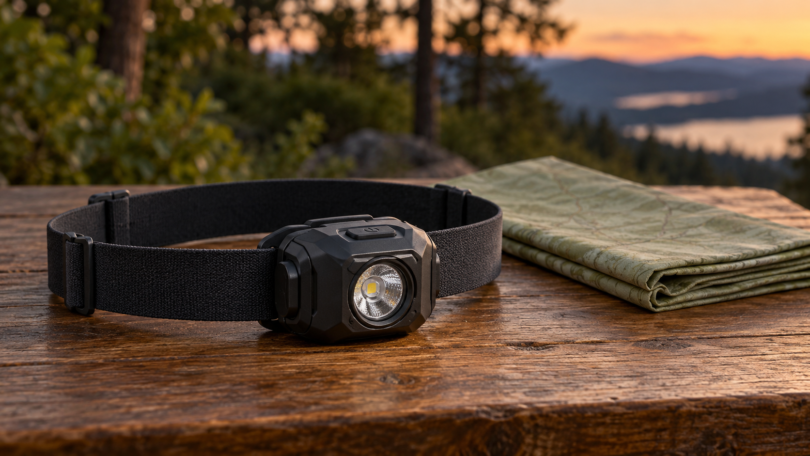

A forehead light is usually sold as a headlamp: a light on an adjustable band that leaves your hands free. For hiking, camping and ordinary tasks around the house, start with the battery arrangement and the light level you can use for the length of the activity.
The Petzl ACTIK CORE 625 is the flexible rechargeable choice, the Black Diamond Spot 400 suits people who want to carry spare AAA batteries, and the Nitecore NU25 MCT UL is the lightest documented option in this selection. Each has different charging and water-resistance limits.
Choose by battery and use
| Headlamp | Best reason to choose it | Main tradeoff |
|---|---|---|
| Petzl ACTIK CORE 625 | Included rechargeable CORE pack, with AAA backup compatibility | IPX4 weather resistance; USB-C charging cable is not included |
| Black Diamond Spot 400, AAA model | Replaceable AAA cells and optional BD 1500 rechargeable battery | The rechargeable system is a separate purchase; do not confuse it with Spot 400-R |
| Nitecore NU25 MCT UL | 47 g including bracket and cord headband, plus USB-C charging | The built-in battery cannot be swapped for fresh AAA cells |
Read the runtime numbers correctly
A headlamp’s brightest setting and its longest runtime describe different things. Under the ANSI/PLATO FL1 method explained by Petzl, runtime continues until light output has fallen to 10% of its initial maximum. A listed “400 lumens, 2.5 hours” does not promise a constant 400 lumens for the whole period.
The figures below are the manufacturers’ mode ratings. They are useful for comparing settings, but temperature, battery condition and use affect the result. Reserve-lighting time is separate and is not included here.
| Model and power source | Highest white mode | Middle white mode | Lowest white mode |
|---|---|---|---|
| ACTIK CORE, included CORE pack | 625 lm / 2 h | 100 lm / 7 h | 7 lm / 100 h |
| Spot 400, AAA alkaline batteries | 400 lm / 2.5 h | 200 lm / 5 h | 6 lm / 200 h |
| NU25 MCT UL, built-in battery | 400 lm / 2 h 40 min | 200 lm / 5 h | 6 lm / 45 h |
The Nitecore also has a 60-lumen low setting rated for 13 hours. Its 6-lumen, 45-hour setting is called Ultralow. Those long, dim-mode runtimes should not be used to plan how long the brightest beam will last.
1. Petzl ACTIK CORE 625: for rechargeable use with AAA flexibility
The current ACTIK CORE combines an included 1250 mAh CORE rechargeable battery with the option to use three AAA/LR03 cells. The black version is reference E065AB00. Check that reference and the 625-lumen, USB-C specification when shopping; older ACTIK CORE versions have different output and charging details.
The wide or mixed beam, red mode and tilting housing make it a useful choice for both close tasks and looking ahead. Petzl lists an 88 g weight, a lock function, and a headband that can be removed, washed and replaced. That offers practical adjustment and upkeep, although personal comfort still needs a fit check.
The battery tradeoff: with AAA batteries, maximum output changes to 450 lumens, while the 100-lumen standard setting is rated for 10 hours instead of seven. Rechargeable and AAA performance tables are not interchangeable. The CORE pack is included; AAA cells and the USB-C charging cable are not.
Charging and weather limits: Petzl gives a 3.5-hour charge time. Its technical notice requires dry battery connectors and a suitable charger whose output does not exceed 5 V; do not leave the battery charging unattended. IPX4 is weather resistance, not permission to submerge it.
Choose it if you want to recharge at home and have an alternative power source on a longer outing. Do not plan a run around the reserve-lighting figure: Petzl describes reserve as reduced light that is insufficient for fast-moving activities.
2. Black Diamond Spot 400: for replaceable AAA batteries
The Spot 400 starts with three included AAA batteries and can also use Black Diamond’s separately sold BD 1500 rechargeable battery. The linked shopping choice is one Graphite, 400 (AAA Powered) headlamp, model BD620672. The Spot 400-R rechargeable version and Spot 450 are different products.
Its brightness memory remembers a chosen setting, while PowerTap allows a quick jump between dimmed and maximum output. Proximity and distance lighting, dimming, red light and a lock mode give it a useful range of controls. Check those controls in person if you prefer a simpler one-button sequence.
The battery tradeoff: the maker rates AAA alkaline operation at 2.5 hours on the 400-lumen mode, five hours at 200 lumens and 200 hours at six lumens. With the optional BD 1500, those respective runtimes become four, eight and 225 hours. These remain FL1 runtimes with declining output, not fixed brightness for every hour.
The water limit: Black Diamond states an IPX8 test of at least 1.1 meters underwater for 30 minutes. It also says water may enter the battery compartment and the lamp must be completely dried after wet use. That is a specific test and care requirement, not a general diving recommendation. Follow the Spot 400 instructions for supported batteries and do not mix old and new cells or different battery types.
Choose it if spare AAA cells fit your travel or emergency-kit routine. Budget separately for the optional rechargeable system.

Black Diamond Spot 400 Headlamp, Graphite, AAA Powered
As an Amazon Associate we earn from qualifying purchases.
3. Nitecore NU25 MCT UL: for a small, light rechargeable setup
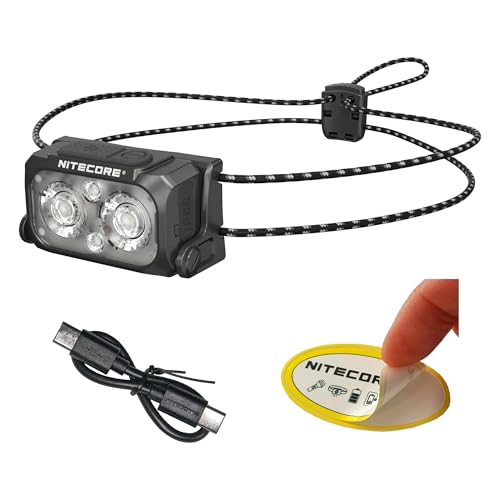
The NU25 MCT UL weighs a listed 47 g with its bracket and cord headband. That makes it the lightweight choice here if you are happy to recharge a built-in 700 mAh battery. Specify MCT UL: the regular MCT uses a different band and weighs 50 g, while the older NU25 UL has different lighting features.
Its two buttons control output and the choice of warm 3000 K, neutral 4500 K or cool 6500 K white light. It also has red light and lockout. Choose the color you find useful for the task; the specifications alone do not establish superior visibility or eye comfort.
The charging tradeoff: Nitecore’s current manual lists approximately one hour and 15 minutes to charge at 5 V/0.5 A through USB-C. A USB-C-to-C cable is supplied. There is no AAA backup option, and the maker says not to disassemble the device, so plan charging or carry a separate backup light.
Use limits: IP66 covers dust and powerful water jets; it does not establish an immersion rating. The manual specifies adult use, warns about heat during extended high-output operation and calls for lockout in a pocket or bag. The cord band saves weight, but try the fit before assuming it will stay comfortable through a long outing.
Choose it if minimum carried weight and a compact USB-C setup matter more than swapping batteries in the field. The linked black elastic-cord package is a single headlamp, not a pair or the full-width-band version.
What matters beyond maximum lumens
- A usable medium or low mode. Compare the mode you expect to use with the length of the outing, then leave a margin for battery condition and cold. A dim camp setting and a beam for moving quickly serve different tasks.
- Battery access. Spare AAA cells, a replaceable proprietary pack and a built-in rechargeable cell create different packing and charging requirements.
- Fit and controls. Check the tilt range, strap adjustment and button sequence with the clothing you will wear. Published weight is useful; it cannot prove bounce-free or all-day comfort.
- Water and charging instructions. Keep the relevant covers closed and follow the maker’s drying instructions before charging or storage. Match the stated IP test to the actual use.
Frequently asked questions
Is the brightest headlamp automatically the best?
No. Beam pattern, controls, battery arrangement and the runtime at your useful setting matter alongside maximum output. A very long low-mode runtime does not tell you how long a high-output beam remains useful.
Are these headlamps waterproof?
Each has a specific rating. ACTIK CORE is IPX4; NU25 MCT UL is IP66; Spot 400 is IPX8 under Black Diamond’s stated test. See Petzl’s IP-rating explanation for what the digits mean. Weather or jet resistance is not an immersion rating, and none is recommended here as a diving light.
Can a forehead light replace bicycle lights?
Do not assume that. Petzl explicitly says its headlamps are not substitutes for required standardized lights in areas governed by traffic rules. A headlamp can help with other tasks, but this comparison does not establish road-light compliance.
Should I carry a second light?
For an activity where a light failure would leave you unable to proceed safely, carry a working backup and an appropriate power plan. Black Diamond’s instructions specifically recommend a second light and sufficient spare batteries for critical situations. Check operation before leaving and avoid shining a bright beam directly into anyone’s eyes.
Which forehead light should you buy?
Choose ACTIK CORE 625 for recharge-at-home convenience with AAA flexibility, Spot 400 for a replaceable-AAA routine, or NU25 MCT UL for a lighter built-in-battery setup. Match the exact generation and battery option, then compare the mode you will actually use.