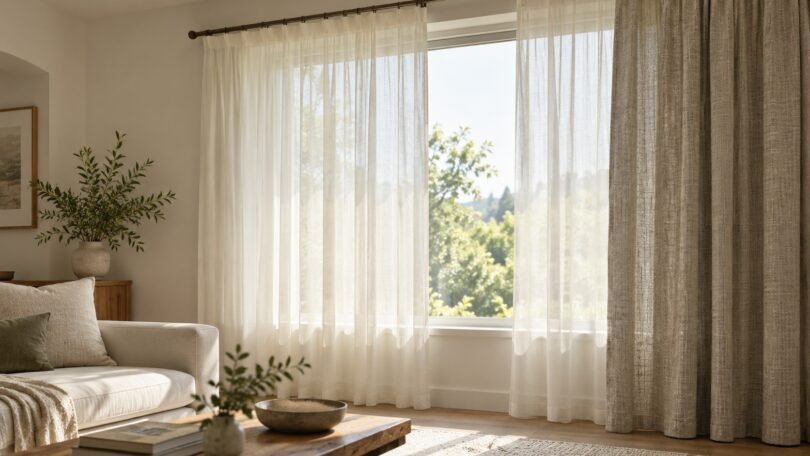

Anti-radiation curtains are better understood as radiofrequency (RF) shielding curtains. Some specialist textiles reduce RF transmission through a tested fabric sample. That does not establish that hanging them in a room will prevent illness, improve sleep or protect against every kind of radiation. A useful purchase starts with a defined technical problem, the relevant frequencies and a verifiable test report.
Ordinary blackout curtains, PEVA shower liners and UV-blocking window products are not interchangeable with tested RF textiles. Their ability to block light, water or ultraviolet radiation does not demonstrate RF shielding. This guide explains how to assess the evidence and compares two documented curtain fabrics, without presenting laboratory specifications as health guarantees.
What the health evidence does and does not show
RF signals from phones and wireless networks are non-ionizing radiation. They differ from ionizing radiation such as X-rays. The National Cancer Institute’s cell-phone evidence review says the evidence to date suggests that cell-phone use does not cause brain or other cancers in humans. This is an assessment of research, not a clinical trial of curtains.
The FDA’s cell-phone information says the overall scientific evidence has not linked cell-phone RF radiation to health problems. The CDC’s July 2026 guidance uses more cautious language: it says a definitive answer is unavailable and research into possible long-term effects continues. Neither position establishes a medical benefit from buying shielding curtains. Uncertainty also does not establish that every exposure is harmful.
If symptoms are driving the purchase, seek medical advice rather than treating a curtain as therapy. In its 2005 backgrounder on electromagnetic hypersensitivity, WHO recognizes that reported symptoms are real and can be disabling, while explaining that a causal connection with EMF exposure has not been established. Persistent sleep problems, headaches or other symptoms deserve appropriate evaluation.
Match the product to the actual problem
- Light and privacy: Choose ordinary curtains for the daylight control, opacity and fit you need. A blackout rating is not an RF test.
- RF transmission or interference: Look for conductive shielding material with measured performance over the relevant frequency range. Have a qualified RF specialist assess a persistent interference problem.
- Low-frequency electric or magnetic fields: Do not assume an RF result applies. These require different assessment, and a claim about electric fields is not automatically a claim about magnetic fields.
- X-rays, gamma rays or a radiation emergency: Do not rely on consumer RF curtains. Their RF reports do not establish protection from ionizing radiation; follow the relevant professional or public-health instructions.
“EMF,” “5G” and “anti-radiation” on a package are not sufficient specifications. Ask what was measured, at which frequencies, and whether the measurement concerns fabric, a finished panel or a complete enclosure.
How to read attenuation figures
Shielding effectiveness is commonly reported in decibels, or dB. For a power-transmission comparison under the stated test conditions, 20 dB corresponds to 1% of the reference power passing through, 30 dB to 0.1%, and 40 dB to 0.01%. These are transmission ratios, not percentages of disease risk removed. The distinction is illustrated in the YSHIELD laboratory report’s measurement explanation.
A headline value at 1 GHz cannot be assumed at 5 GHz or 30 GHz. Read the frequency curve or table, layer count, sample description and test method. Also check the test date and ask whether the report applies to the fabric currently supplied. A named standard describes a measurement approach; it does not convert the result into a health certification.
For an installed curtain, the practical question is the change at the locations and frequencies that matter to your project. A fabric sample’s result cannot by itself answer that question.
Two documented fabrics to compare
These are specification examples rather than a ranked list or hands-on performance review. Both have accessible technical documentation, but the cited reports concern samples and were commissioned by the respective suppliers. Neither report measures a finished room or a medical outcome.
YSHIELD SILVER-TULLE: narrow silvered mesh
YSHIELD lists SILVER-TULLE as semitransparent fabric sold by length, with a width of 130 cm, plus or minus 2 cm. Its stated composition is 80% nylon and 20% silver, with a weight of 40 g/m². The listed 48 dB figure applies at 1 GHz under the page’s stated convention. This is fabric width, not the dimensions of a ready-hung curtain set.
The August 2021 expert report describes a setup based on IEEE 299-2006 over 600 MHz to 40 GHz. Its one-layer table gives 48 dB at 2,400–2,500 MHz, 43 dB at 5,150–5,350 MHz and 30 dB at 30 GHz. Those differing values matter more than a broad “5G protection” label.
For sewing and upkeep, the manufacturer warns that the stretchy fabric is difficult to make dimensionally stable, that silver can discolor, and that ironing is unsuitable. Request a sample before ordering custom lengths, and confirm the current cleaning instructions.
Swiss Shield NATURELL: wider cotton-based fabric
The manufacturer’s NATURELL page describes an off-white, semitransparent cotton-based textile containing 18% copper/silver, with a non-conductive coated surface. It lists 250 cm width, 69 g/m² weight and 3% dimensional stability. The wider fabric may be useful when planning large panels, but finished dimensions depend on cutting, hems and the chosen curtain construction.
Its linked November 2021 expert report also describes an IEEE 299-2006-based setup covering 600 MHz to 40 GHz. The one-layer table lists 33 dB at 2,400–2,500 MHz, 24 dB at 5,150–5,350 MHz and 14 dB at 30 GHz. Separate two-layer results should not be substituted for a one-layer installation.
The product page’s summary numbers and the linked report are not identical. Confirm which report and specification apply to the supplied version before ordering. Do not confuse NATURELL with NATURELL ULTRA or other similarly named fabrics.
Why installation changes the result
A window covering is one part of a room. Open edges, the gap between panels, uncovered surfaces and sources already inside the room can make its overall effect different from the fabric test. Plan the coverage with the supplier or an RF professional rather than expecting the advertised dB figure everywhere indoors.
For a consequential project, ask for before-and-after measurements using suitable, calibrated equipment. The comparison should document frequencies, measurement locations, equipment settings and operating conditions. A phone’s signal bars, or an unspecified consumer “EMF meter,” cannot validate a broadband shielding claim or establish whether a room is medically safe.
Shielding may also interfere with connectivity you want to keep. Test normal calls, internet access and any essential connected devices after installation. The FTC’s advice on phone shields explains that obstructing a phone’s signal can make it use more power. That warning does not quantify the effect of any particular curtain, but it is a reason not to assume weaker reception means lower total exposure.
Follow the fabric supplier’s electrical-safety instructions. Do not improvise grounding connections to outlets, wiring or pipes. If the proposed installation involves grounding or electrical changes, have a qualified electrician assess it. Keep curtains clear of heaters and preserve ventilation and emergency exits.
Questions to ask before ordering
- What exactly am I buying? Confirm the fabric name and version, finished panel count, width and drop, header style, and whether the listing is only unsewn material.
- Does the evidence match my intended use? Request the complete report, relevant frequency results, layer count and test conditions. Ask about gaps between the tested sample and the proposed installation.
- Will it work as an everyday curtain? Consider daylight, nighttime privacy, drape, cleaning and dimensional changes. Use a physical swatch to assess appearance.
- What happens if it disappoints? Check written return terms before ordering cut fabric or custom panels. Include sewing, mounting and any professional assessment in the total project cost.
- Are medical claims being substituted for evidence? A testimonial, textile-safety certificate or laboratory attenuation graph is not proof of better sleep, cancer prevention or pregnancy protection.
Bottom line
Buy RF shielding curtains only for a clearly defined technical purpose supported by appropriate documentation. Compare exact materials and frequency-specific results, then assess the installed outcome. For ordinary light control, choose curtains on their furnishing merits. For health concerns, use qualified medical advice rather than a seller’s promise of protection.