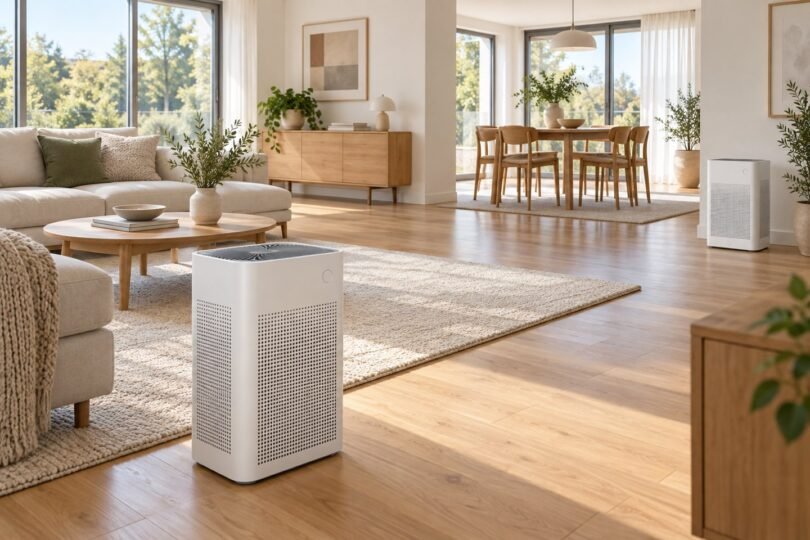

For a 1,200-square-foot room with an 8-foot ceiling, look for roughly 770 to 800 CFM of combined smoke clean air delivery rate if you want about 4.8 filtered air changes per hour. Many purifiers advertised for 1,200 square feet or more achieve their headline coverage at only one or two changes per hour. The coverage number needs a time basis before it becomes useful.
A pair of US-spec Levoit Core 600S-P units is one approach worth comparing: their certified smoke CADR of 391 CFM each adds to 782 CFM. For a larger individual unit, the Coway Airmega ProX offers 568 CFM smoke CADR, but one ProX still falls below that 4.8-change target across the full space. This guide uses published specifications and transparent calculations, rather than hands-on tests or claimed health outcomes.
What 1,200-square-foot coverage really means
AHAM’s room-size guidance bases its suggested area on approximately 4.8 air changes per hour. These are equivalent changes supplied by filtered air. A purifier recirculates indoor air; it does not bring in fresh outdoor air.
For an 8-foot ceiling, 1,200 square feet contains 9,600 cubic feet. One filtered change per hour needs 160 CFM. Multiplying by 4.8 gives 768 CFM. AHAM’s convenient two-thirds-of-floor-area rule gives 800 CFM, a slightly more conservative shopping target. These are sizing calculations, not a guarantee that every corner will have the same particle concentration.
| Ceiling height | Room volume | CADR for 4.8 filtered changes/hour |
|---|---|---|
| 8 feet | 9,600 cubic feet | 768 CFM |
| 9 feet | 10,800 cubic feet | 864 CFM |
| 10 feet | 12,000 cubic feet | 960 CFM |
The calculation is floor area multiplied by ceiling height multiplied by the desired hourly changes, divided by 60. Use smoke CADR consistently when comparing fine-particle performance. Do not mix a product’s larger pollen figure with another product’s smoke figure or mistake cubic meters per hour for cubic feet per minute. AHAM explains the CADR-to-room-volume relationship in its technical guidance.
Purifiers and combinations worth comparing
| Option | Published CADR used | Calculated changes/hour in 1,200 sq ft, 8-foot ceiling | Practical role |
|---|---|---|---|
| One Levoit Core 600S-P | 391 CFM smoke | 2.44 | One zone or part of a multi-unit plan |
| Two Core 600S-P units | 782 CFM combined smoke | 4.89 | Near the 4.8-change sizing target at rated output |
| One Coway Airmega ProX | 568 CFM smoke | 3.55 | Higher-output starting point, with extra capacity needed |
| One Coway Airmega 400 | 328 CFM smoke | 2.05 | A separate room or supplementary unit |
| ProX plus Airmega 400 | 896 CFM combined smoke | 5.60 | Additional capacity across a connected open area |
Combined values assume both units operate at their rated output in the same well-mixed space. They are planning estimates. A closed door, awkward corridor or quieter fan setting can make the lived result substantially different.
Levoit Core 600S-P: consider two for a large open room
The US Levoit Core 600S-P, model LAP-C601S-WUS, lists 391 CFM CADR and 606 square feet at 4.8 changes per hour. Its current ENERGY STAR record confirms that 391 CFM is specifically the smoke CADR, making it comparable with the Coway smoke figures below. It has a particle sensor, automatic fan control and app connectivity. Each unit is approximately 12.3 inches square and 23.6 inches tall.
Two units can be easier to distribute across a long living-and-dining area than one centrally placed machine. They also give you separate controls for different seating areas. However, doubling the machines also doubles the filters to replace, floor positions to accommodate and power outlets to plan.
Levoit’s page contains inconsistent headline coverage figures, so this comparison uses its specification table’s CADR. Confirm the US electrical model and original filter configuration before ordering. A pair barely clearing the calculated target at maximum output leaves little margin if you expect to use quieter settings most of the day.
Coway Airmega ProX: a larger unit with a clear limit
The Coway Airmega ProX lists separate CADRs of 568 for smoke, 580 for dust and 450 for pollen. Its filtration includes washable pre-filters and replaceable Max2 filters. The verified retail selection is the white ProX(W).
The main reason to compare it is higher individual smoke-air-cleaning output. Its large coverage headline should still be read alongside the hourly exchange rate: one machine does not supply 4.8 filtered changes per hour to a 1,200-square-foot room with an 8-foot ceiling. Adding a suitable second unit can raise total capacity and improve placement options.
Check its physical size against the actual floor space and access route before buying. A high-output machine that only fits behind furniture is a poor match for the room. Leave the clearances required by the manual and enough room to remove the filter panels.

Coway Airmega ProX(W) Air Purifier - White
As an Amazon Associate we earn from qualifying purchases.
Coway Airmega 400: useful as part of the plan
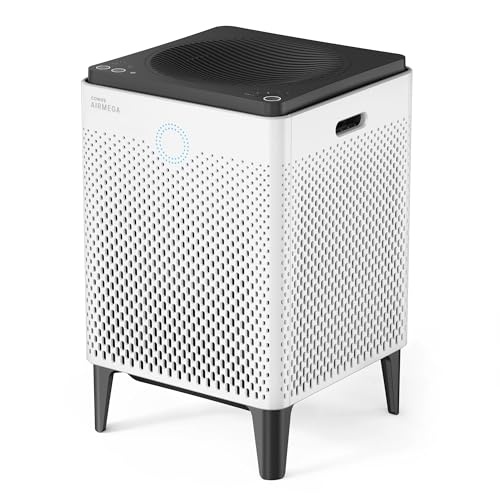
The Coway Airmega 400 publishes 328 CFM smoke CADR, 328 dust and 400 pollen. It has washable pre-filters, a Max2 filter set and automatic operating modes. The standard 400 is not Wi-Fi or app-enabled; do not confuse it with the 400S.
For this room size, its best role is a supplementary unit or a purifier serving a smaller, separate room. A single Airmega 400 is not the full-space recommendation here. Even two total 656 CFM smoke CADR, below the 768 CFM calculation. Pairing one with a ProX provides more capacity on paper, although placement and fan speeds still matter.
One open room and a 1,200-square-foot home need different plans
Sketch the floor plan before choosing equipment. Mark doors that stay closed, stairs, narrow connecting passages and the places where people spend the most time. A machine in the living room should not be expected to deliver its full output to a bedroom behind a shut door.
For an open room, put units in useful separated positions rather than side by side. For several enclosed rooms, size equipment for each occupied room and its ceiling height. You might need more than two units even if their combined headline coverage exceeds the home’s total floor area.
Make a placement checklist: an unobstructed intake, an open discharge path, safe cord routing, accessible controls and room for filter servicing. Use the manufacturer’s actual clearance instructions rather than a generic distance copied from another purifier.
Noise, filters and running costs can decide the purchase
Decide where the purifier will run while you sleep, watch television or work. Maximum CADR and minimum advertised noise usually describe different operating conditions. A low-decibel sleep mode does not establish that the machine will provide its full listed CADR quietly.
Look for speed-specific airflow data when available. If the seller supplies only maximum CADR, treat lower-speed coverage as unknown instead of estimating it from the number of fan settings. Buying some extra capacity may make the day-to-day setting more practical, but the quiet setting still needs adequate output.
Before checkout, identify the exact replacement filter and its current cost. Count complete sets, especially in dual-sided machines. Check whether a quoted replacement includes both sides, and distinguish a washable pre-filter from a main particle filter that must be replaced. Read the cleaning directions before washing anything.
For an operating-cost comparison, multiply watts by hours of use, divide by 1,000 and apply your electricity rate. Add the expected filter expense separately. A larger purchase price can sometimes be offset by different maintenance costs, but calculate with current local prices rather than assuming which brand will be cheaper.
Keep the limits of filtration in view
The EPA describes portable cleaners as a supplement to controlling pollution sources and ventilating with clean outdoor air. They cannot remove every pollutant. Particle-cleaning capacity alone does not establish performance against gases or odors, and a purifier is not a substitute for fixing a moisture problem or an unsafe combustion source.
For wildfire smoke, AHAM recommends a higher smoke-CADR target equal to the room’s square footage. That would be 1,200 CFM for this example at a standard ceiling height, above the everyday sizing comparison here. Follow local smoke guidance and consider concentrating filtration in an appropriately sized occupied room.
Before you order
- Measure the connected space and ceiling height.
- Choose a target using CADR and hourly changes, not coverage alone.
- Account for the fan speed you will actually tolerate.
- Verify the exact model, electrical region and replacement filters.
- Plan separate filtration for regularly closed rooms.
For a genuinely open 1,200-square-foot area, compare a properly specified two-unit setup first. For a divided home, build a room-by-room plan. Either approach gives you a more useful starting point than choosing the largest square-footage number on the box.
Image note: AI-generated editorial illustration of generic items; not a photograph of a named or tested product.